
Carpet Extractor Machine: How It Works and How to Choose | Aikerui Guide
How spray-extraction actually removes soil from carpet, why vacuum power matters more than spray pressure, and how to size an extractor from tank volume.
In This Guide
- What a Carpet Extractor Machine Actually Does
- Spray-Extraction vs the Dry Methods
- The Specification That Actually Differs
- Why Vacuum Power Matters More Than Spray Pressure
- Drying Time Is the Constraint Nobody Plans For
- Matching the Machine to the Carpet
- Maintenance That Protects the Investment
- Common Questions
What a Carpet Extractor Machine Actually Does
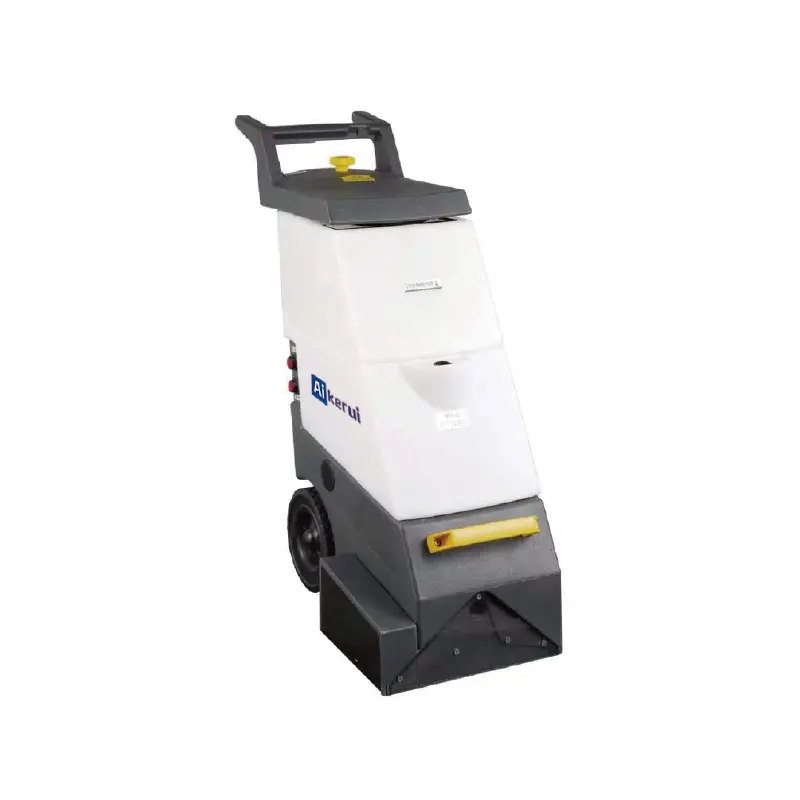
A carpet extractor machine performs three actions in sequence: it sprays a detergent solution into the carpet pile under pressure, it agitates the fibre with a rolling brush so the solution can lift soil that has settled at the base of the pile, and it immediately vacuums the dirty liquid back into a recovery tank.
The third step is the one that defines the category. Anyone can wet a carpet. What separates an extractor from a sprayer or a bonnet machine is that it removes the water and the suspended soil together, in the same pass, before either can dry back into the fibre. Detergent left behind is what causes carpet to look dull a week after cleaning — it acts as a magnet for new soil — and extraction is the only method that removes it rather than redistributing it.
This is also why an extractor is not a floor scrubber. A scrubber is built to recover water from a hard, non-absorbent surface; on carpet pile it recovers almost nothing and leaves detergent behind. The two machines look similar and solve opposite problems.
- Spray, agitate, vacuum — and the vacuum is what defines the category.
- Detergent left in the pile attracts new soil; extraction removes it rather than spreading it.
- A floor scrubber and a carpet extractor are not interchangeable.
Spray-Extraction vs the Dry Methods
Three methods compete for commercial carpet, and they differ in what they leave behind rather than in how clean the carpet looks on the day.
- Only extraction removes detergent residue, which is why it is the standard for periodic deep cleaning.
- Bonnet and encapsulation methods address the surface of the pile; the base of the pile is where soil actually settles.
- Method choice should follow the maintenance cycle, not the price of the machine.
| Method | How it works | What it removes | What it leaves |
|---|---|---|---|
| Spray-extraction (this category) | Solution injected into pile, agitated by a rolling brush, vacuumed out in the same pass | Suspended soil, detergent residue, spills, most stains | Damp fibre that dries with ventilation — no residue |
| Bonnet / encapsulation | A absorbent pad rotates over pre-sprayed carpet and picks up loosened soil from the tips | Surface soil and light spills | Encapsulating polymer that crystallises and is vacuumed later |
| Dry powder | Moist powder is worked into the pile, absorbs soil, then is vacuumed away | Oily and greasy surface soil | Powder residue if vacuuming is incomplete |
The Specification That Actually Differs
Aikerui publishes three extractor models, and the interesting finding is what does not differ between them. All three share a 330 mm working width and a 280 mm cleaning path. The differences are tank volume and vacuum power — which tells you where the engineering in this category actually goes.
That matters for buyers because it inverts the usual comparison. In scrubbers, cleaning path is the headline specification because it sets how many passes an aisle needs. In extractors, the pass count is set by the carpet, not the machine, and the limiting factors become how long you can work before refilling and how much water the vacuum can pull back out.
- Aikerui figures: Aikerui product documentation for the D15, D24 and D55 carpet extractors, published November 2026.
- All three models share a 330 mm working width and 280 mm cleaning path; the range differs in tank volume and vacuum power.
- Where a specification is not published, this guide states that rather than inferring it.
| Model | Fresh / recovery tank | Vacuum motor | Vacuum suction | Net weight | Dimensions |
|---|---|---|---|---|---|
| Aikerui D15 | 15 L / 15 L | 1,000 W | 18 kPa | 30 kg | 780 × 380 × 880 mm |
| Aikerui D24 | 24 L / 24 L | 1,600 W | ≥26.5 kPa | 19.5 kg | 535 × 370 × 790 mm |
| Aikerui D55 | 55 L / 40 L | 2,000 W | ≥34 kPa | Not published | 960 × 530 × 960 mm |
Why Vacuum Power Matters More Than Spray Pressure
Buyers instinctively compare spray pressure, on the reasoning that harder spraying means deeper cleaning. In practice the recovery side is what decides the result.
Spray pressure only needs to be enough to saturate the pile to its base. Beyond that point additional pressure adds water that the machine must then remove, and water left in the carpet creates two problems: the carpet stays out of service longer, and moisture at the base of the pile is where mould and delamination begin.
Vacuum suction, measured in kilopascals, is what determines how much of that water comes back. The three Aikerui models illustrate the range clearly: 18 kPa on the compact unit, ≥26.5 kPa on the mid model, ≥34 kPa on the larger machine. That difference is not cosmetic — it determines whether a carpet is walkable within the same shift or is left overnight with air movers.
- Spray pressure beyond saturating the pile adds water the machine must remove again.
- Moisture at the base of the pile is where mould and backing delamination start.
- Vacuum suction (kPa) is the specification that decides drying time.
Drying Time Is the Constraint Nobody Plans For
Carpet cleaning competes with the use of the room. A hotel corridor, a restaurant dining floor or an office aisle is only available for cleaning in a window, and the carpet has to be usable when that window closes.
Drying time is governed by four things, and only one of them is the machine. The amount of water left in the pile is the first, and that is the vacuum's job. Air movement is the second — a closed room with no airflow will hold moisture for far longer than the same carpet with a fan on it. Carpet construction is the third: a low, tight loop pile releases water much faster than a deep cut pile, because there is less depth for water to sit in. Ambient humidity is the fourth, and it is the one nobody controls.
The practical planning rule is to match the machine to the drying window rather than to the floor area. A room that must reopen in two hours needs the highest recovery suction available; a floor that can stay closed overnight gives more margin, and a larger-tank machine becomes more valuable than a higher-suction one because it reduces refill stops.
- Match the machine to the drying window, not to the square metres.
- Air movement matters as much as suction — plan fans with the machine, not after it.
- Low loop pile dries far faster than deep cut pile for the same water load.
Matching the Machine to the Carpet
Carpet construction decides both the method and the machine size.
Low, tight loop pile — the standard in offices, airports and retail — tolerates extraction well and releases water quickly. It is also where a rolling brush does most of its work, because the brush needs to reach the base of a shallow pile.
Deep cut pile and plush carpet, common in hotels and residential-style spaces, hold far more water and are more easily distorted by a stiff brush. These need lower flow, higher suction and slower passes; a large-tank machine is less useful here than a high-suction one.
Wool and natural fibres require the most care. They are sensitive to high pH and to over-wetting, and they can shrink or brown if left damp. The machine choice changes less than the chemistry and the drying discipline: neutral detergent, controlled flow, and air movement from the moment the pass ends.
Where carpet tiles are installed, extraction is still the right method but over-wetting is a specific risk at the seams, which is another argument for suction over spray pressure.
- Low loop pile is the easiest to extract and the fastest to dry.
- Deep cut pile needs lower flow and higher suction, not more agitation.
- Wool needs neutral chemistry and disciplined drying more than a different machine.
Maintenance That Protects the Investment
An extractor degrades in predictable ways, and all of them show up as "the machine does not clean as well as it used to" rather than as a breakdown.
The spray nozzle is the first: detergent residue and hard water scale narrow the jet, which reduces coverage without reducing pressure, so the symptom is uneven cleaning rather than a visible fault. Rinsing the system with clean water at the end of each use prevents most of it.
The recovery tank and float are the second. A float that sticks will shut off suction early, and the operator will read that as lost power. Emptying and rinsing the recovery tank after every use — not at the end of the week — is what keeps it working.
Brushes wear on the rolling element exactly as they do on a scrubber: bristles shorten, contact pressure falls, and the machine cleans less deeply while sounding identical. The vacuum motor and its seals degrade slowly into a loss of suction that is easy to mistake for normal ageing.
None of these have a fixed calendar interval that holds across sites. Usage hours, water hardness, detergent chemistry and whether the machine is rinsed after each shift all move the number, which is why a maintenance plan built on dates rather than hours under-serves a busy site.
- A narrowed spray nozzle shows up as uneven coverage, not as a visible fault.
- A sticky float reads to the operator as lost suction power.
- Rinse after every use — the single highest-return habit with an extractor.
Common Questions
The questions that come up most when someone is buying an extractor for the first time.
- Can a carpet extractor machine also clean hard floors? — No. It is built to inject water into carpet pile and vacuum it back out; on a sealed hard floor it leaves standing water and recovers poorly. Hard floors need a scrubber-dryer, which is a different machine in the same equipment family.
- How long does carpet take to dry after extraction? — It depends on water left in the pile, air movement, carpet construction and ambient humidity — not on a fixed figure. The control you have is recovery suction and airflow: plan fans with the machine, and match the model to the window in which the room must reopen.
- What is the difference between the Aikerui D15, D24 and D55? — All three share a 330 mm working width and 280 mm cleaning path. They differ in tank volume (15 L, 24 L, 55 L fresh) and vacuum power (1,000 W / 18 kPa, 1,600 W / ≥26.5 kPa, 2,000 W / ≥34 kPa), which decides refill frequency and drying performance rather than coverage.
- Why does carpet look dull a week after cleaning? — Usually detergent residue left in the pile, which then attracts new soil. It points to insufficient recovery rather than insufficient cleaning — check vacuum suction, pass speed and whether the recovery tank was emptied often enough.
- Do I need a heated model? — Heat helps detergent performance on greasy soil, but it does not substitute for recovery suction. On a drying-window constraint, suction matters more than temperature; on heavy grease, heat helps. Neither replaces correct chemistry.
- How often should commercial carpet be extracted? — It follows traffic and soil type rather than a universal interval: entrances and food-service areas cycle far faster than back offices. Interim bonnet cleaning between extractions is normal practice; the extractor is the periodic deep clean, not the daily routine.
Related Products
Related Guides
Browse Machines by Type
Ready to Get Factory-Direct Pricing?
Get a quote within 24 hours. No middlemen — buy direct from the manufacturer and save 30-50%.
About the Author
Mark Wang is Sales Director at Aikerui with 15+ years of experience in industrial floor cleaning equipment. He has helped 2,000+ facilities across 50+ countries source factory-direct cleaning equipment.
About Aikerui
Aikerui is an industrial cleaning equipment manufacturer founded in 2008, operating its own 10,000+ square meter production facility in Anqing, Anhui, China. It manufactures floor scrubbers, sweepers and replacement parts, holds CE and ISO 9001 certification, and exports to 50+ countries. Every guide on this site is written by the manufacturer's own team — not a third-party agency.