
Floor Cleaning Machines: 6 Types Compared and How to Choose | Aikerui Guide
Six floor cleaning machine types, what each one actually removes, which floors accept which machine, and how to size one from area and shift length.
In This Guide
What “Floor Cleaning Machine” Actually Covers
A floor cleaning machine is a powered machine that removes something from a floor surface without the operator carrying the load. That definition is broad on purpose, because the term is used commercially to cover six machine families that do different jobs, and confusing them is the single most common buying mistake in this category.
The six families are: scrubber-dryers, sweepers, sweeper-scrubbers, carpet extractors, industrial vacuums (including ride-on dust carts), and burnishers. Only the first three appear on most industrial sites, and only the first one cleans a smooth floor by wetting it.
The practical consequence is that “I need a floor cleaning machine” is not a purchase order. A buyer who wants food debris and dust off a warehouse floor needs a sweeper. A buyer who wants tyre marks and oil film off the same floor needs a scrubber. A buyer who wants both needs a sweeper-scrubber or two machines. The floor is the same, the machine is not.
- Six families share the label; three of them matter on most industrial sites.
- Wetting the floor is what separates scrubbing from every other type.
- The same floor can need a sweeper in a warehouse aisle and a scrubber in the same building's canteen.
Six Types, and What Each One Removes
The table below pairs each family with what it physically takes off the floor and the size range Aikerui manufactures, so the comparison is anchored to real specifications rather than category marketing. Figures in the fourth column come from Aikerui product documentation for the current range.
- Aikerui figures: Aikerui product documentation for scrubbers, sweepers, extractors and dust carts, published November 2026.
- Where a model does not publish a productivity figure, this guide says so rather than deriving one from an unknown travel speed.
- A burnisher is listed for completeness: it improves appearance and removes nothing.
| Machine type | What it removes | Floor it suits | Aikerui published range |
|---|---|---|---|
| Scrubber-dryer | Film, oil, tyre marks, ingrained soil; water recovered in the same pass | Sealed concrete, tile, epoxy, marble, vinyl | Cleaning path 330–860 mm; tanks 15 L fresh / 18 L recovery up to 160 L / 180 L; 1,200–6,000 ㎡/h |
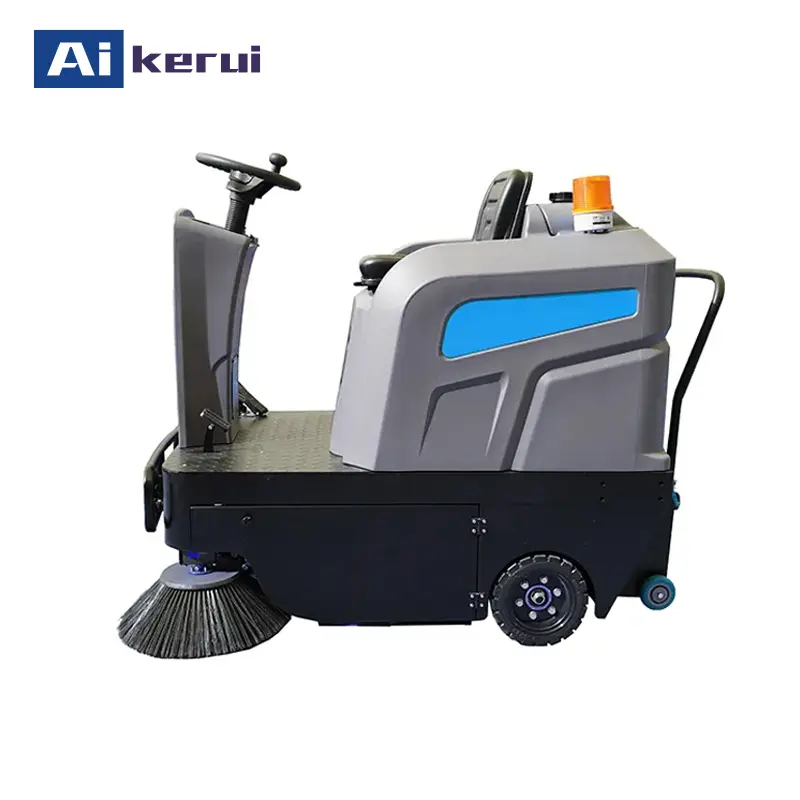
| Sweeper (walk-behind or ride-on) | Dry debris: dust, packaging, grit, leaves, swarf | Concrete, asphalt, warehouse floors, outdoor aprons | Cleaning path 1,050–1,900 mm; dust box 40–180 L |
| Sweeper-scrubber | Dry debris and wet film in one pass, with a hopper ahead of the brush deck | Mixed-use floors carrying both debris and film | One model: B260R60 all-in-one |
| Carpet extractor | Embedded soil and detergent residue in carpet fibre; sprays then vacuums out | Carpet, rugs, upholstery | Three models: D15, D55, D24 |
| Industrial vacuum / dust cart | Fine dust, powders, workshop debris, without wetting | Concrete, workshop floors, plant rooms | Four ride-on dust carts: A2, A3, K5, K6 |
| Burnisher | Nothing — it polishes and levels finish already on the floor | Finished hard floors that must look polished | Not manufactured by Aikerui |
The Split That Decides Everything: Wet or Dry
Before comparing models, decide one thing: does the floor carry liquid film, or only dry material?
A dry machine on a wet floor spreads the mess and clogs its filter. A wet machine on a debris-covered floor pushes the debris around and, worse, drags it under the brush where it scratches the finish. This is why a site that buys one machine for a mixed floor usually ends up dissatisfied with it, regardless of brand.
The test is simple and takes one shift. Walk the route at the end of a working day and note, for each zone, whether the floor is damp to the touch and whether a broom would pick something up. Zones that are both need a sweeper-scrubber or two machines. Zones that are neither need nothing beyond a mop and a schedule.
- Wet machine on debris scratches the finish; dry machine on liquid spreads it.
- Run one walk-through at shift end and record dampness plus debris per zone.
- Zones that are both wet and debris-heavy are the only case that justifies a combined machine.
Matching the Machine to the Floor
Floor material constrains the machine more than most buyers expect.
Sealed concrete, epoxy and tile accept a scrubber without qualification. Polished marble and terrazzo accept one only with the right brush — a soft or medium disc brush, never a steel or abrasive one, because the machine's own pressure will dull the polish. Vinyl and linoleum accept a scrubber but not aggressive chemistry. Carpet needs an extractor: a scrubber will recover almost nothing from pile and will leave detergent behind.
Rough or outdoor concrete is the case where a sweeper usually wins, because the surface abrades brushes and the debris load is high. Where that concrete is also dusty rather than littered, a vacuum or dust cart removes the fine fraction that a sweeper's filter will not hold.
- Marble and terrazzo are cleaned by a scrubber only with a soft disc brush.
- Carpet needs an extractor — a scrubber recovers almost nothing from pile.
- Rough outdoor concrete wears brushes; a sweeper is usually the right answer there.
Matching the Machine to the Area
Area and shift length decide walk-behind versus ride-on, and the published productivity figure is the input rather than a guess. Plan at 60 to 75 percent of the published number: the difference accounts for turning, refilling, emptying and moving between zones, none of which appear in a brochure figure.
The table below applies that calculation to the Aikerui range, using the published productivity where it exists. It is the number to compare against the floor area — not the hourly figure on its own.
- Aikerui figures: Aikerui product documentation for the A330/A380/A400/A518/A500/A500BT/K500BT/B460/A650T/A650R/A660/K660/A800R/A860 scrubbers and the A1000/A1050/S1250/A1350/A1280/S2000 sweepers, published November 2026.
- Coverage at 70 percent is a planning allowance for turning, refilling and repositioning, not a manufacturer figure.
- Sweeper productivity is not published per model, so no coverage figure is derived for that row.
| Cleanable area per shift | Machine class that fits | Aikerui models in that class | Coverage at 70% of published |
|---|---|---|---|
| Under 1,000 ㎡ | Compact walk-behind scrubber | A330 (330 mm), A380 (380 mm), A400 (400 mm), A518 (520 mm) | 840–1,120 ㎡/h depending on model |
| 1,000–3,000 ㎡ | Mid walk-behind scrubber, battery or traction | A500, A500BT, K500BT, B460, A650T | 1,400–1,750 ㎡/h |
| 3,000–8,000 ㎡ | Ride-on scrubber, or high-capacity walk-behind | A650R, A660, K660, K500BT | 3,150–3,430 ㎡/h |
| Over 8,000 ㎡ | Large ride-on scrubber | A800R (800 mm), A860 (860 mm) | 4,200 ㎡/h (A860, published) |
| Debris-dominant, any area | Sweeper | A1000, A1050 (1,050 mm); S1250 (1,250 mm); A1350 (1,350 mm); A1280, S2000 (1,900 mm) | Not published per model |
When Two Machines Beat One
A combined machine is the right answer less often than the sales conversation suggests. Its advantage is one operator, one pass and one purchase; its cost is that it carries both systems — hopper and tanks, two motive loads — while doing one job at a time on any given patch of floor.
The cases where two machines genuinely win: a site where scrubbing and sweeping happen on different schedules (fresh-food areas scrubbed nightly, warehouse aisles swept daily); a site where the debris load would fill a combined hopper before the scrubber finishes its route; and a site with narrow aisles where the combined machine's turning circle does not fit but a walk-behind sweeper does.
The case where a combined machine wins: a single large open floor, one operator, one shift, both debris and film present across the whole area. That is a narrower case than it sounds, and it is worth measuring before paying the premium.
- A combined machine carries both systems but still cleans one way at a time.
- Two machines win when scrubbing and sweeping run on different schedules.
- Measure the turning circle before assuming a combined unit fits the aisles.
Reading a Spec Sheet Without Being Misled
Four numbers on a floor machine spec sheet carry most of the decision, and three of them are routinely misread.
Cleaning path is the width the brush or broom actually covers. Working width is normally wider, because a squeegee or side brush extends beyond the cleaning element. Comparing one brand's working width against another's cleaning path is the most common false comparison in the category.
Productivity, in square metres per hour, is theoretical: path width multiplied by a nominal travel speed. It is useful for comparing two machines and useless for predicting a shift, which is why the planning allowance above exists.
Tank volume, for scrubbers, matters in its derived form — refill interval — rather than in litres. A 55-litre fresh tank at 2 litres per minute holds roughly 27 minutes of solution, and that is when the operator stops, whether or not the route is finished.
Runtime is the fourth, and it is only half a number on its own. Working hours per charge and charging hours together decide whether a machine covers one shift or needs a second battery.
- Compare cleaning path with cleaning path, never with a competitor's working width.
- Published productivity is comparative, not predictive — plan at 60–75 percent.
- A scrubber's tank size matters as refill interval, not as litres.
Common Questions
The questions that come up most when a buyer is choosing a first machine in this category.
- What is the difference between a floor scrubber and a floor cleaning machine? — A scrubber is one type of floor cleaning machine. The wider term also covers sweepers, sweeper-scrubbers, carpet extractors, industrial vacuums and burnishers. A scrubber wets the floor and recovers the water; a sweeper removes dry debris without wetting it.
- Can one machine clean both hard floor and carpet? — Not well. A scrubber recovers almost nothing from carpet pile and leaves detergent behind; an extractor is built to spray and vacuum carpet fibre but is not a hard-floor scrubber. Sites with both floors normally run two machines.
- Do I need a ride-on or a walk-behind? — It follows area and shift length rather than prestige. In the Aikerui range, walk-behind scrubbers cover 330–800 mm cleaning paths and ride-ons 650–860 mm; the crossover on a single shift is around 2,000–3,000 ㎡ of cleanable floor, adjusted for aisle width.
- How much floor will a 500 mm scrubber clean in a shift? — The A500BT publishes 2,500 ㎡/h and 4–5 hours of runtime. At 70 percent of published productivity that is about 1,750 ㎡/h, or roughly 7,000–8,750 ㎡ per charge — the figure to compare against a site's area.
- Why does a machine leave streaks after cleaning? — Work backwards through the cleaning cycle: squeegee blade condition and adjustment first, then vacuum suction and hose blockage, then solution flow, then the brush. Excess solution is the most common misdiagnosis because it looks exactly like a squeegee fault.
- Is a sweeper-scrubber worth the price premium? — Only when both debris and film are present across the same area on the same schedule, and the aisles allow the turning circle. Where scrubbing and sweeping run at different times, two dedicated machines usually cost less over their life and do each job better.
Related Products
Related Guides
Browse Machines by Type
Ready to Get Factory-Direct Pricing?
Get a quote within 24 hours. No middlemen — buy direct from the manufacturer and save 30-50%.
About the Author
Mark Wang is Sales Director at Aikerui with 15+ years of experience in industrial floor cleaning equipment. He has helped 2,000+ facilities across 50+ countries source factory-direct cleaning equipment.
About Aikerui
Aikerui is an industrial cleaning equipment manufacturer founded in 2008, operating its own 10,000+ square meter production facility in Anqing, Anhui, China. It manufactures floor scrubbers, sweepers and replacement parts, holds CE and ISO 9001 certification, and exports to 50+ countries. Every guide on this site is written by the manufacturer's own team — not a third-party agency.