
Sweeper Scrubber: When One Machine Beats Two
What a sweeper scrubber actually is, the three widths that decide whether it fits your building, and when two separate machines remain the better buy.
In This Guide
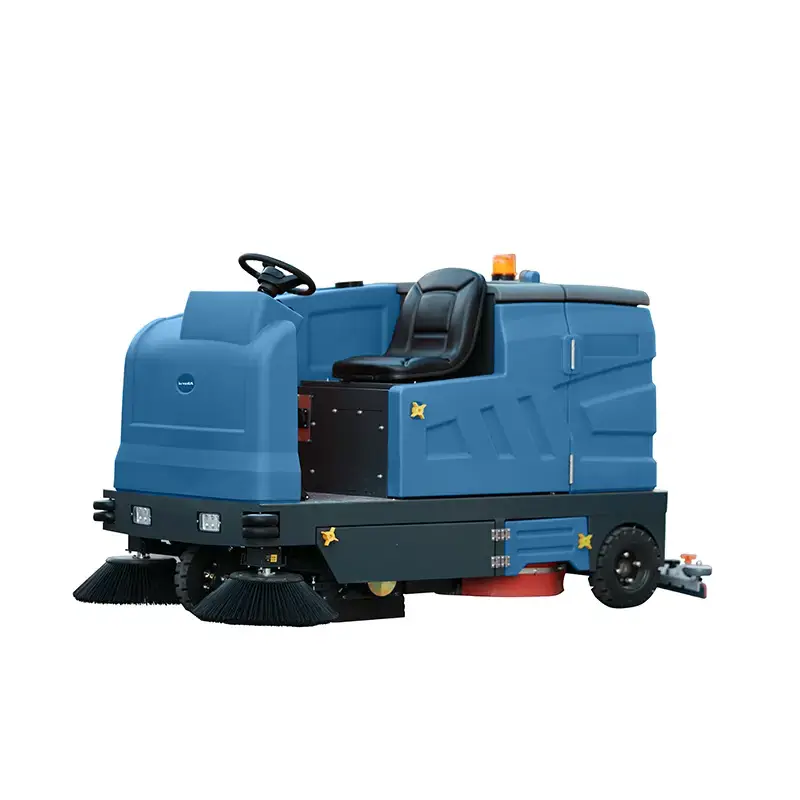
What a Sweeper Scrubber Actually Is
An industrial floor sweeper scrubber is two machines on one chassis: a sweeping deck that lifts dry debris into a dust bin, followed by a scrubbing deck that applies solution, scrubs, and vacuums the water back up. One pass does both jobs.
A floor sweeper scrubber looks like an obvious improvement — and as a floor scrubber sweeper it is judged on exactly that promise: one pass, two jobs. For some buildings it delivers. For others it is an expensive mistake, because the sweeper scrubber carries the compromises of both machine types and adds a few of its own.
- Sweeping deck: side brushes sweep debris into the path of a main cylindrical brush, which throws it into a dust bin. No water involved.
- Scrubbing deck: disc or cylindrical brushes apply solution, scrub, and the squeegee assembly vacuums the dirty water into a recovery tank.
- The two decks work in sequence on the same pass, which is why a sweeper scrubber covers less ground per hour than a dedicated scrubber of the same deck width — the sweeping stage adds drag and consumes bin capacity.
- Every moving part of both machines is present, so there are roughly twice as many components to maintain.
- Industrial scrubbers remain an active research subject rather than a settled one. A 2026 paper in Clean Technologies examined an in-situ hydrogen-powered ride-on industrial scrubber, which shows the category is still being re-engineered around energy and emissions. That matters when you are buying: the machine you purchase today sits in a technology line that is still moving.
The Three Widths That Decide Everything
Buyers compare cleaning width and stop there. A sweeper scrubber has three different widths doing three different jobs, and confusing them is how buildings end up with a machine that does not fit.
The figures below are from the Aikerui B260R60 ride-on sweeper scrubber, used as a worked example throughout this page.
- On a ride on sweeper scrubber the gap between sweeping width and cleaning width is not a bonus. Debris swept from the outer 450 mm is collected, but that strip is not scrubbed.
- In a building with heavy dry debris and light soil, that outer strip rarely matters. In one with oil film across the whole floor, it does — you will need a second pass or a wider brush deck.
- Squeegee width being wider than the brush deck is normal and necessary. A squeegee exactly as wide as the deck leaves water on both edges whenever the machine tracks slightly off-line.
| Width | B260R60 figure | What it decides |
|---|---|---|
| Sweeping width | 1,350 mm | How much debris the side brushes pull in per pass — the widest of the three, because the side brushes extend beyond the body |
| Cleaning width | 900 mm | The actual scrubbing footprint of the brush deck — this is the number that limits productivity |
| Squeegee width | 1,200 mm | How much water is recovered per pass — wider than the brush deck so the squeegee catches water pushed sideways |
Machine Specification: Aikerui B260R60
The B260R60 is a ride-on sweeper scrubber with a 50 L dust bin in addition to the usual solution and recovery tanks. Published figures from the product documentation:
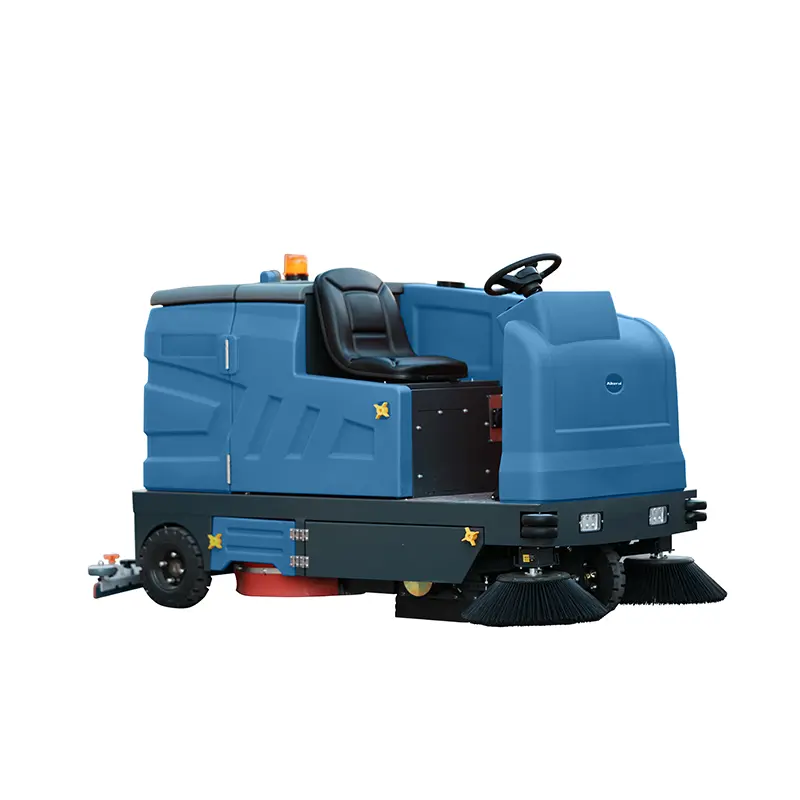
- The 200 L solution tank and 260 L recovery tank matter more than the deck width on a machine this size. At typical flow rates they support long runs between refills, which is the main reason to choose ride-on over walk-behind.
- The 50 L dust bin is the constraint a dedicated scrubber does not have. In a building with heavy packaging debris, the bin fills before the tanks empty, and the operator stops to empty it.
- We do not publish a price for this model on this page. Ride-on sweeper scrubbers are configured against freight, duty and destination requirements, so the delivered cost differs materially by market. Ask for a quote with your site details.
| Parameter | Value |
|---|---|
| Sweeping width | 1,350 mm |
| Cleaning width | 900 mm |
| Squeegee width | 1,200 mm |
| Solution tank | 200 L |
| Recovery tank | 260 L |
| Dust bin | 50 L |
| Travel speed | up to 10 km/h |
| Main brush length / diameter | 590 mm / 300 mm |
| Side brush diameter | 500 mm |
| Brush disc motor | 550 W x 2 |
| Suction motor | 600 W |
| Drive motor | 1,500 W |
| Brush deck lift motor | 55 W |
| Squeegee lift motor | 35 W |
| Water pump | 24 V, 120 W |
| Dimensions, with bristles | 2,200 x 1,100 x 1,350 mm |
| Machine weight | 650 kg |
| Packed weight | 700 kg |
When One Machine Beats Two
The case for a sweeper scrubber is not that it is better at either job. It is that one operator, one shift and one charging point replace two of everything.
- One operator instead of two. This is the largest single saving, and it is a labour saving rather than a machine saving — the same argument that makes any powered machine worthwhile.
- One pass over the floor instead of two. In a building cleaned during operating hours, halving the number of passes halves the disruption.
- One charging point, one parking space and one maintenance schedule. These are small individually and add up across a fleet.
- No pre-sweeping step. A dedicated scrubber needs the floor swept first, or the debris turns to mud and consumes tank capacity. A sweeper scrubber removes that separate task.
- Better performance on mixed soil. Warehouses with both packaging debris and oil film are exactly the buildings where a scrubber sweeper earns its cost and where two separate machines are usually both underused.
- Floor condition feeds into worker performance. Research on green cleaning in commercial buildings has reported that an improved indoor environment can raise worker productivity by 5 to 7 per cent. That figure is about indoor environment quality rather than about scrubber throughput, so treat it as context for why floor condition is budgeted at all, not as a productivity claim for this machine.
When Two Machines Remain the Better Buy
The honest case against is just as specific. A sweeper scrubber costs more than either machine alone, weighs more, and does neither job as well as the specialist version.
- Small floor areas. Below roughly 3,000 to 5,000 square metres of cleanable floor, the capital cost of a combined machine rarely pays back against a walk-behind scrubber plus a push sweeper.
- Mostly dry debris with little soil. If the building is a warehouse storing dry goods, an industrial sweeper scrubber may be more machine than you need — a sweeper alone may be all that is required. Buying scrubbing capacity you do not use is a waste of weight and battery.
- Mostly liquid soil with little debris. Food processing and kitchens often have no dry debris at all. A dedicated scrubber is lighter, cheaper and simpler.
- Weight-limited floors. At 650 kg unladen, a machine like the B260R60 is heavier than a dedicated scrubber of the same cleaning width. Mezzanine floors, older timber floors and some suspended slabs cannot take it.
- Buildings with narrow aisles. Sweeping width of 1,350 mm requires clearance beyond that figure. Racking at 1.5 m centres with overhanging pallets rules a machine this size out entirely.
- When one machine failing stops both functions. In a single-machine operation, a fault takes out sweeping and scrubbing together. Two machines fail independently.
Sizing a Sweeper Scrubber for Your Building
Work through these five checks before comparing sweeper scrubber machine models. Each one eliminates machines rather than adding them.
- Narrowest aisle and doorway. The machine needs clearance beyond its widest dimension — 1,350 mm sweeping width on the B260R60. Measure with a tape at the tightest point, including where pallets overhang.
- Cleanable floor area per shift. Use cleanable area, not total footprint. Dense racking can leave less than half the floor actually reachable.
- Debris volume per shift. Compare it with the dust bin. If the bin fills twice a shift, you will be emptying it mid-route, and bin capacity becomes the productivity limit rather than tank size.
- Floor loading limit. Check the machine weight against what the slab or mezzanine is rated for. 650 kg plus a full 200 L tank and 260 L recovery tank is roughly 1,100 kg on the wheels.
- Then check the soil mix. If most of the floor is dry debris with only patchy soil, a sweeper alone may be correct. If most is liquid soil with no debris, a scrubber alone is correct.
- Finally, budget for operator competence. A sweeper scrubber asks the operator to manage two systems at once — debris collection with its own emptying schedule, and scrubbing with its own solution and recovery limits. Usability research published in Applied Ergonomics used a floor scrubber as its model product precisely because operating one places real demands on the user, and found measurable differences between expert and novice performance. On a combined machine those demands are higher, so factor training time into the purchase rather than assuming the machine operates itself.
Common Questions
The questions buyers ask most often when comparing a sweeper scrubber against buying two separate machines.
- What is the difference between a sweeper and a sweeper scrubber? — A sweeper only collects dry debris into a dust bin. A sweeper scrubber adds a scrubbing deck and a recovery tank, so it also applies solution, scrubs and vacuums the water back up. A sweeper cannot clean oil film; a sweeper scrubber can.
- Why is cleaning width smaller than sweeping width on a sweeper scrubber? — Side brushes extend beyond the machine body to pull debris inward, which makes the sweeping width the widest figure. The brush deck underneath is narrower, and that figure — 900 mm on the B260R60 — is what limits scrubbing productivity.
- Can a sweeper scrubber replace a dedicated scrubber? — On mixed soil and adequate floor area, usually yes. On a floor with heavy oil film and no debris, a dedicated scrubber is lighter, cheaper and scrubs better per pass. On a floor with only dry debris, a sweeper alone is sufficient.
- How much floor area justifies a ride-on sweeper scrubber? — As a rough guide, from about 5,000 square metres of cleanable floor upward, the operator hours saved by riding outweigh the capital cost difference. Below roughly 3,000 square metres, a walk-behind scrubber plus a push sweeper is usually better value.
- Where can I buy sweeper scrubbers for a warehouse? — Direct from the manufacturer rather than through a dealer is usually the lowest landed cost, but verify spare brushes and squeegee blades are available for your model first. Sweeper scrubbers are configured against destination requirements, so ask for a quote with your aisle widths, cleanable floor area and debris volume rather than a catalogue price.
- What is the smallest sweeper scrubber available? — A walk-behind sweeper scrubber exists for tight buildings, with cleaning widths around 500 to 700 mm. The trade-off is that a walk-behind has no dust bin large enough for heavy debris, so the combined benefit is smaller than on a ride-on.
- Does a sweeper scrubber need pre-sweeping? — No, that is the main operational advantage. It does need the dust bin emptied on schedule, because a full bin stops collection while the scrubber keeps running over debris it cannot pick up.
Related Guides
Browse Machines by Type
Ready to Get Factory-Direct Pricing?
Get a quote within 24 hours. No middlemen — buy direct from the manufacturer and save 30-50%.
About the Author
Mark Wang is Sales Director at Aikerui with 15+ years of experience in industrial floor cleaning equipment. He has helped 2,000+ facilities across 50+ countries source factory-direct cleaning equipment.
About Aikerui
Aikerui is an industrial cleaning equipment manufacturer founded in 2008, operating its own 10,000+ square meter production facility in Anqing, Anhui, China. It manufactures floor scrubbers, sweepers and replacement parts, holds CE and ISO 9001 certification, and exports to 50+ countries. Every guide on this site is written by the manufacturer's own team — not a third-party agency.