
Chinese Floor Scrubbers vs Tennant, Nilfisk and Kärcher
A specification table comparing a Chinese walk-behind scrubber against three Tennant T300E configurations, with published figures and dealer prices.
In This Guide
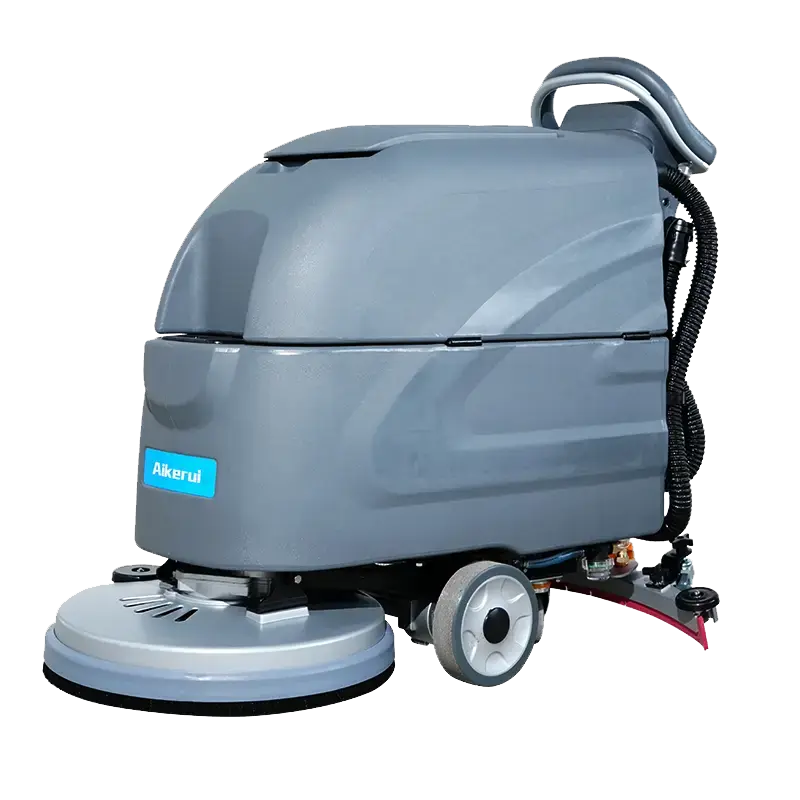
The Comparison in One Table
This page puts published figures side by side and stops there. It does not rank the machines and it does not tell you which one to buy.
All four columns below are 20-inch walk-behind scrubbers. One is a Chinese factory-direct machine. The other three are Tennant T300E configurations, quoted by a US dealer, ranging from a basic lithium model to a self-propelled unit with ec-H2O technology.
- Aikerui figures are from the A500 product documentation and our published factory-direct price range.
- Tennant figures are from a US dealer listing retrieved October 2026, for part numbers ENTNT300E20-LI, ENTNT300E-1001D and ENTNT300E20T-LI.
- Not published means the figure was not available on the manufacturer's public product pages or the dealer listing at the time of writing. It does not mean the machine lacks that specification.
| Specification | Aikerui A500 | T300E Li-ion | T300E lead-acid | T300E Traction + ec-H2O |
|---|---|---|---|---|
| Cleaning path | 500 mm (19.7 in) | 20 in | 20 in | 20 in |
| Battery chemistry | Lead-acid or lithium | Li-ion | Wet (lead-acid) | Li-ion, 90 Ah |
| Battery rating | 24 V / 100 Ah | Not published | Not published | 90 Ah |
| Self-propelled | No, manual push | Not published | Not published | Yes |
| Brush speed | Not published | Not published | Not published | 230 RPM |
| Cleaning technology | Detergent dosing + mechanical | Standard | Standard | ec-H2O (electrically converted water) |
| Solution tank | 50 L | Not published | Not published | Not published |
| Recovery tank | 55 L | Not published | Not published | Not published |
| Rated productivity | 2,200 m2/h | Not published | Not published | Not published |
| Brush motor | 550 W | Not published | Not published | Not published |
| Vacuum motor | 500 W | Not published | Not published | Not published |
| On-board charger | External charger | Not published | Not published | Yes (OBC) |
| Price | 700-1,000 USD | 7,533 USD | 8,163 USD | 11,448 USD |
| Price channel | Factory-direct | US dealer, discounted from 9,557 USD | US dealer, list price | US dealer, discounted from 13,472 USD |
What the Published Figures Show
Three rows in that table are directly comparable across all four machines: cleaning path, battery chemistry availability and price. Everything else is either specific to one configuration or not published.
The price spread is the finding that matters most, and it is wide enough to be worth stating plainly.
- Cleaning path: 500 mm on the A500 is 19.7 inches, effectively the same working width as the 20-inch Tennant units.
- Battery chemistry: all four machines are available with lithium. The specific lithium rating is published only for the Traction variant, at 90 Ah.
- Price: 700-1,000 USD factory-direct for the A500, against 7,533 USD, 8,163 USD and 11,448 USD for the three dealer-supplied Tennant configurations.
- That is a gap of roughly 7.5 to 11 times against the base lithium and lead-acid units, and roughly 11 to 16 times against the self-propelled ec-H2O configuration.
- The Traction variant costs more partly because of what it adds: self-propulsion, ec-H2O, an on-board charger and multi-down pressure settings. Those are real differences, not marketing.
Why the Two Prices Are Not Directly Equivalent
A factory-direct price and a dealer price measure different things, and comparing them without saying so would be misleading.
A dealer price includes the dealer's margin, local stock holding, delivery, warranty administration and often service. A factory-direct price from China includes the machine and export packing, and excludes freight, import duty, and any local support the buyer arranges.
- A buyer importing directly should add freight, duty and clearance to the factory price before comparing. Those costs vary by destination and volume and are not estimated on this page.
- The comparison is still useful, because it shows the scale of the difference and makes clear that most of it sits in the channel rather than in the machine.
| Cost element | In factory-direct price | In dealer price |
|---|---|---|
| Machine and export packing | Yes | Yes |
| International freight | No | Yes (local stock) |
| Import duty and customs clearance | No | Already landed |
| Dealer margin | No | Yes |
| Local warranty administration | Case by case | Yes |
| Local service and spare parts stock | No | Typically yes |
What This Table Does Not Compare
A specification sheet compares published figures. It does not capture control electronics and fault diagnostics, service network coverage, spare parts availability in your region, certification required for public tenders, or build consistency between units. Those factors differ between manufacturers and are not visible in any table on this page.
- Use the table to establish what the machines have in common, then evaluate the factors above directly with each supplier.
- The ec-H2O row is an example of a difference that a specification table records but cannot evaluate. Whether reduced chemical use matters to you depends on your floor types, your chemical spend and your environmental reporting requirements.
How to Compare on a Like-for-Like Basis
If you are comparing a Chinese factory-direct machine against a dealer-supplied brand, do it in this order so the numbers mean something.
- Fix the specification first: cleaning path, tank sizes, battery chemistry and capacity, and whether self-propulsion is required. Compare only machines that match on all of these.
- Add landed cost to the factory-direct price: freight, duty, clearance and inland delivery to your site.
- Ask the dealer what the quoted price includes: delivery, commissioning, operator training, warranty labour, and an initial spare parts kit.
- Compare total cost over the same service period, including the wear parts each machine consumes. Brushes, squeegees and pad drivers are consumables on both.
- Ask both suppliers for the same three figures in writing: demonstrated productivity on your floor, runtime on your duty cycle, and the price of a full set of wear parts.
Common Questions
The questions that come up most often when buyers put a Chinese scrubber next to a Tennant, Nilfisk or Karcher specification sheet.
- Is a 20-inch Chinese scrubber the same machine as a 20-inch Tennant? — No. Cleaning path is one specification among many. The machines share a working width; they do not share control electronics, build tolerances or service arrangements. Compare the full specification and the support terms before treating them as equivalent.
- Why is the price difference so large? — Most of it sits in the supply chain rather than the machine. A dealer price includes margin, local stock, delivery, warranty administration and service; a factory-direct price includes the machine and export packing. Add freight and duty to the factory price before comparing.
- What does the ec-H2O configuration add? — On the quoted Traction variant, ec-H2O uses electrically converted water instead of daily chemicals, and the same unit adds self-propulsion, an on-board charger and multi-down pressure settings. Those features account for part of the price difference against the base models.
- Does Tennant publish full specifications publicly? — Not all of them. Tank capacities, rated productivity and motor ratings for the T300E were not available on the manufacturer's public product pages at the time of writing, which is why this table shows Not published rather than an estimate.
- What should I check before buying a Chinese scrubber directly? — Whether spare brushes, squeegees and pad drivers are available for your model, whether they can be supplied to your region, and whether the supplier will state runtime and productivity figures in writing rather than only on a datasheet.
- Which machine should I buy? — This page does not answer that. It compares published figures and shows where the price difference comes from. The decision depends on landed cost in your market, service requirements, and whether your contracts specify a particular brand.
Related Guides
Browse Machines by Type
Ready to Get Factory-Direct Pricing?
Get a quote within 24 hours. No middlemen — buy direct from the manufacturer and save 30-50%.
About the Author
Mark Wang is Sales Director at Aikerui with 15+ years of experience in industrial floor cleaning equipment. He has helped 2,000+ facilities across 50+ countries source factory-direct cleaning equipment.
About Aikerui
Aikerui is an industrial cleaning equipment manufacturer founded in 2008, operating its own 10,000+ square meter production facility in Anqing, Anhui, China. It manufactures floor scrubbers, sweepers and replacement parts, holds CE and ISO 9001 certification, and exports to 50+ countries. Every guide on this site is written by the manufacturer's own team — not a third-party agency.