
Auto Scrubber: How It Works and How to Size One | Aikerui Guide
What an automatic floor scrubber is, how the solution-brush-squeegee-vacuum cycle works in order, and how to size one from cleaning path, tank volume and shift length.
In This Guide
- What “Auto Scrubber” Actually Means
- The Four-Step Cycle, in the Order It Fails
- Three Published Numbers That Decide Whether a Machine Fits
- Sizing Worksheet: From Floor Area to a Model
- Walk-Behind or Ride-On: What the Dividing Line Really Is
- Runtime, Batteries and How Many Times You Stop
- What Actually Wears Out
- Common Questions
What “Auto Scrubber” Actually Means
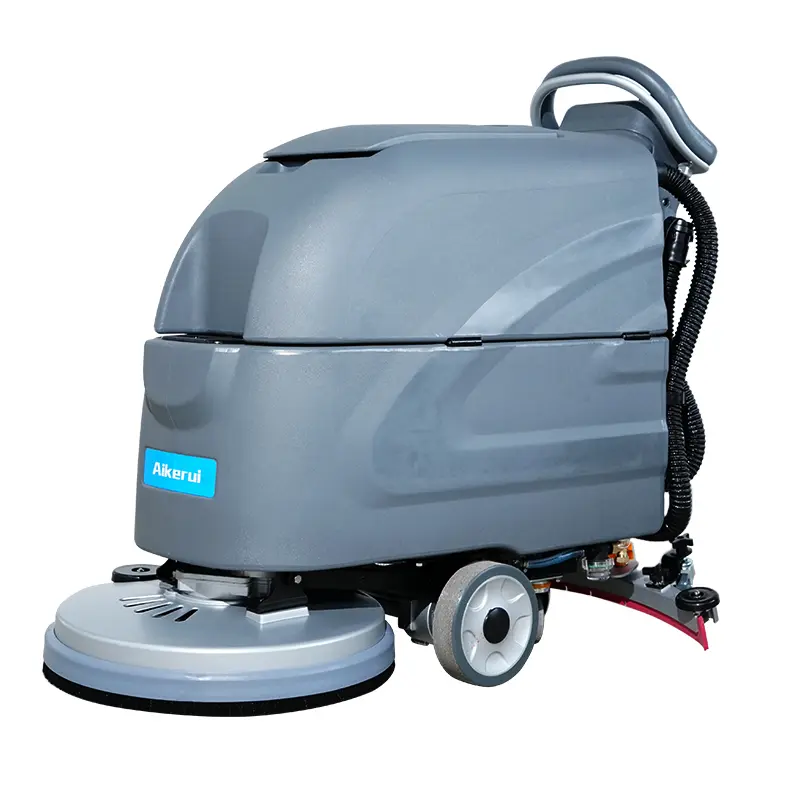
An auto scrubber — written in full as an automatic floor scrubber or automatic scrubber machine — is a machine that delivers cleaning solution, agitates the floor with a rotating brush, then picks the dirty water back up with a squeegee and a vacuum, in one pass over the floor.
The word automatic does not refer to self-driving. It refers to the fact that the four operations happen together: a mechanical floor scrubber (a rotary or swing machine) does one job at a time and leaves the water on the floor for a separate wet-vacuum pass. On an automatic scrubber the recovery step is built into the same machine, which is why one operator can clean and dry a floor in a single movement.
That single difference explains most of the cost, the weight, and the operator training between the two machine families. It also explains why a scrubber is specified by recovery tank volume rather than by motor power: the machine is a water-handling system that happens to scrub.
- Automatic means solution, agitation, pickup and recovery happen in one pass — not that the machine drives itself.
- A mechanical rotary machine leaves the water on the floor; an automatic scrubber picks it up in the same movement.
- This is why the recovery tank and the squeegee matter as much as the brush motor on a specification sheet.
The Four-Step Cycle, in the Order It Fails
Every automatic scrubber runs the same sequence, and the sequence is worth knowing in the order that problems appear, because diagnosis is where most operators lose time.
Step one is solution delivery: a pump or gravity feed sends water and detergent from the fresh tank to the brush deck. Step two is agitation: the brush rotates against the floor, and brush pressure — not brush speed — determines how much soil it can physically displace. Step three is pickup: the squeegee blade channels the dirty water into a throat behind the brush deck. Step four is recovery: a vacuum motor pulls that water up into the recovery tank.
When a machine leaves streaks, the order to check is the reverse of the order above. The squeegee is the first thing to inspect, because a nicked, hardened or badly adjusted blade leaves a film regardless of how well the rest of the machine works. The vacuum is second: a blocked hose or a worn motor seal leaves water behind even with a perfect blade. Solution flow is third — too much water overloads the squeegee, and the floor comes out wetter, not cleaner. The brush is usually last, because a worn brush tends to produce an even but incomplete clean rather than streaks.
- Check in reverse order of the cycle: squeegee, then vacuum, then flow, then brush.
- Too much solution looks like a squeegee fault — the floor comes out wet, not dirty.
- A worn brush cleans evenly but incompletely; it rarely causes streaking.
Three Published Numbers That Decide Whether a Machine Fits
Buyers compare tank capacity because it is the most published figure in the category. Three numbers decide fit, and tank volume is only the third of them.
Cleaning path is the width the brush actually covers, in millimetres. It sets how many passes a floor needs: a 4-metre aisle takes five passes with an 800 mm machine and eight with a 500 mm machine. Squeegee width is normally wider than the brush path because it has to catch water thrown outward, which is why a machine can show an 800 mm working width against a 500 mm cleaning path.
Productivity, usually quoted in square metres per hour, is the theoretical figure: cleaning path multiplied by a nominal travel speed. It is comparative, not predictive. No machine achieves its theoretical figure across a shift, because turning, refilling, emptying, moving between areas and operator breaks all take time. Planning at 60 to 75 percent of the published figure is the normal working assumption, and it is the only adjustment this guide makes to a manufacturer’s numbers.
The tank volume is the third number, and its useful form is not litres but the refill interval: solution tank divided by flow rate. A 55-litre tank at 2 litres per minute holds roughly 27 minutes of solution. That is the interval at which the operator stops, whether or not the floor is half done — which is why tank size has to be read against productivity, not on its own.
- Cleaning path sets passes per aisle; squeegee width is normally wider than the brush.
- Published productivity is theoretical — plan at 60-75 percent of it across a shift.
- Refill interval, not tank volume, is what the operator actually experiences.
Sizing Worksheet: From Floor Area to a Model
A workable sizing method uses four inputs: cleanable area per shift, the shift length, the narrowest aisle the machine must turn in, and the floor condition.
The calculation runs in one direction. Divide cleanable area by shift hours to get the area per hour the machine must deliver. Divide that again by 0.7 to allow for turning, refuelling and repositioning, which gives the published productivity the machine needs. From there the cleaning path follows, and the tank size follows the shift length.
The table below applies that method to five Aikerui machines using their published figures. The last two columns are the area each machine covers at 70 percent of published productivity — the realistic coverage, not the brochure figure.
- Aikerui figures: Aikerui product documentation for the A500BT, K500BT, A650T, K660 and A860, published November 2026.
- Coverage at 70 percent is a planning allowance for turning, refilling and repositioning. It is not a manufacturer figure.
- Where a manufacturer does not publish productivity, this guide says so rather than deriving a number from an unknown travel speed.
| Model | Cleaning path | Working width | Published productivity | Coverage at 70% (per hour) | Coverage in a 4-hour shift | Fresh / recovery tank |
|---|---|---|---|---|---|---|
| Aikerui A500BT (walk-behind) | 500 mm | 800 mm | 2,500 ㎡/h | 1,750 ㎡/h | 7,000 ㎡ | 55 L / 65 L |
| Aikerui K500BT (walk-behind) | 800 mm | 800 mm | 2,500 ㎡/h | 1,750 ㎡/h | 7,000 ㎡ | 55 L / 65 L |
| Aikerui A650T (walk-behind, traction) | 650 mm | 800 mm | Not published | Cannot be derived | Cannot be derived | 55 L / 65 L |
| Aikerui K660 (ride-on) | 660 mm | 1,000 mm | 4,900 ㎡/h | 3,430 ㎡/h | 13,720 ㎡ | 90 L / 110 L |
| Aikerui A860 (ride-on) | 860 mm | 1,200 mm | 6,000 ㎡/h | 4,200 ㎡/h | 16,800 ㎡ | 160 L / 180 L |
Walk-Behind or Ride-On: What the Dividing Line Really Is
The usual rule of thumb puts the walk-behind-to-ride-on crossover at somewhere between 2,000 and 3,000 square metres of cleanable floor. The number is a proxy for two things that matter more than area: shift length and aisle width.
Shift length matters because an operator pushing a machine for six hours covers less than one riding for six hours, and the gap widens through the shift. Aisles matter because a ride-on needs room to turn: a machine with a 1,000 mm working width will not turn inside a racking aisle built for a walk-behind, and no amount of higher productivity compensates for a machine that physically does not fit.
The Aikerui range shows the two segments clearly. Walk-behind machines run from a 330 mm compact unit with 15 litres up to an 800 mm machine with a 55-litre tank. Ride-on machines start at a 660 mm cleaning path with 90 litres and run to an 860 mm path with 160 litres and 24 V / 800 Ah battery capacity. The overlap is real: a 650 mm walk-behind with traction drive and a 660 mm ride-on cover similar widths, and the choice between them is shift length and operator fatigue rather than floor area.
- Treat 2,000-3,000 ㎡ as a starting point, then check aisle width and shift length.
- A ride-on that cannot turn in the aisle is worse than a walk-behind that can.
- In the Aikerui range, walk-behind runs 330-800 mm and ride-on 660-860 mm — the overlap is decided by shift length, not width.
Runtime, Batteries and How Many Times You Stop
Published working hours are quoted per charge, and they vary more across a range than buyers expect. In the Aikerui line, a compact 330 mm machine quotes 2 to 2.5 hours, a 400 mm unit quotes 4 hours, a 550 mm-class walk-behind quotes 3 to 4 hours, and the 500 mm battery machines quote 4 to 5 hours. Ride-on models quote 3 to 4 hours on 24 V / 150 Ah packs, and the largest machines use 24 V / 800 Ah.
Charging time is the second half of the same constraint, and it is the half that gets missed. Charging runs 5 to 6 hours on the 24 V / 100 Ah machines and 7 to 8 hours on the 800 Ah machines. A machine that runs 4 hours and charges 6 hours cannot cover two shifts on one battery — the practical answer is either a second battery, an opportunity-charge routine in the middle of the day, or a larger machine covering the area in one pass.
The derived planning figure is coverage per charge: published productivity at 70 percent, multiplied by quoted working hours. On the A500BT that is 1,750 ㎡/h over 4 to 5 hours, or roughly 7,000 to 8,750 square metres per charge, which is the number to compare against the floor area rather than the hourly figure alone.
- Quoted working hours across the Aikerui range run from 2 hours (compact) to 5 hours (500 mm battery walk-behind).
- Charging is 5-6 hours on 24 V / 100 Ah machines and 7-8 hours on 800 Ah machines — plan the second shift around it.
- Coverage per charge is the number that decides whether one machine covers the site.
What Actually Wears Out
Four consumables decide whether a scrubber keeps performing, and none of them are the motor.
Squeegee blades wear on the trailing edge and start leaving a film before they fail visibly; they are the cheapest part on the machine and the most common cause of a complaint about pickup. Brushes wear down and lose contact pressure as the bristles shorten, so the machine cleans less deeply while sounding exactly the same. Vacuum motor brushes and seals degrade slowly, which shows up as water left behind rather than as a sudden failure. Batteries lose capacity with cycle count, and a lead-acid pack that reads the correct voltage at rest can still collapse under load — which is the one thing to test properly on any used machine.
None of these has a fixed replacement interval that holds across sites. The hourly usage, the detergent chemistry, the floor finish and whether the machine is rinsed at the end of each shift all move the number, which is why a maintenance plan built on calendar dates under-serves a busy site and over-serves a quiet one.
- Squeegee blades are the cheapest part and the most common cause of poor pickup.
- Worn brushes reduce cleaning depth without changing how the machine sounds.
- Battery capacity is the item to test on a used machine — voltage at rest does not prove capacity.
Common Questions
The questions that come up most when a buyer is choosing a first automatic scrubber.
- Is an auto scrubber the same as a walk-behind scrubber? — Not quite. Walk-behind describes how the machine is driven; automatic describes what it does. A ride-on scrubber is also an automatic scrubber. The distinction that matters for cleaning is automatic (cleans and recovers in one pass) versus mechanical (scrubs only).
- How much floor can one machine clean in a shift? — Use published productivity at 70 percent, multiplied by quoted working hours. A 500 mm walk-behind with 2,500 ㎡/h and 4-5 hours of runtime covers roughly 7,000-8,750 ㎡ per charge. That figure, not the hourly one, decides whether one machine is enough.
- Do I need a ride-on? — Only when the aisle width allows it and the shift is long enough that pushing becomes the constraint. Below roughly 2,000-3,000 ㎡ a walk-behind is usually the better value, and in narrow racking aisles it is the only option.
- Why does my machine leave streaks? — Work backwards through the cycle: squeegee blade condition and adjustment first, then vacuum suction and hose blockage, then solution flow, and the brush last. Excess solution is the most common misdiagnosis, because it looks like a squeegee fault.
- Can an automatic scrubber clean carpets? — No. A scrubber is built to recover water from hard floors; carpet needs an extractor, which is a different machine in the same family. The Aikerui range includes carpet extractor washers as a separate category for that reason.
- How long does a battery last? — It depends on cycle count, depth of discharge and charging routine rather than on age. Ask for the battery's rated cycle life and the charging regime it was run under; on a used machine, load-test it instead of reading the resting voltage.
Related Products
Related Guides
Browse Machines by Type
Ready to Get Factory-Direct Pricing?
Get a quote within 24 hours. No middlemen — buy direct from the manufacturer and save 30-50%.
About the Author
Mark Wang is Sales Director at Aikerui with 15+ years of experience in industrial floor cleaning equipment. He has helped 2,000+ facilities across 50+ countries source factory-direct cleaning equipment.
About Aikerui
Aikerui is an industrial cleaning equipment manufacturer founded in 2008, operating its own 10,000+ square meter production facility in Anqing, Anhui, China. It manufactures floor scrubbers, sweepers and replacement parts, holds CE and ISO 9001 certification, and exports to 50+ countries. Every guide on this site is written by the manufacturer's own team — not a third-party agency.