
Mechanical Floor Scrubber vs Auto Scrubber Explained
A mechanical floor scrubber and an auto scrubber are not the same machine. Compare three automation levels by brush action, water recovery and labour cost.
In This Guide
- What Buyers Mean by Mechanical Floor Scrubber
- The Three Levels of Automation
- Where the Mechanical Action Comes From
- What an Auto Scrubber Machine Adds
- Specification Comparison Across the Range
- What Rated Productivity Actually Assumes
- The Labour Arithmetic That Decides the Level
- Where a Mechanical Machine Still Wins
- Where an Automatic Scrubber Pays Back
- What the Third Level Changes
- Where These Numbers Come From
- Is a Mechanical Floor Scrubber the Same as a Manual Scrubber?
- Auto Scrubber and Automatic Floor Scrubber, What Is the Difference?
- How Many Square Meters Justify an Auto Scrubber?
- Does a Wider Brush Always Mean Faster Cleaning?
- Can a Mechanical Scrubber Handle a Warehouse Floor?
What Buyers Mean by Mechanical Floor Scrubber
The phrase is used three different ways in equipment catalogues, and only one of them describes a distinct machine class. In floor care, mechanical refers to the cleaning action itself: brush pressure and rotation doing the work that a stronger chemical would otherwise do. In sweeper catalogues it marks a brush-only unit with no vacuum. In older price lists it simply meant a machine without electronic controls.
For anyone comparing scrubbers, the useful reading is the first. Every scrubber sold today cleans mechanically, so the term on its own does not separate one machine from another. What does separate them is how much of the work the machine takes over from the operator: moving, dosing the solution, and recovering the water.
Most buying guides sort floor scrubbers by shape, as compact, walk-behind, ride-on or sweeper-scrubber. This guide sorts the same machines by automation level, which is the axis that decides how many labour hours the floor actually costs.
- Mechanical describes brush action, not a machine type. Two scrubbers of the same width can sit at different automation levels.
- The term is often used as the opposite of automatic, yet in floor care automatic means one-pass solution, scrub and recovery, which every modern scrubber does.
- The distinction that changes the purchase price is who supplies the motion and who sets the dose.
The Three Levels of Automation
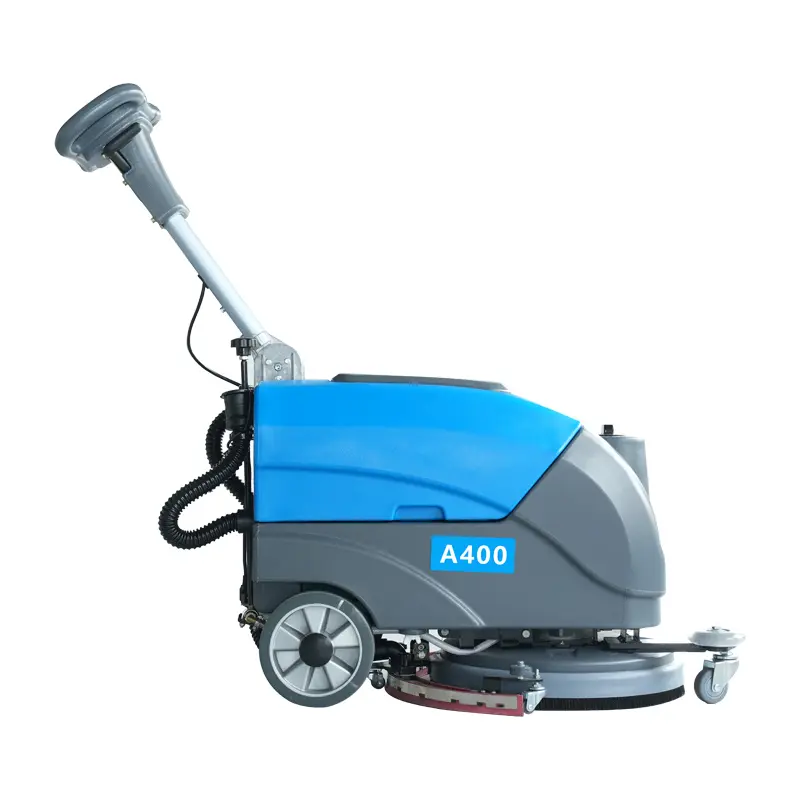
Three levels cover the market. The table places each level by what the operator still has to do, using Aikerui models where the published specifications allow a clear placement.
| Level | Solution control | Tank volume | Rated productivity | Operator role | Aikerui examples |
|---|---|---|---|---|---|
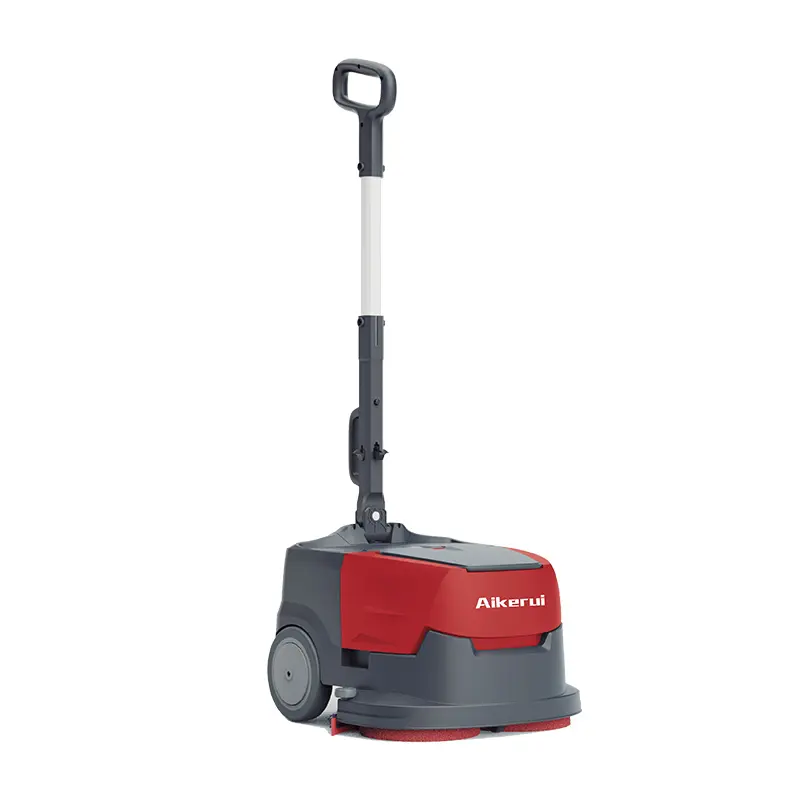
| 1, mechanical | Hand valve or gravity feed | 5 to 6 L | 1,200 sqm/h | Push, steer, set flow | A380 |
| 2, automatic | Solenoid valve, adjustable flow | 15 to 180 L | 1,300 to 6,000 sqm/h | Steer and set flow | A330 to A860 |
| 3, autonomous | Sensor-driven, no setting | Platform dependent | Quoted as coverage per charge | Supervise and refill | Not in the current Aikerui range |
Where the Mechanical Action Comes From
Mechanical cleaning is the product of three things: how hard the brush presses, how fast it turns, and how long it stays on the same patch. The third factor is set by travel speed, which is why a slow single pass cleans better than two fast ones.
Aikerui publishes both numbers for the A380: a brush pressure of 5.5 kg and a rotation speed of 170 rpm on a 380 mm disc. That combination suits light soil on sealed floors, and it explains why the machine weighs 10 kg net and carries a 100 W brush motor. Larger models raise the motor instead: the K660 runs two 450 W brush motors and the A860 two 550 W motors, because a wider brush spreads the same downforce over more area unless the machine adds weight or a separate pressure system.
Disc and cylindrical brushes deliver that action differently. A disc brush turns about a vertical axis and leaves a circular pattern. A cylindrical brush turns about a horizontal axis and throws debris forward into a tray, which is why cylindrical machines handle grit and small solids better in a single pass.
What an Auto Scrubber Machine Adds
An automatic scrubber, also written auto scrubber or autoscrubber, adds three mechanisms on top of brush action. Solution delivery moves from a hand valve to a solenoid valve, so the flow rate is set once and repeated. Recovery adds a float shutoff, so the vacuum stops before the tank overfills and floods the motor. Capacity grows, and that is what removes the mid-shift refill.
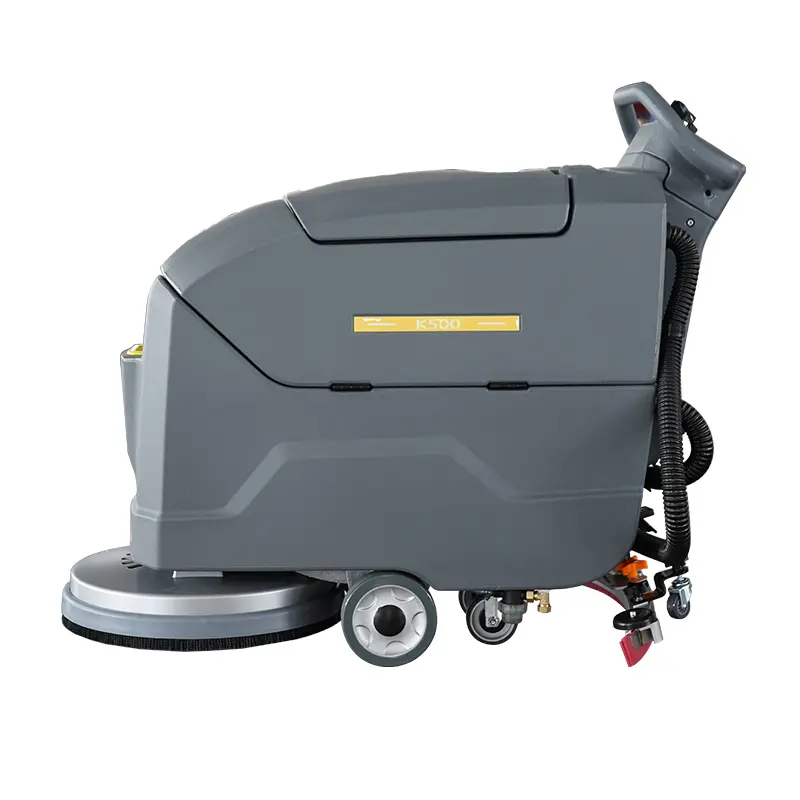
The K500 shows the pattern in its published specification: a 55 L clean tank against a 65 L recovery tank, a 650 W brush motor and a 550 W vacuum motor, with a rated runtime of 4 to 5 hours and a charge time of 5 to 6 hours. The recovery tank is deliberately the larger of the two, because soil adds volume to the water that comes back up.
Specification Comparison Across the Range
The table uses published Aikerui specifications for five models, ordered by brush width. Brush width is listed separately from working width because the two differ on several models, and productivity follows the brush rather than the machine body.
| Model | Brush width | Working width | Rated sqm/h | Clean tank | Recovery tank | Brush motor | Vacuum motor | Runtime | Charge time |
|---|---|---|---|---|---|---|---|---|---|
| A380 | 380 mm | 380 mm | 1,200 | 5 L | 6 L | 100 W | 70 W | not published | not published |
| A400 | 400 mm | 580 mm | 1,600 | 25 L | 30 L | 380 W | 500 W | 4 h | not published |
| K500 | 800 mm | 800 mm | 2,500 | 55 L | 65 L | 650 W | 550 W | 4 to 5 h | 5 to 6 h |
| K660 | 660 mm | 1,000 mm | 4,900 | 90 L | 110 L | 450 W x 2 | 500 W | 4 to 5 h | 5 to 6 h |
| A860 | 860 mm | 1,200 mm | 6,000 | 160 L | 180 L | 550 W x 2 | 600 W | 3 to 4 h | 7 to 8 h |
What Rated Productivity Actually Assumes
Every rating in that table is brush width multiplied by maximum travel speed, with no allowance for turning, overlapping passes or emptying a tank. The arithmetic confirms it: the K500 at 2,500 square meters per hour on an 800 mm brush implies 3,125 linear meters per hour, or about 52 meters per minute, which is normal walking speed behind a machine.
That is why a rating should never be used directly to size a machine. A facility with racking, machinery or frequent obstacles loses a large share of it, and heavy soil needs a slower pass. The practical method is to derate the published figure, then test the derated number on your own floor for one shift. The 65 percent factor used below is an assumption for arithmetic, not a measured constant, and it should be replaced with what your floor actually delivers.
The Labour Arithmetic That Decides the Level
Take a 5,000 square meter floor with an obstacle factor of 0.85, which leaves 4,250 square meters of cleanable area. Apply a 65 percent real-world factor to each rating and the hours per shift follow directly.
Convert those hours into money with your own loaded labour rate. At 20 USD per loaded hour, used here only as a placeholder for the arithmetic, the K500 saves 2.8 hours per shift, or 700 hours across 250 shifts a year, which is 14,000 USD of labour. The A860 saves 1,075 hours, or 21,500 USD. Replace the 20 USD figure with your own rate before relying on either result, and remember that a machine needing a second operator or a long charge window will not deliver the full saving.
| Machine | Rated sqm/h | Real sqm/h at 65 percent | Hours per shift | Hours saved against A380 |
|---|---|---|---|---|
| A380 | 1,200 | 780 | 5.4 | baseline |
| A400 | 1,600 | 1,040 | 4.1 | 1.3 |
| K500 | 2,500 | 1,625 | 2.6 | 2.8 |
| K660 | 4,900 | 3,185 | 1.3 | 4.1 |
| A860 | 6,000 | 3,900 | 1.1 | 4.3 |
Where a Mechanical Machine Still Wins
A compact machine is not a compromise in every setting. It wins where the constraint is access or budget rather than throughput.
- Floors under about 500 square meters, where walk time between areas exceeds cleaning time.
- Congested areas: a 413 by 428 mm footprint enters service corridors and back-of-house spaces that a ride-on cannot.
- Floors cleaned in short bursts, such as a retail frontage twice a day, where tank capacity is never the limit.
- Sites without a dedicated charging bay, because a small 24 V pack charges from a standard socket.
- Floors that need a fast response rather than a scheduled shift, since a 10 kg machine can be carried between levels.
Where an Automatic Scrubber Pays Back
The crossover is set by hours, not by area. An automatic scrubber earns its price difference when the hours it removes, multiplied by your loaded rate, exceed the capital gap across the machine service life. As a working test: if the floor takes more than two hours per shift with a compact machine, the larger tanks and higher productivity of an automatic model usually clear that bar inside the first year.
The second trigger is refill frequency. A 5 L clean tank at a flow rate of 0.5 litres per minute empties in ten minutes, so a compact machine on a large floor spends more time at the tap than on the brush. A 55 L tank at the same flow runs for 110 minutes. That difference, not the brush width, is what changes the shape of a shift.
What the Third Level Changes
Autonomous scrubbers remove the operator from the loop: they map the floor, plan a route and return to a dock. Their productivity is not comparable with the ratings above, because it is usually quoted as coverage per charge rather than square meters per hour.
Aikerui does not build autonomous machines, and this guide does not present one as a recommendation. The defensible position for a buyer evaluating that level is to request a supervised trial on the actual floor, confirm how the machine handles aisles narrower than its sensor margin, and establish who services it locally. The economics work where labour is scarce or where cleaning happens outside operating hours, not on the strength of a coverage figure alone.
Where These Numbers Come From
Every specification in this guide is taken from published Aikerui product data for the models named, not from a generic industry table.
- Brush width, working width, tank volumes, motor ratings, battery, runtime and charge time: Aikerui specifications for A380, A400, K500, K660 and A860.
- Brush pressure of 5.5 kg and rotation speed of 170 rpm: A380 published specification.
- Net weights of 10 kg and 76 kg: A380 and A400 published specifications.
- Productivity ratings: manufacturer figures, defined as brush width multiplied by maximum travel speed.
- The 65 percent real-world factor and the 20 USD hourly rate are stated assumptions for arithmetic, not measured values. Replace both with your own figures.
Is a Mechanical Floor Scrubber the Same as a Manual Scrubber?
Often yes, but not by definition. A manual scrubber is defined by who supplies the motion, which is the operator pushing. A mechanical scrubber is defined by how the cleaning happens, which is brush pressure and rotation. A ride-on machine cleans mechanically and is not manual at all, while a small push unit is both. When a supplier lists a machine as mechanical, ask which of the two meanings applies.
Auto Scrubber and Automatic Floor Scrubber, What Is the Difference?
None. Auto scrubber, automatic scrubber, autoscrubber and automatic floor scrubber describe the same class: a machine that applies solution, scrubs and recovers the water in one pass. The shortened forms appear mostly in North American catalogues. What varies between machines is tank volume, brush width and motor rating, not the category.
How Many Square Meters Justify an Auto Scrubber?
There is no fixed area, because the answer depends on cleaning frequency and labour cost. Run the arithmetic instead: hours saved per shift, multiplied by shifts per year, multiplied by your loaded rate, compared against the price difference. In the worked example above, a 5,000 square meter floor cleaned once per shift produced 2.8 hours saved per shift when moving from a compact machine to an 800 mm model.
Does a Wider Brush Always Mean Faster Cleaning?
No. Productivity is brush width multiplied by travel speed, so width only helps where the machine can maintain speed. On a congested floor a wider brush loses its advantage in turning and repositioning, and it also spreads downforce across more area unless the machine adds weight. Compare the A400 and the K500: 400 mm against 800 mm on paper, but the difference in output also comes from 25 L against 55 L of solution and 380 W against 650 W of brush motor.
Can a Mechanical Scrubber Handle a Warehouse Floor?
It can clean it, but it cannot keep up. A warehouse floor of several thousand square meters exceeds both the runtime and the tank volume of a compact machine: the A380 carries 5 L of solution and a small 24 V battery, and its rated productivity of 1,200 square meters per hour derates to nearer 780. In warehouse aisles the limiting factor is usually access and debris load rather than cleaning action, which is why the usual answer is a ride-on automatic scrubber or a sweeper-scrubber rather than a larger mechanical unit.
Related Products
Get a Quote for These ProductsRelated Guides
Browse Machines by Type
Ready to Get Factory-Direct Pricing?
Get a quote within 24 hours. No middlemen — buy direct from the manufacturer and save 30-50%.
About the Author
Mark Wang is Sales Director at Aikerui with 15+ years of experience in industrial floor cleaning equipment. He has helped 2,000+ facilities across 50+ countries source factory-direct cleaning equipment.
About Aikerui
Aikerui is an industrial cleaning equipment manufacturer founded in 2008, operating its own 10,000+ square meter production facility in Anqing, Anhui, China. It manufactures floor scrubbers, sweepers and replacement parts, holds CE and ISO 9001 certification, and exports to 50+ countries. Every guide on this site is written by the manufacturer's own team — not a third-party agency.