
Floor Scrubber Machine: How to Choose, Spec and Buy One | Aikerui Guide
The four specifications that decide a floor scrubber machine, how to read a quote without being misled, what to inspect before paying, and the costs after delivery.
In This Guide
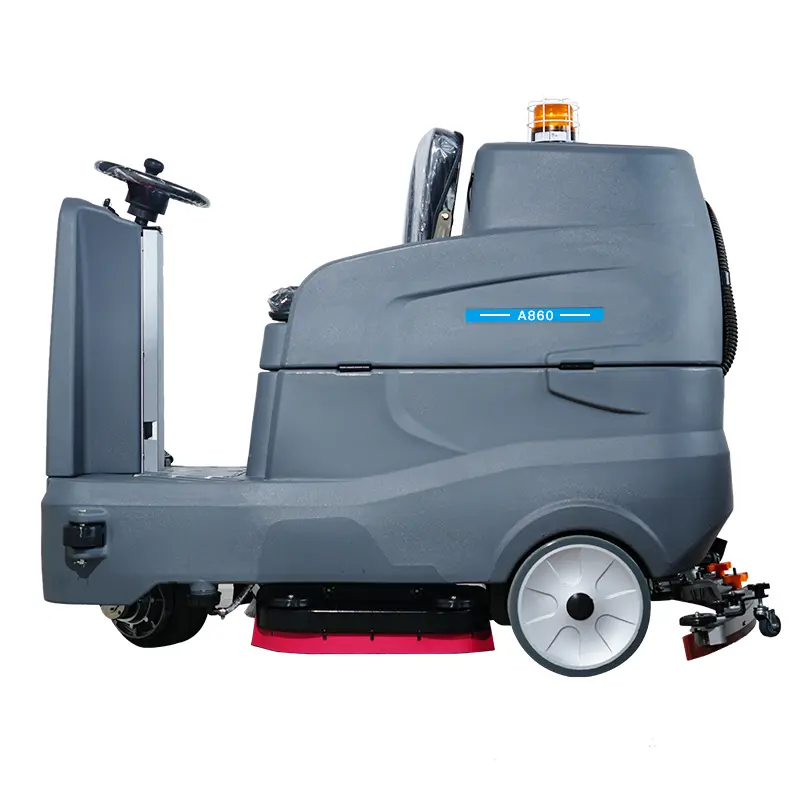
What a Floor Scrubber Machine Actually Is
A floor scrubber machine delivers cleaning solution, agitates the floor with a rotating brush, then picks the dirty water back up with a squeegee and vacuum in a single pass. That last step is what separates it from every other machine that touches a floor, and it is the reason one operator can clean and dry an area in one movement instead of leaving it to air-dry.
The word is used loosely in the trade, so a quick set of exclusions is worth stating. A floor scrubber machine is not a sweeper — sweepers remove dry debris and never wet the floor. It is not a burnisher, which polishes finish that is already there and removes nothing. It is not an extractor, which is built for carpet pile rather than hard floors. And it is not the household-sized unit sold in retail channels; the machines in this category are built for repeated daily shifts.
If a floor carries both loose debris and liquid film, the correct answer is either a sweeper-scrubber or two machines — a distinction covered separately in the machine-type comparison.
- Solution, agitation, pickup and recovery happen in one pass — that is the defining feature.
- A sweeper never wets the floor; a burnisher removes nothing.
- Floors with both debris and film need a combined machine or two separate units.
The Four Specifications That Decide the Machine
Buyers tend to compare tank capacity first because it is the most heavily published number. Four specifications actually decide whether a machine fits, and tank volume is only the third of them.
Cleaning path is the width the brush covers, in millimetres. It sets the number of passes: a 4-metre aisle takes five passes with an 800 mm machine and eight with a 500 mm machine. Working width is normally larger because the squeegee extends past the brush, so comparing one brand's working width with another's cleaning path is the most common false comparison in this category.
Productivity, in square metres per hour, is theoretical — cleaning path multiplied by a nominal travel speed. It is useful for comparing two machines and useless for predicting a shift, because turning, refilling, emptying and moving between zones all consume time that the figure ignores. Plan at 60 to 75 percent of it.
Tank volume matters in its derived form rather than in litres: fresh tank divided by flow rate gives the refill interval. A 55-litre tank at 2 litres per minute holds roughly 27 minutes of solution, and that is when the operator stops whether or not the route is finished.
Runtime is the fourth, and it is only half a number on its own. Working hours per charge and charging hours together decide whether one machine covers a site or a second battery is required.
- Aikerui figures: Aikerui product documentation for the A500BT, K500BT, K660 and A860, published November 2026.
- Where a model does not publish a working-hours figure, this guide says so instead of inferring one from battery capacity.
- Published productivity is theoretical — it is a comparison tool, not a shift plan.
| Model | Cleaning path | Fresh / recovery tank | Published productivity | Working hours per charge |
|---|---|---|---|---|
| Aikerui A500BT (walk-behind) | 500 mm | 55 L / 65 L | 2,500 ㎡/h | 4–5 h |
| Aikerui K500BT (walk-behind) | 800 mm | 55 L / 65 L | 2,500 ㎡/h | 4–5 h |
| Aikerui K660 (ride-on) | 660 mm | 90 L / 110 L | 4,900 ㎡/h | 3–4 h |
| Aikerui A860 (ride-on) | 860 mm | 160 L / 180 L | 6,000 ㎡/h | Not published |
Walk-Behind or Ride-On: The Only Calculation You Need
The decision is arithmetic, not preference. Divide the cleanable area by the number of hours in a shift to get the area per hour the machine must deliver, then divide that again by 0.7 to allow for turning, refilling and repositioning. The result is the published productivity the machine needs.
A worked example: 4,000 square metres cleaned across one 4-hour shift is 1,000 ㎡/h of required output. Divided by 0.7, the machine needs to publish about 1,430 ㎡/h. In the Aikerui range that lands on a 500 mm battery walk-behind rather than a ride-on, which is the opposite of what floor area alone would suggest.
Aisle width overrides the arithmetic. A ride-on with a 1,000 mm working width will not turn inside racking built for a walk-behind, and no productivity advantage compensates for a machine that physically does not fit. Measure the narrowest point of the route — doorways, ramp entries and lift thresholds included — before the calculation matters.
- Required output = cleanable area ÷ shift hours ÷ 0.7.
- A 4,000 ㎡ floor over a 4-hour shift needs roughly 1,430 ㎡/h of published productivity.
- Aisle width can disqualify a ride-on regardless of what the area figure says.
Reading a Quote Without Getting Fooled
Two quotes for the same machine can differ by 40 percent and both be accurate, because five items decide the real number. None of them are usually on the first page.
Batteries: quoted separately on some machines, included on others. A quote without batteries is not cheaper, it is incomplete — and the battery type (lead-acid versus lithium) changes both the price and the charging routine.
Brushes and squeegee: machines ship with one set, sometimes none. Ask what is included and what a replacement set costs, because these are the parts that wear out.
Freight and duties: a factory-direct price is normally ex-works or FOB, which means the machine is cheap until it reaches a port. Ask for the delivered cost to your address, not the unit price.
Warranty scope: "one year warranty" can mean the whole machine, or only the chassis, with motors and electronics excluded. Ask which components are covered and what the claim process is.
Spare parts availability: the least asked and most expensive question to get wrong. Ask for the price of a squeegee blade, a brush and a vacuum motor for that specific model — a supplier who cannot quote them is not planning to support the machine.
- A quote without batteries is incomplete, not cheaper.
- Ask for delivered cost, not the ex-works unit price.
- Ask what "warranty" covers — chassis only, or motors and electronics too.
- The price of a squeegee blade and a brush tells you more about support than any brochure.
What to Inspect Before You Pay
Inspection matters more on a factory-direct purchase than on a dealer purchase, because there is no local dealer to absorb a defect. It applies to new machines as much as used ones — the point is to verify what was ordered rather than to look for damage.
Run the machine on a hard floor with solution for at least five minutes. Watch the squeegee line at the end of each pass: a thin film left behind means blade adjustment, and a wide wet band means vacuum or flow. Check the brush deck for even contact — a warped plate shows as a crescent-shaped clean patch. Confirm the battery type and capacity against the order, since this is the single most commonly substituted component. Confirm the cleaning path with a tape measure rather than the label. Then empty the recovery tank and check the drain and filter for debris that would indicate the machine was run before shipment.
- Five minutes of wet running beats any visual inspection.
- Verify battery type and capacity against the purchase order — the most substituted component.
- Measure the cleaning path instead of trusting the label.
The Cost Beyond the Machine
A scrubber's purchase price is roughly half of what it costs over its life. The rest is consumables, energy and labour time, and the split between them depends on how the machine is used rather than on which brand it is.
Consumables are the largest variable: squeegee blades are the cheapest part on the machine and the most common cause of a poor result, brushes lose cleaning depth as bristles shorten, and vacuum seals degrade into a slow loss of pickup. None of these have a fixed replacement interval that holds across sites — hourly usage, detergent chemistry, floor finish and whether the machine is rinsed after each shift all move the number.
Energy and labour are the two that buyers forget. Charging hours compete with the shift schedule, and a machine that needs a mid-shift charge adds an hour of idle time that no productivity figure accounts for. Refill interval is labour time as well: a 27-minute solution window means the operator stops four times across a two-hour route.
- Consumables plus energy plus labour typically rival the purchase price over the machine's life.
- Fixed replacement intervals are misleading — usage and maintenance routine move them.
- Refill interval and charging time are labour costs, not just specifications.
Common Questions
The questions that come up most when someone is buying a floor scrubber machine for the first time.
- How much floor can one floor scrubber machine clean per shift? — Use published productivity at 60–75 percent, multiplied by quoted working hours. A 500 mm walk-behind publishing 2,500 ㎡/h and running 4–5 hours covers roughly 7,000–8,750 ㎡ per charge. Compare that figure — not the hourly one — against the site's cleanable area.
- What is the difference between cleaning path and working width? — Cleaning path is the width the brush covers; working width is normally larger because the squeegee extends beyond it. Compare cleaning path with cleaning path across brands, or the numbers are not measuring the same thing.
- Do I need a ride-on? — Only when aisle width allows it and shift length makes pushing the limiting factor. Below roughly 2,000–3,000 ㎡ of cleanable floor a walk-behind is usually better value, and in narrow racking it is the only option.
- Why does a new machine leave streaks? — Nine times out of ten it is the squeegee: blade condition, worn trailing edge, or adjustment angle. Check that first, then vacuum suction and hose blockage, then solution flow. Excess solution looks exactly like a squeegee fault and is the most common misdiagnosis.
- Can one machine clean both hard floors and carpet? — No. A scrubber recovers almost nothing from carpet pile and leaves detergent behind; an extractor is built for carpet but is not a hard-floor scrubber. Sites with both surfaces normally run two machines.
- What should I ask a factory-direct supplier before ordering? — Delivered cost rather than unit price, battery type and capacity, what is included in the box, which components the warranty covers, and the price of a replacement squeegee blade, brush and vacuum motor for that specific model.
Related Products
Related Guides
Browse Machines by Type
Ready to Get Factory-Direct Pricing?
Get a quote within 24 hours. No middlemen — buy direct from the manufacturer and save 30-50%.
About the Author
Mark Wang is Sales Director at Aikerui with 15+ years of experience in industrial floor cleaning equipment. He has helped 2,000+ facilities across 50+ countries source factory-direct cleaning equipment.
About Aikerui
Aikerui is an industrial cleaning equipment manufacturer founded in 2008, operating its own 10,000+ square meter production facility in Anqing, Anhui, China. It manufactures floor scrubbers, sweepers and replacement parts, holds CE and ISO 9001 certification, and exports to 50+ countries. Every guide on this site is written by the manufacturer's own team — not a third-party agency.