
Ride On Floor Scrubber: How to Choose One for Your Facility | Aikerui Guide
How a ride-on floor scrubber differs from a walk-behind in turning radius, aisle width and shift endurance — plus the five spec figures that decide fit.
In This Guide
What “Ride On” Actually Changes
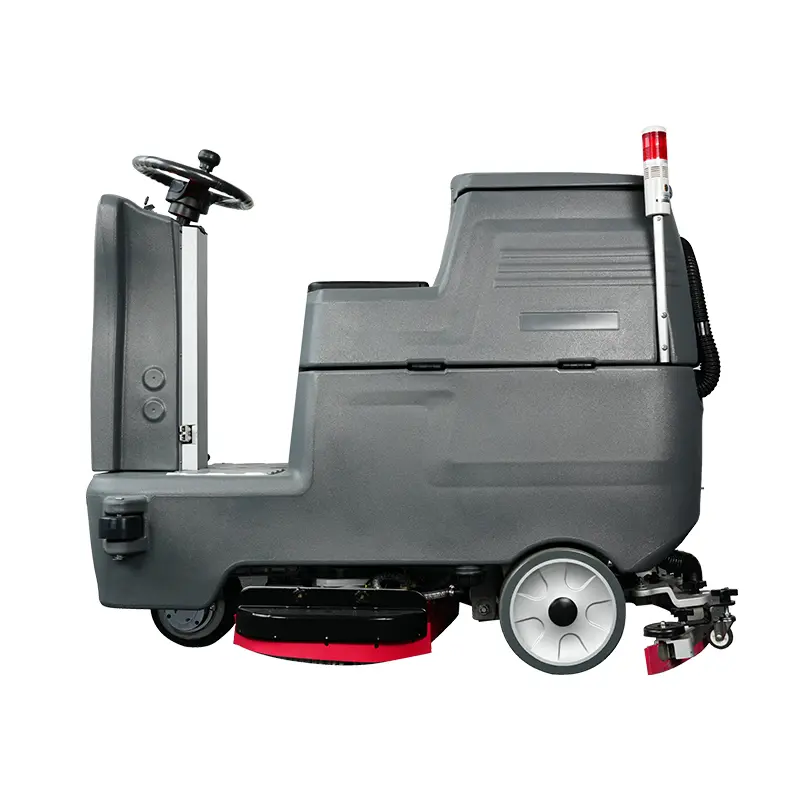
A ride-on floor scrubber is an automatic scrubber that the operator sits on and steers rather than walks behind. The obvious benefit is comfort, and comfort is not the reason the category exists. Two other differences decide whether a ride-on is the right machine for a site.
The first is endurance. A walk-behind operator pushes the machine, and the work rate falls through a shift as fatigue sets in. A seated operator holds a roughly constant rate for the whole shift, which is why the productivity gap between the two classes widens in the afternoon rather than staying flat. On a single-shift site this matters little; on a site running two shifts with a small team, it is the difference between one machine covering the work and needing two.
The second is turning geometry, and it is the one that causes the most expensive mistakes. A ride-on machine has a turning radius set by its chassis, not by its cleaning path. A machine with a 1,000 mm working width needs a defined aisle to turn in, and no amount of productivity makes up for a machine that physically cannot get down the aisle. Buyers who select on area alone and discover the aisle problem after delivery are the recurring case in this category.
- Ride-on is about sustained work rate across a full shift, not just comfort.
- Turning radius is set by the chassis — check it before comparing productivity.
- Aisles are the most common expensive mistake in this category.
Turning Radius and Aisle Width: The Real Gate
The published figure that matters here is the working width, because it is the widest part of the machine that has to fit and turn. In the Aikerui range, the compact ride-on machines carry a 1,000 mm working width on a 650-660 mm cleaning path, and the large machines move to a 1,200 mm working width on an 800-860 mm path. The difference between a 1,000 mm and a 1,200 mm chassis is the difference between fitting a standard racking aisle and not fitting it.
A practical check before quoting: measure the narrowest point of the route the machine has to travel, not just the cleaning area. That means doorways, lift entries, ramps and the gap between racking and any fixed obstacle. A machine that cleans beautifully in the open warehouse but cannot pass the door into the mezzanine is the wrong machine for that building.
Where the aisle is genuinely too tight, the answer is not a smaller ride-on — it is a walk-behind with traction drive, which turns in a fraction of the space while still taking the operator's weight off the pushing. That is the overlap zone between the two categories and it is worth pricing both before committing.
- Working width (1,000 mm compact / 1,200 mm large in this range) is what has to fit the aisle.
- Measure doorways, lift entries and ramps, not just the cleaning floor.
- If the aisle is too tight, a traction-drive walk-behind beats a shrunken ride-on.
The Five Numbers on a Ride-On Spec Sheet
Ride-on specification sheets carry a lot of figures. Five of them decide fit, and everything else is secondary.
Cleaning path is the width the brushes cover. Working width is the widest part of the machine, and it governs aisle access. Productivity in square metres per hour is theoretical and should be planned at 60 to 75 percent across a shift. Tank volume decides refill interval — a 90-litre solution tank holds roughly 45 minutes at 2 L/min, and a 160-litre tank holds proportionally longer. Battery capacity decides how much of the shift is actually powered, and on the largest machines it also decides charging logistics.
The fifth figure is the one buyers ask about last and should ask about first: the machine's own footprint in metres. A 1,200 mm working width machine is not a small object, and storage, charging position and lift access all depend on it.
- Cleaning path = brushes. Working width = what has to fit through the door.
- Plan productivity at 60-75 percent of the published figure.
- Tank size is best read as refill interval, not litres.
Sizing: From Floor Area to a Model
The calculation is the same one used for any automatic scrubber: cleanable area per shift divided by shift hours gives the required hourly rate; divide again by 0.7 for turning, dumping and repositioning; the result is the published productivity the machine needs to have.
The table below applies that to five Aikerui ride-on machines using their published figures. The last column is coverage per charge, which is the number that decides whether one machine covers the site or whether the site needs two.
- Aikerui figures: Aikerui product documentation for the K660, A650R, A660, A800R and A860, published November 2026.
- Coverage at 70 percent is a planning allowance for turning, dumping and repositioning — not a manufacturer figure.
- Where productivity is not published, this guide says so rather than deriving it from an unknown travel speed.
| Model | Cleaning path | Working width | Published productivity | Coverage at 70% | Fresh / recovery tank | Battery | Quoted runtime |
|---|---|---|---|---|---|---|---|
| Aikerui K660 | 660 mm | 1,000 mm | 4,900 ㎡/h | 3,430 ㎡/h | 90 L / 110 L | 24 V / 150 Ah | 4-5 h |
| Aikerui A650R | 650 mm | 1,000 mm | 4,500 ㎡/h | 3,150 ㎡/h | 90 L / 110 L | 24 V / 150 Ah | 3-4 h |
| Aikerui A660 | 660 mm | 1,000 mm | 4,500 ㎡/h | 3,150 ㎡/h | 90 L / 110 L | 24 V / 150 Ah | 3-4 h |
| Aikerui A800R | 800 mm | 1,200 mm | Not published | Cannot be derived | 160 L / 180 L | 24 V / 800 Ah | 3-4 h |
| Aikerui A860 | 860 mm | 1,200 mm | 6,000 ㎡/h | 4,200 ㎡/h | 160 L / 180 L | 24 V / 800 Ah | 3-4 h |
Battery and Charging: The Part That Decides the Second Shift
The compact ride-on machines in this range run 24 V / 150 Ah packs and quote 3 to 5 hours of working time. The large machines move to 24 V / 800 Ah, which is a different order of battery: charging time goes from 5-6 hours to 7-8 hours.
That single change has an operational consequence. A machine that runs 4 hours and charges 8 does not do two shifts on one pack, no matter what the site needs. The options are a second battery set, an opportunity charge during a break, or accepting that the second shift starts with a smaller area capacity. Quoting a ride-on without checking the charging window against the shift pattern is how a site ends up with a machine that is correct on paper and short in practice.
A second point on the big packs: they are heavy, and they change how the machine is moved between buildings. Charging position matters as much as charging time — a machine that has to be driven 200 metres to its charger every night loses a meaningful slice of its working window.
- 150 Ah machines charge in 5-6 hours; 800 Ah machines need 7-8.
- A 4-hour runtime with 8-hour charging cannot cover two shifts on one pack.
- Charging position is part of the runtime calculation, not an afterthought.
Sweeper-Scrubber: When One Machine Does Two Jobs
Sites that sweep before they scrub sometimes buy a ride-on sweeper-scrubber instead of two machines. The Aikerui B260R60 is that category: one ride-on chassis that sweeps debris and scrubs in the same pass.
The trade-off is worth stating plainly. A combined machine carries a debris hopper, which takes space and weight away from tank volume, and it costs more than a scrubber of the same cleaning path. It earns its price where floors carry both loose debris and film — logistics yards, foundries, parking structures — and where a separate pre-sweep would otherwise be a second operator's job. On a clean indoor floor with no debris, the combined machine is paying for capability the site never uses.
- A sweeper-scrubber replaces a two-step process on floors that carry both debris and film.
- The debris hopper takes volume and payload away from the tanks; it costs more than a pure scrubber.
- On clean indoor floors, a pure scrubber is the better buy.
What Actually Goes Wrong
Ride-on machines fail in different places than walk-behinds, and three of them are predictable.
Squeegee blades wear the same way as on any scrubber and cause the same symptom — a film left behind — but on a ride-on the blade is longer and the cost of ignoring it is a larger wet patch. Drive and brush motors take more load because the operator's weight is on the machine, which is why brush motor ratings on ride-ons (450-650 W per brush in this range) sit higher than on comparable walk-behinds. And the battery pack is the item that ends the machine's useful life: 800 Ah packs are expensive to replace, and their condition is what decides the resale value of a used ride-on.
None of these have a calendar interval that holds across sites. Hourly usage, detergent chemistry, floor finish and whether the machine is rinsed after each shift all move the number.
- Longer squeegee blades mean a bigger wet patch when they wear.
- Ride-on brush motors carry more load because the operator's weight is on the chassis.
- The 800 Ah pack is the biggest single replacement cost and the main driver of resale value.
Common Questions
The questions that come up most when a buyer is choosing a first ride-on scrubber.
- How large does a floor need to be before a ride-on makes sense? — Roughly 2,000-3,000 ㎡ of cleanable floor is the usual starting point, but aisle width and shift length decide it. A narrow-aisle site of 5,000 ㎡ may still need walk-behinds; a wide-open 2,500 ㎡ floor run for two shifts may justify a ride-on.
- What is the minimum aisle width for a ride-on scrubber? — It follows the working width: 1,000 mm machines in this range need an aisle that lets the chassis turn, and 1,200 mm machines need more. Measure the narrowest point of the route — doorways and ramp entries included — before choosing.
- How long does a ride-on scrubber run on one charge? — The compact machines here quote 3-5 hours on 24 V / 150 Ah, and the large machines 3-4 hours on 24 V / 800 Ah. Charging runs 5-6 hours and 7-8 hours respectively, which is what decides whether a second shift is possible.
- Can one machine cover two shifts? — Only with a second battery set or a mid-shift opportunity charge. A 4-hour runtime against an 8-hour charge window does not cover two shifts, regardless of how productive the machine is.
- Do I need a sweeper-scrubber instead of a scrubber? — Only if the floor carries loose debris as well as film. On clean indoor floors the hopper is dead weight and the price premium buys nothing.
- What should I check on a used ride-on scrubber? — The battery pack first: resting voltage does not prove capacity, so load-test it. Then the squeegee mount (bent in transit more often than worn), then the drive motor, then the brush deck for a warped plate.
Related Products
Related Guides
Browse Machines by Type
Ready to Get Factory-Direct Pricing?
Get a quote within 24 hours. No middlemen — buy direct from the manufacturer and save 30-50%.
About the Author
Mark Wang is Sales Director at Aikerui with 15+ years of experience in industrial floor cleaning equipment. He has helped 2,000+ facilities across 50+ countries source factory-direct cleaning equipment.
About Aikerui
Aikerui is an industrial cleaning equipment manufacturer founded in 2008, operating its own 10,000+ square meter production facility in Anqing, Anhui, China. It manufactures floor scrubbers, sweepers and replacement parts, holds CE and ISO 9001 certification, and exports to 50+ countries. Every guide on this site is written by the manufacturer's own team — not a third-party agency.