
Ride On Floor Scrubber Runtime and Tank Sizing
Size a ride-on floor scrubber by calculation: battery runtime, clean tank and recovery tank worked out from your floor area, with formulas and Aikerui data.
In This Guide
- How to Size a Ride On Floor Scrubber
- Step 1: Calculate Real Cleaning Area Per Shift
- Step 2: Calculate Required Battery Runtime
- Step 3: Calculate Clean Water Tank Capacity
- Step 4: Calculate Recovery Tank Capacity
- Step 5: Match Machine to Facility Size
- Charging Time Limits Daily Shifts
- Five Sizing Mistakes
- How Do I Work Out My Solution Flow Rate?
- What Happens if the Recovery Tank Fills Before the Clean Tank?
- Can I Fit a Bigger Battery Than the Factory Specification?
- How Accurate Are Manufacturer Productivity Ratings?
- Why Does a Bigger Battery Not Multiply Runtime?
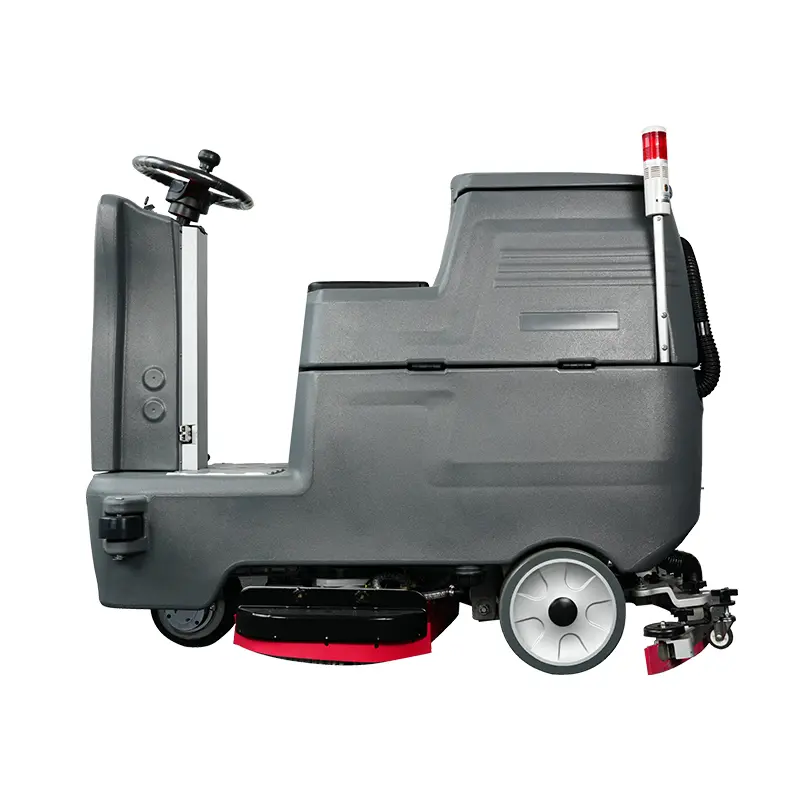
How to Size a Ride On Floor Scrubber
Choosing a ride-on floor scrubber comes down to matching three numbers to your facility: battery runtime, clean water tank capacity and recovery tank capacity. Get them wrong in one direction and you stop mid shift to refill or recharge. Get them wrong in the other and you paid for capacity you never use.
This guide gives the calculation, not a product ranking. Work through the five steps with your own floor area and you will know which machine class fits, how many refills a shift needs, and whether a single battery can cover your working day.
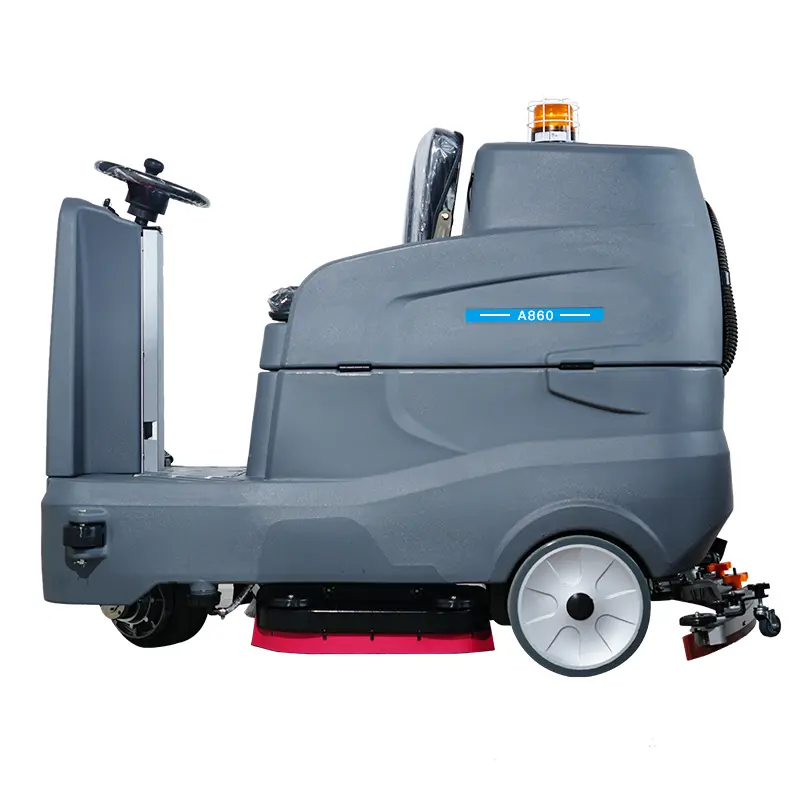
- Size to within 10 to 15 percent of your actual requirement. Oversizing costs money, undersizing costs uptime.
- Always convert manufacturer productivity ratings down to real-world output before sizing anything.
- Battery runtime and tank capacity fail in different ways. Check both, not just the one you think is tight.
Step 1: Calculate Real Cleaning Area Per Shift
Start from the total floor area and discount it twice. First for obstacles such as racking, machinery and aisle structure, then again for the gap between the manufacturer productivity rating and what a machine actually delivers once it turns, overlaps and stops.
| Parameter | Example | Your Facility |
|---|---|---|
| Total floor area | 8,000 sqm | fill in |
| Obstacle factor | 15 percent | fill in |
| Effective cleaning area | 8,000 x 0.85 = 6,800 sqm | fill in |
| Machine rated productivity | 4,900 sqm/h (K660) | fill in |
| Real world factor | 65 percent | fill in |
| Real productivity | 4,900 x 0.65 = 3,185 sqm/h | fill in |
| Cleaning time required | 6,800 / 3,185 = 2.1 hours | fill in |
Step 2: Calculate Required Battery Runtime
Runtime has to exceed cleaning time with a 20 percent margin for obstacles, re-cleaning and operator breaks. The Aikerui K660 and A660 both carry a 24 volt 150 amp hour battery rated for 3 to 5 hours, while the A860 and A800R carry a 24 volt 800 amp hour battery.
The larger pack does not simply run longer. The A860 drives higher wattage motors, 550 watts per brush against 450 watts, and a 600 watt vacuum against 500 watts, so much of the extra capacity is consumed by the extra load. That is why both classes land in a similar runtime band.
| Model | Battery | Rated Runtime | Needed for 2.1 h Plus 20 Percent | Sufficient |
|---|---|---|---|---|
| K660 | 24V / 150AH | 4 to 5 hours | 2.5 hours | Yes |
| A660 | 24V / 150AH | 3 to 4 hours | 2.5 hours | Yes |
| A650R | 24V / 150AH | 3 to 4 hours | 2.5 hours | Yes |
| A860 | 24V / 800AH | 3 to 4 hours | 2.5 hours | Yes |
| A800R | 24V / 800AH | 3 to 4 hours | 2.5 hours | Yes |
Step 3: Calculate Clean Water Tank Capacity
Tank size follows solution flow rate, and flow rate follows how dirty the floor is. Light dust on a smooth sealed floor needs roughly 0.5 to 0.8 litres per minute. Heavy oil and tyre marks can take 1.2 to 2.0 litres per minute. Post-construction cleanup can exceed 2.5 litres per minute.
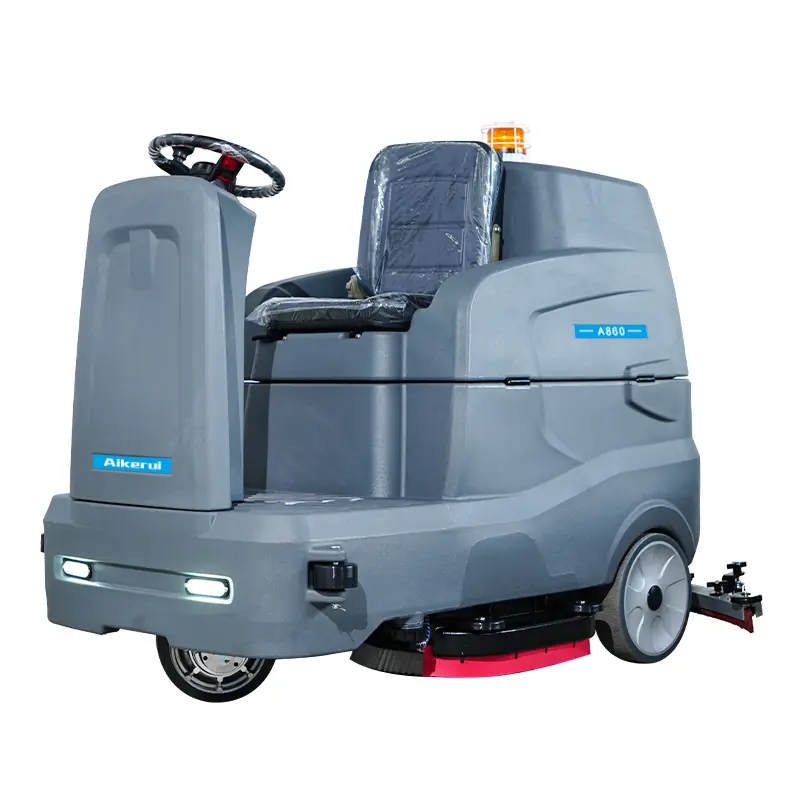
Multiply flow rate by cleaning time and add a 10 percent margin. For the 8,000 sqm example at normal soil levels, the K660 with its 90 litre tank needs roughly one refill mid shift, while the A860 with 160 litres completes the same job without refilling.
| Scenario | Flow Rate | Cleaning Time | Required Tank | K660 90 L Sufficient |
|---|---|---|---|---|
| Light soil | 0.7 L/min | 126 min | 97 L | Marginal, one refill |
| Normal soil | 1.0 L/min | 126 min | 139 L | One refill needed |
| Heavy soil | 1.5 L/min | 126 min | 208 L | Two refills needed |
| Construction | 2.5 L/min | 126 min | 347 L | Three to four refills |
Step 4: Calculate Recovery Tank Capacity
The recovery tank must hold everything the clean tank releases, plus the soil pulled off the floor and any foam the chemical generates. A ratio below 1.2 means the recovery tank can fill before the clean tank empties, and the float shutoff will stop your work early.
| Model | Clean Tank | Recovery Tank | Ratio | Assessment |
|---|---|---|---|---|
| K660 | 90 L | 110 L | 1.22 | Adequate |
| A660 | 90 L | 110 L | 1.22 | Adequate |
| A860 | 160 L | 180 L | 1.13 | Tight for heavy foam |
| A800R | 160 L | 180 L | 1.13 | Tight for heavy foam |
| B260R60 | 200 L | 260 L | 1.30 | Optimal |
Step 5: Match Machine to Facility Size
With real productivity and tank figures in hand, the machine class follows directly from floor area. Use the K660 class for up to roughly 8,000 square metres per shift, and step up to the A860 class beyond that.
| Floor Area | Cleaning Time | Recommended Model | Refills | Battery Margin |
|---|---|---|---|---|
| 2,000 to 3,000 sqm | 0.6 to 1.0 h | K660 or walk-behind | 0 | Over 300 percent |
| 3,000 to 5,000 sqm | 1.0 to 1.6 h | K660 | 0 to 1 | Over 200 percent |
| 5,000 to 8,000 sqm | 1.6 to 2.5 h | K660 or A860 | 1 to 2 | Over 150 percent |
| 8,000 to 12,000 sqm | 2.5 to 3.8 h | A860 | 1 to 2 | Over 120 percent |
| 12,000 to 20,000 sqm | 3.8 to 6.3 h | A860 plus spare battery | 2 to 3 | 80 percent, swap needed |
Charging Time Limits Daily Shifts
Charging time is the constraint most buyers overlook. A machine that needs 7 to 8 hours to charge cannot run two shifts a day on one battery, no matter how good its rated runtime looks on paper. The K660 and A660 charge in 5 to 6 hours and can support two shifts. The A860 and A800R need 7 to 8 hours and realistically cover one shift only, unless you keep a spare pack for hot swapping.
- Two-shift operation on the A860 requires a second battery pack, budgeted from the start.
- Charging time is a fixed property of the battery and charger, not something you can tune later.
- Hot swapping needs a safe lifting arrangement. The 800 amp hour packs are heavy.
Five Sizing Mistakes
These are the five errors that show up most often when facilities size a ride-on scrubber without doing the arithmetic first.
- Using the manufacturer productivity rating as if it were achievable. Real output runs at 55 to 65 percent of the rated figure.
- Sizing the tank from floor area alone, without deciding the solution flow rate that floor actually needs.
- Assuming a larger battery always means longer runtime. Higher wattage motors consume the extra capacity.
- Ignoring charging time when planning a two-shift schedule.
- Forgetting that a machine sized for 12,000 sqm is slow and awkward in a 2,000 sqm facility, and wastes battery cycles.
How Do I Work Out My Solution Flow Rate?
Fill the clean tank, run at the default setting and time how long the tank lasts. A 90 litre tank emptying in 90 minutes means 1.0 litre per minute. Adjust up if the floor is still dirty, down if it dries too slowly. Compare the measured figure with the flow rate listed in the machine specification: the specification value is what the pump delivers at full opening, and the measured value is what the floor actually receives at your working setting.
What Happens if the Recovery Tank Fills Before the Clean Tank?
The float shutoff stops the vacuum to protect the motor, and the shift ends early. Three causes explain almost every case: too much solution for the soil load, a foaming chemical, or unusually heavy soil that carries more solids into the tank. Reduce the flow, switch to a low-foam product, or dump mid shift. On a correctly sized machine the two tanks run out at about the same time, which is why the recovery tank is normally the larger of the two.
Can I Fit a Bigger Battery Than the Factory Specification?
Only if the battery compartment and the electrical system support it, and the charger is rated for the new capacity. A larger pack on an undersized charger never reaches full charge, so the extra capacity is wasted and the plates sulfate. Confirm with the manufacturer first: a heavier pack also changes the centre of gravity and can affect the warranty position.
How Accurate Are Manufacturer Productivity Ratings?
They are theoretical maximums, calculated as working width multiplied by maximum travel speed, and they assume continuous straight-line running with no stops. Use 60 percent of the figure for any facility sizing calculation. A 4,900 square meter per hour rating describes a machine that never turns, never overlaps a pass and never stops to empty a tank, which no real facility allows.
Why Does a Bigger Battery Not Multiply Runtime?
Because amp hours only describe stored energy. A larger machine also carries higher wattage brush and vacuum motors, so its current draw rises with its battery. Net runtime lands within roughly an hour across the class, not as a multiple. Aikerui has manufactured floor scrubbers since 2008 in a facility of more than 10,000 square meters, exports to more than 50 countries, and holds CE and ISO 9001 certification, and can configure battery options at the factory for different runtime targets.
Related Guides
Browse Machines by Type
Ready to Get Factory-Direct Pricing?
Get a quote within 24 hours. No middlemen — buy direct from the manufacturer and save 30-50%.
About the Author
Mark Wang is Sales Director at Aikerui with 15+ years of experience in industrial floor cleaning equipment. He has helped 2,000+ facilities across 50+ countries source factory-direct cleaning equipment.
About Aikerui
Aikerui is an industrial cleaning equipment manufacturer founded in 2008, operating its own 10,000+ square meter production facility in Anqing, Anhui, China. It manufactures floor scrubbers, sweepers and replacement parts, holds CE and ISO 9001 certification, and exports to 50+ countries. Every guide on this site is written by the manufacturer's own team — not a third-party agency.