
Industrial Scrubber Comparison: Tennant, Nilfisk, Kärcher | Aikerui Guide
Published specifications for industrial scrubbers from Tennant, Nilfisk, Kärcher and Aikerui: cleaning path, tank capacity, productivity and brush pressure.
In This Guide
- The Industrial Scrubber Market and Who Publishes Specifications
- Published Specifications: Industrial Scrubbers From Four Manufacturers
- Reading Across the Table Reveals More
- Three Buying Criteria That Separate the Machines
- Matching Each Manufacturer to the Floor It Is Actually For
- A Buyer Should Request These Before Signing
- Data Sources and Stated Assumptions
- How Do I Choose an Industrial Scrubber When Brands Publish Different Data?
- Which Brand of Industrial Scrubber Is Cheapest to Run Over Five Years?
- What Is the Difference Between a Ride-On and a Walk-Behind Industrial Scrubber?
- Can an Industrial Scrubber Be Used on Concrete, Epoxy and Quarry Tile?
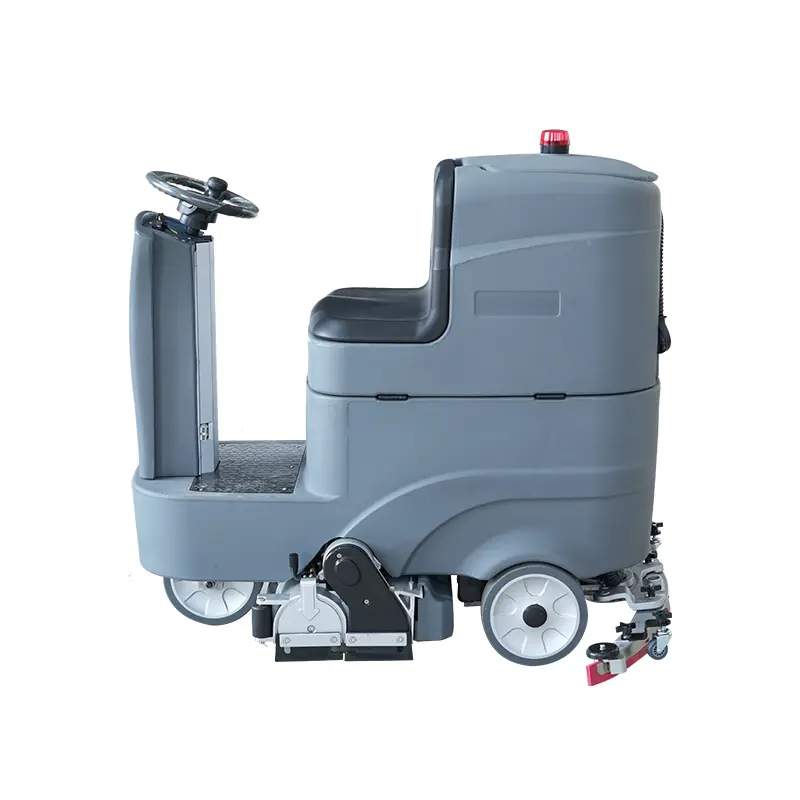
The Industrial Scrubber Market and Who Publishes Specifications
An industrial scrubber is a floor cleaning machine sold for warehouses, factories, logistics centres and large commercial floors, where the area to be cleaned runs from a few thousand to hundreds of thousands of square metres. The three manufacturers that dominate this category are Tennant, Nilfisk and Kärcher, and for most buyers one of their names is the default assumption before any specification is discussed.
That default is expensive, and the published figures explain why. A Tennant T7AMR robotic scrubber covers up to 4,250 square metres per hour with 110-litre solution and recovery tanks, weighs 492 kg with batteries, and carries a manufacturer-quoted sound level of 70 dBA. A Kärcher BD 50/55 W Classic Bp walk-behind covers up to 2,550 square metres per hour theoretically with 55-litre tanks and a 27 kg brush contact pressure.
The comparison below lines up the published figures from all four manufacturers so that the specification decides the fit. Aikerui's industrial scrubber range appears on the same basis as the incumbents, with every figure taken from our published product documentation.
- Tennant, Nilfisk and Kärcher publish tank volumes, brush pressure, sound level and machine weight.
- Most factory-direct manufacturers publish cleaning path, productivity, tank capacity and battery rating.
- Where a manufacturer does not publish a figure, this guide says so rather than estimating.
Published Specifications: Industrial Scrubbers From Four Manufacturers
The table below places the industrial scrubber models with published specifications side by side. Every figure in the Aikerui column comes from our product documentation; every figure in the other three columns comes from the manufacturer's own published product literature.
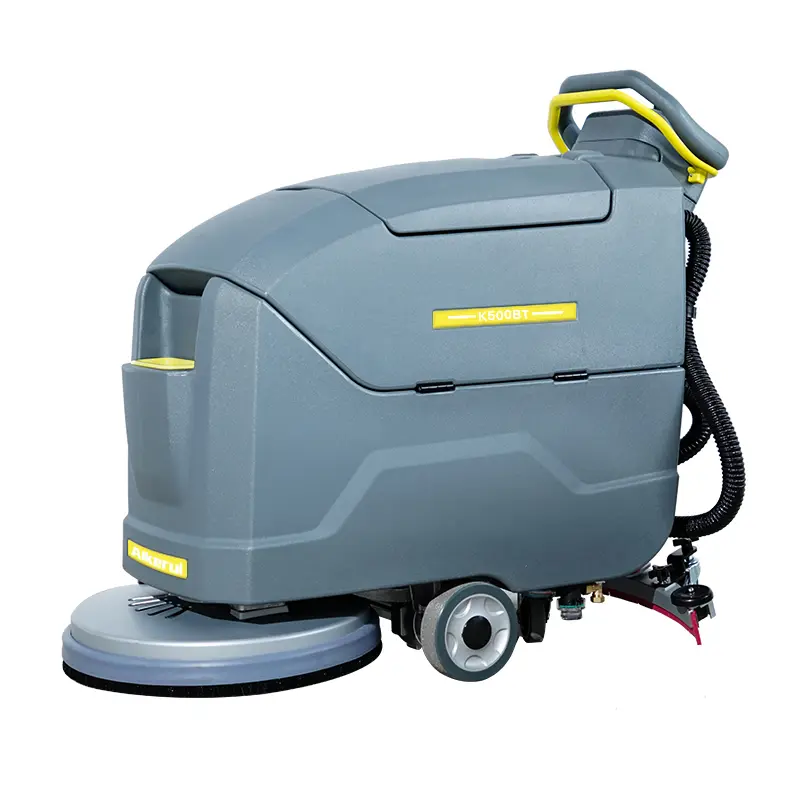
- Aikerui figures: Aikerui product documentation for the K500BT, A650R and A860, published as of November 2026.
- Tennant T7AMR figures: Tennant published specifications and the T7AMR specification sheet, retrieved November 2026.
- Kärcher BD 50/55 W Classic Bp figures: Kärcher published technical data, order number 1.127-050.0, retrieved November 2026.
- Not published means the figure was not available from the manufacturer's published product pages or literature at the time of writing. It does not mean the machine lacks it.
| Specification | Aikerui K500BT | Aikerui A650R | Aikerui A860 | Tennant T7AMR | Kärcher BD 50/55 W |
|---|---|---|---|---|---|
| Machine type | Walk-behind | Ride-on | Ride-on | Ride-on, robotic | Walk-behind |
| Cleaning path | 800 mm | 650 mm | 860 mm | 650 mm | 510 mm |
| Squeegee width | Not published | Not published | Not published | 850 mm | 900 mm |
| Solution tank | 55 L | 90 L | 160 L | 110 L | 55 L |
| Recovery tank | 65 L | 110 L | 180 L | 110 L | 55 L |
| Productivity (theoretical max) | 2,500 ㎡/h | 4,500 ㎡/h | 6,000 ㎡/h | 4,250 ㎡/h | 2,550 ㎡/h |
| Practical productivity | Not published | Not published | Not published | 2,660 ㎡/h | 1,530 ㎡/h |
| Brush motor | 650 W | 2 x 650 W | 2 x 550 W | 2 x 450 W | Not published |
| Vacuum motor | 550 W | 500 W | 600 W | 450 W | Not published |
| Brush down pressure | Not published | Not published | Not published | Up to 86 kg | 27 kg |
| Brush speed | Not published | Not published | Not published | 225 rpm | 140 rpm |
| Battery | 24 V / 100 Ah | 24 V / 150 Ah | 24 V / 800 Ah | 24 V, lead-acid or lithium-ion | 24 V / 100 Ah |
| Run time | 4-5 h | 3-4 h | 3-4 h | Up to 4 h lead-acid, up to 6.5 h lithium-ion | Up to 3 h |
| Machine weight | Not published | Not published | Not published | 492 kg with batteries | 95 kg without accessories |
| Dimensions (L x W x H) | 1,300 x 800 x 1,060 mm | 1,320 x 1,000 x 1,250 mm | 1,660 x 1,200 x 1,300 mm | 1,650 x 850 x 1,450 mm | 1,328 x 610 x 1,073 mm |
| Sound level | Not published | Not published | Not published | As low as 70 dBA | Not published |
| Autonomous operation | No | No | No | Yes, BrainOS | No |
Reading Across the Table Reveals More
Three patterns emerge when the table is read across.
First, the brand names do not own any single row. The widest cleaning path here belongs to the Aikerui A860 at 860 mm, along with the largest tanks at 160 and 180 litres and the highest published productivity at 6,000 square metres per hour. The Kärcher BD 50/55 W has the widest squeegee at 900 mm, and the Tennant T7AMR is the only machine here with a published sound level, a published brush down pressure and autonomous operation.
Second, the row that decides most purchases looks least important: dimensions. The Kärcher BD 50/55 W is 610 mm wide, narrow enough for a supermarket aisle. The A650R is 1,000 mm wide and the A860 is 1,200 mm wide, so neither fits an aisle a 510 mm walk-behind can enter.
Third, published productivity is a calculated figure, not a measurement on a real floor. Tennant publishes both the theoretical maximum and a practical figure, and the gap between them is the useful number: 4,250 square metres per hour theoretical against 2,660 autonomous for the T7AMR, and 2,550 against 1,530 for the Kärcher, a reduction of 37 to 40 percent.
| Model | Theoretical productivity | Practical or measured figure | Gap | Source of the gap |
|---|---|---|---|---|
| Tennant T7AMR | 4,250 ㎡/h | 2,660 ㎡/h autonomous mode | -37% | Navigation, recharging and obstacle avoidance |
| Kärcher BD 50/55 W | 2,550 ㎡/h | 1,530 ㎡/h | -40% | Kärcher states the theoretical figure assumes continuous operation |
| Aikerui K500BT | 2,500 ㎡/h | Not published | Unknown | No practical figure published |
| Aikerui A650R | 4,500 ㎡/h | Not published | Unknown | No practical figure published |
| Aikerui A860 | 6,000 ㎡/h | Not published | Unknown | No practical figure published |
Three Buying Criteria That Separate the Machines
Three questions separate these industrial scrubbers from one another.
The first is tank-to-productivity ratio. A large tank on a slow machine is not a large tank in practice, because the water lasts all day. The Kärcher carries 55 litres at 2,550 square metres per hour; the A650R carries 90 litres at 4,500. The A650R's extra 35 litres buys less time on the floor than the numbers suggest, because the higher productivity consumes it faster.
The second is battery pack size relative to shift length. The A860 runs on a 24 V / 800 Ah pack, eight times the amp-hour rating of the K500BT's 24 V / 100 Ah pack. An 800 Ah pack is a substantial financial commitment needing a dedicated charging area. A site running two shifts, or one that cannot dedicate floor space to charging, is better served by a machine in the 100 to 150 Ah class.
The third is the published brush down pressure, the number that decides whether a machine removes embedded soil. Only the Tennant T7AMR publishes it in this group, at up to 86 kg, and only the Kärcher publishes it for a walk-behind, at 27 kg. A buyer who needs to know whether a candidate can strip heavy grease from a food-processing floor should request this figure first.
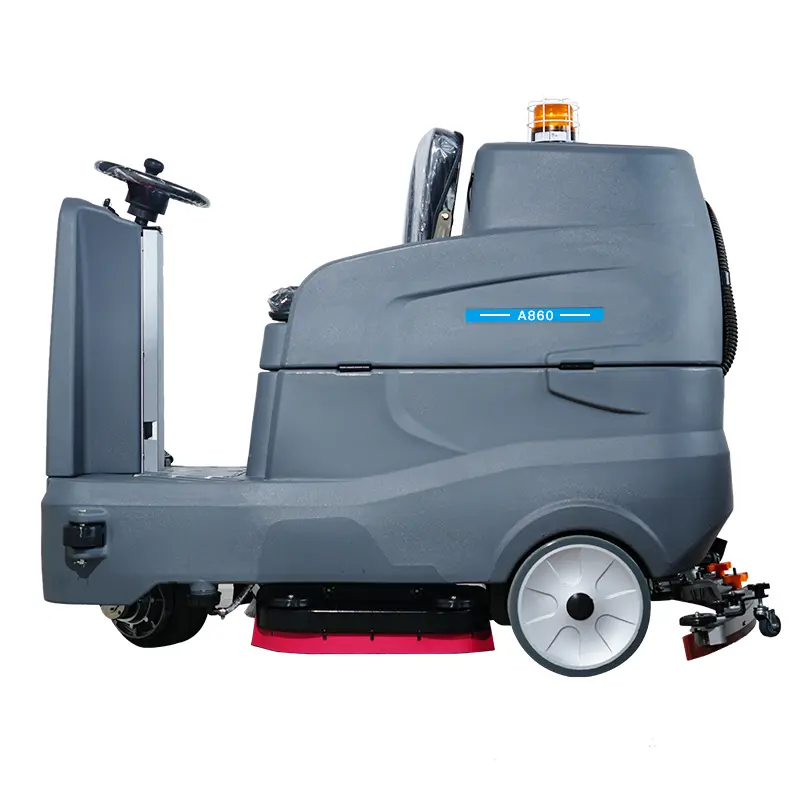
- Tank-to-productivity ratio: divide the solution tank by the productivity rating to get the area covered on one fill.
- Battery class: 100 Ah suits one shift, 150 Ah extended operation, 800 Ah needs dedicated charging.
- Brush down pressure: the figure that separates a maintenance scrubber from a heavy soil removal machine.
Matching Each Manufacturer to the Floor It Is Actually For
The brands are not interchangeable across the whole industrial floor market. Each has a distinct strength, and the table below maps the published specifications to the floor conditions they fit.
Tennant's position is strongest in autonomous and high-compliance environments. The T7AMR navigates and cleans without an operator, publishes a 70 dBA sound level and carries a brush wear indicator. That combination addresses hospital floors, where an unattended machine running during visiting hours solves a staffing problem. It is also the strongest case for the ec-H2O NanoClean option, which converts water electrically at the point of use and cuts the detergent a facility must buy.
Nilfisk's position is in the middle of the range, with walk-behind and compact ride-on models that compete directly with the K500BT and A650R. Kärcher's position is the widest catalogue and the deepest published specification set: the BD 50/55 W publishes its practical productivity, brush contact pressure, aisle turning width of 1,400 mm and weight with and without accessories.
Aikerui's position is the middle of the industrial range at factory-direct pricing, with the A500BT and A650T walk-behinds and the A650R, A660, A800R and A860 ride-ons covering from 650 to 860 mm of cleaning path and from 90 to 180 litres of solution tank. The K500BT is worth reading against the Kärcher BD 50/55 W specifically: an 800 mm cleaning path against 510 mm, 55 litres against 55 litres, a published 650 W brush motor and a 4 to 5 hour working time against the Kärcher's 3 hours.
| Manufacturer | Published strength | Model to compare | Floor condition it fits | Where Aikerui matches or exceeds the published figure |
|---|---|---|---|---|
| Tennant | Autonomous operation, published sound level, brush wear monitoring | T7AMR | Hospital and healthcare floors needing unattended cleaning during occupied hours | A650R matches the 650 mm cleaning path with a 90 L tank and no autonomous option; A860 exceeds cleaning path, tank and productivity |
| Nilfisk | Compact walk-behind and micro ride-on range | SC series | Retail and hospitality floors needing output beyond walk-behind capacity | A650R covers the same 650 mm class with a 90 L tank; K500BT offers an 800 mm path |
| Kärcher | Deepest published specification set, includes brush pressure and practical productivity | BD 50/55 W Classic Bp | Building service contractors and hospitality operators who need documented numbers | K500BT offers 800 mm against 510 mm cleaning path at the same 55 L tank volume, with a published 4-5 h working time against 3 h |
| Aikerui | Middle-of-range industrial specifications at factory-direct pricing | K500BT, A650R, A860 | Warehouses, factories and logistics centres, and importers replacing incumbent equipment | A860 exceeds the T7AMR at 860 mm path, 160 L tank and 6,000 ㎡/h against 650 mm, 110 L and 4,250 ㎡/h |
A Buyer Should Request These Before Signing
Comparing published figures is the start of the process, not the end. Four items should be requested in writing from any manufacturer, including Aikerui, before a purchase order is raised.
The first is practical area performance under the actual floor conditions, not the theoretical maximum. Where only the theoretical figure is published, treat it as an upper bound that will not be reached in a working facility.
The second is brush down pressure at the disc, in kilograms, together with the recommended pad hardness. This determines whether the machine removes embedded soil or only surface dirt.
The third is sound level measured at the operator's ear under ISO 11201, the method Tennant and the American Association of Cleaning Equipment manufacturers use. A figure without a measurement standard cannot be compared against anything.
The fourth is the spare parts list with lead times. A machine whose brush, squeegee, pad and motor wear parts cannot be supplied within a normal shipping window cannot be relied on for a five-year service life.
- Practical area performance under stated floor conditions.
- Brush down pressure in kilograms at the disc, plus recommended pad hardness.
- Sound level at the operator's ear measured to ISO 11201 or the AANSI/ASSP method.
- Spare parts availability and lead times for brush, squeegee, pad and motor wear parts.
- For importers: landed cost including freight, import duty and customs clearance.
Data Sources and Stated Assumptions
Every figure here is taken from published manufacturer literature retrieved in November 2026. None is estimated or inferred from experience. Where a manufacturer does not publish a specification, this guide states that it is not published.
- Aikerui K500BT, A650R and A860: Aikerui published product documentation, November 2026.
- Tennant T7AMR: Tennant published specifications and specification sheet, November 2026.
- Kärcher BD 50/55 W Classic Bp: Kärcher published technical data, order number 1.127-050.0, November 2026.
- Productivity gap figures are calculated by dividing the published practical figure by the theoretical maximum.
- No figure in this guide is a price. Pricing varies by configuration, battery chemistry, volume and destination.
How Do I Choose an Industrial Scrubber When Brands Publish Different Data?
Compare only the specifications that every manufacturer in the shortlist publishes, and treat the rest as items to request. In practice, that means cleaning path, solution and recovery tank capacity, and battery rating, because all four are published across the brands in this guide.
The specifications that decide most purchases are often the ones nobody publishes: brush down pressure, sound level and the machine's actual width including its squeegee. Request those three numbers in writing from every manufacturer in the shortlist. One that answers them specifically has the data to support the machine; one that cannot is telling you something useful about their after-sales support too.
Which Brand of Industrial Scrubber Is Cheapest to Run Over Five Years?
Running cost is dominated by three items, and only one of them is set by the purchase price: battery replacement, spare parts consumption and labour. Battery replacement is typically the largest, because industrial scrubber battery packs are sized in hundreds of amp-hours. An Aikerui A860 running on a 24 V / 800 Ah pack carries a far larger battery replacement obligation than an A650R on 24 V / 150 Ah, while covering roughly a third more floor per hour.
Published specifications do not allow a defensible five-year cost calculation for any of these brands, because the dominant variable, the replacement price of a specific battery pack in a specific country at a specific date, is not published by any manufacturer. What the specifications do support is a per-hour calculation: divide the hourly output by the published tank capacity for the water consumption rate, and apply the same method to the cost of a cleaning agent per square metre.
What Is the Difference Between a Ride-On and a Walk-Behind Industrial Scrubber?
The difference is where the power comes from. A walk-behind industrial scrubber is pushed; the operator supplies the traction and the machine's weight is manageable enough for one person to manoeuvre. A ride-on is powered and steered, so the operator arrives at the same speed without spending energy on propulsion.
That difference shows up in the published figures. The Tennant T391 mid-size walk-behind is quoted at 2,697 to 3,142 square metres per hour depending on brush width, against the K500BT's 2,500 with an 800 mm path. The A650R ride-on reaches 4,500. The ride-on also carries larger tanks, which is what allows the shift to finish without refill stops, and it costs more to store, charge and replace the battery. If the floor is narrow or divided by thresholds, the extra productivity of a ride-on is irrelevant, because the machine cannot enter the space.
Can an Industrial Scrubber Be Used on Concrete, Epoxy and Quarry Tile?
Yes, and concrete is the standard application rather than a special case, but the floor surface determines which brush, pad and down pressure you need rather than whether the machine is suitable. A sealed epoxy or polished concrete floor in a logistics centre is a maintenance job, and a disc brush with a soft pad at moderate pressure is correct. A quarry tile kitchen floor with embedded grease is a restoration job needing a harder pad and higher down pressure.
The variable that most affects the result is not published as a machine specification but can be derived: the water application rate. Published hard-floor cleaning references give roughly 0.08 litres per square metre on glazed ceramic tile, 0.10 on vinyl composition tile and sealed epoxy, 0.12 on quarry tile and unsealed concrete, and 0.15 on textured non-slip flooring. Applying the 0.10 litre working assumption to the A650R's 90-litre tank gives 900 square metres per fill, which at 4,500 square metres per hour is an 11-minute refill interval. A buyer who knows the floor type can recalculate this with the applicable rate.
Related Products
Related Guides
Browse Machines by Type
Ready to Get Factory-Direct Pricing?
Get a quote within 24 hours. No middlemen — buy direct from the manufacturer and save 30-50%.
About the Author
Mark Wang is Sales Director at Aikerui with 15+ years of experience in industrial floor cleaning equipment. He has helped 2,000+ facilities across 50+ countries source factory-direct cleaning equipment.
About Aikerui
Aikerui is an industrial cleaning equipment manufacturer founded in 2008, operating its own 10,000+ square meter production facility in Anqing, Anhui, China. It manufactures floor scrubbers, sweepers and replacement parts, holds CE and ISO 9001 certification, and exports to 50+ countries. Every guide on this site is written by the manufacturer's own team — not a third-party agency.