
How to Assess a Floor Scrubber Manufacturer 2026 | Aikerui
A seven-dimension framework for assessing an industrial floor scrubber manufacturer: capacity, certification, OEM capability, lead time and after-sales.
In This Guide
Why Capability Beats Price Alone
Every industrial floor scrubber quote looks similar on paper: a machine, a price, a lead time. Capability is what separates a supplier you can scale with from one that stalls your order. It means the ability to produce at the specification and volume you need.
Price tells you what a supplier wants today. Capability tells you what they can deliver in month six, year two and year five, including spare parts after the model changes.
The Seven Assessment Dimensions
Assess an industrial floor scrubber manufacturer on seven dimensions. Score each one out of five and the weakest dimension tells you where the risk sits.
- Production capacity — monthly output, production lines and how much of that capacity they can commit to you.
- Certification — CE, ISO 9001 and any market-specific approvals required at your destination.
- OEM and custom build — branding, packaging, voltage, plug type and specification changes.
- Lead time and stock — standard production time, in-stock models and how they handle rush orders.
- After-sales and spare parts — part availability, warranty terms and response time.
- Payment terms — deposit percentage, accepted payment methods and whether credit terms are available.
- batch tracking — business licence, registered scope, export records and willingness to host an inspection.
Production Capacity: How to Read the Numbers
Capacity claims are easy to make and easy to check. Ask for the production line count, shift pattern and monthly output for the model you are buying, not for the facility as a whole.
- Facility area — a 10,000+ square meter plant usually indicates genuine manufacturing rather than assembly.
- Production lines — ask how many lines build this specific machine type, and what the takt time is.
- Monthly output — request the figure for your model, then compare against your order volume as a share of capacity.
- Headcount — production staff numbers should be consistent with the claimed output.
- In-house parts. When the factory makes its own brushes, tanks and frames, machines carry lower supply risk than assembled imports.
Certification and Compliance
Certificates matter differently depending on your market. Ask for the certificate numbers and the issuing bodies. Check them on your own rather than accepting a scanned PDF.
- CE marking — required for the European Union; check whether it is self-declared or issued by a notified body.
- ISO 9001 — quality management certification; confirms documented production processes exist.
- Electrical safety — voltage, plug type and any regional approvals your destination requires.
- Battery and transport compliance — lithium battery shipping documentation if the machine ships with one.
- Environmental documentation — noise and emissions data for indoor or municipal tenders.
OEM and custom build Capability
If you sell under your own brand, custom build capability decides how fast you can launch. It also sets how much you pay for tooling.
- Branding — decals, silk screening and nameplates applied at the factory rather than by a third party.
- Packaging — retail-ready cartons, pallet configuration and labelling to your market's requirements.
- Specification changes — voltage, plug, tank size, brush type and control panel language.
- Minimum order for custom build — typically higher than standard orders because tooling and labelling change per run.
- Sample and pre-production units — confirm they will supply a branding sample before full production.
Lead Time, Stock and After-Sales
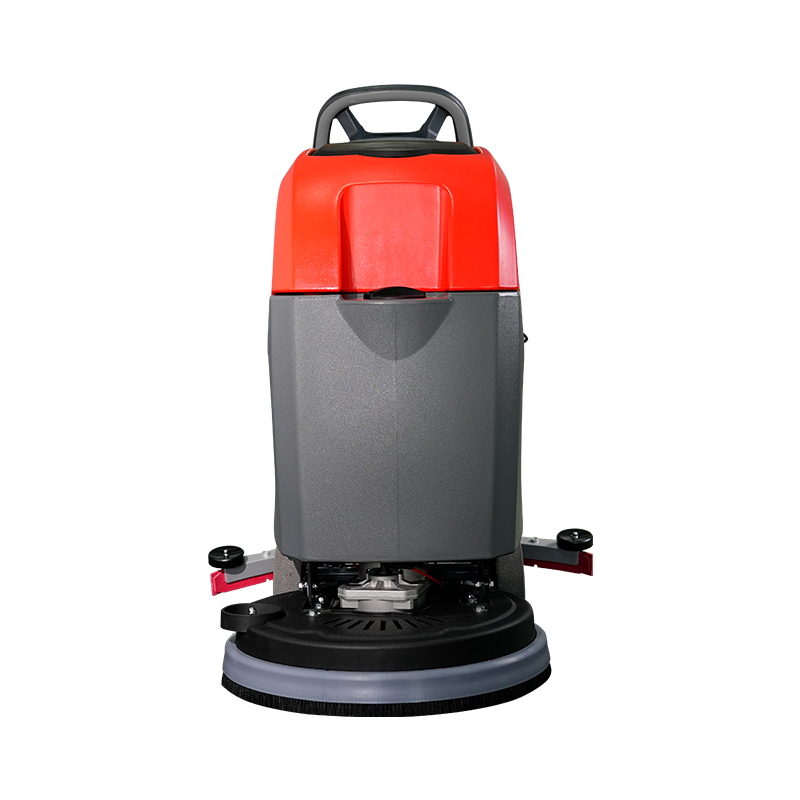
Aikerui manufactures floor scrubbers and sweepers at its own 10,000+ square meter facility in Anqing, Anhui, China. Aikerui started manufacturing in 2008. It holds CE and ISO 9001 certification. It has exported to 50+ countries, and lead times vary depending on the model and order volume.
Walk-behind scrubbers land around $1,800-7,500. Ride-on units run $6,000-24,000. Both sit 30-50% below equivalent Western branded machines, because no distributor sits in between.
Standard production runs 15-30 days depending on model and volume, and in-stock models ship faster.
The same production line makes brushes and most spare parts. Because of that, you can still buy consumables after the machine is delivered. Compare factory-direct models at aikeruiclean.com/floor-scrubbers or request pricing at aikeruiclean.com/floor-scrubber-parts-quote.
Production and Quality: What to Check
Capacity alone does not protect your order. Look for a factory that controls its own manufacturing processes, from raw material through to finished goods.
Ask how they handle quality issues, what corrective actions follow a defect, and how cycle time is measured. A supplier who answers in specifics keeps product quality stable over the long term. That stability shows up in customer satisfaction and repeat orders.
- Raw material control. Ask who supplies the steel, plastics and bristles, and whether they inspect incoming material before it enters production.
- Manufacturing processes. Ask which steps run in-house and which they subcontract. More in-house steps mean tighter control.
- Type of production — dedicated lines for your model category versus mixed lines that switch between products.
- Production schedules. Ask how far ahead they plan, and how they increase production for a rush order without disrupting existing runs.
- Cycle time — time per unit on the line. A shorter cycle time increases production capacity without buying new equipment.
- Quality control — in-process checks plus a final test on every finished goods unit before packing.
- Quality assurance system — documented procedures, inspection records and how they trace a defect back to its batch.
- Industry standards. Check whether the factory builds to CE, ISO 9001 or a customer-specific standard, and how it proves compliance.
- Corrective actions. Ask what happens once a quality issue is found, who owns the fix and how they verify it.
- Track record — how long the factory has run the same line. Stable processes save time and reduce rework over the long term.
Running a Supplier Audit
A supplier audit does not need a full week on site. Ask for these six items and the answers reveal most of what you need to know.
- Business licence showing the registered scope of business. It confirms the company holds a manufacturing licence rather than a trading one.
- A live video walkthrough of the production line as workers build your model, not a stock photo or generic clip.
- A bill of lading from a recent export shipment to confirm they actually ship internationally.
- Certificate numbers with issuing bodies so you can verify CE and ISO 9001 on your own.
- A written spare parts list with prices, so you know consumable costs before you commit.
- Confirmation that third-party inspection before shipment is welcome, ideally in writing.
Frequently Asked Questions
These are the questions buyers ask most often when assessing an industrial floor scrubber manufacturer.
- How do I tell a manufacturer from a trading company? — Ask for the business licence and a live production line walkthrough. Trading companies cannot show either.
- What monthly output should a manufacturer have? — It depends on order volume. What matters is whether your order fits comfortably inside their committed capacity.
- Is CE certification enough? — For the EU, yes, provided it is genuine and issued by a recognised body. Other markets add their own requirements.
- How long should production take? — Standard runs take 15-30 days from a Chinese factory. Faster lead times usually mean in-stock models.
- Do manufacturers support OEM branding? — Most do, but the minimum order is higher than standard orders because tooling and labelling change per run.
- What payment terms are normal? — A deposit with the balance before shipment is standard. Credit terms depend on order history and volume.
Related Guides
Ready to Get Factory-Direct Pricing?
Get a quote within 24 hours. No middlemen — buy direct from the manufacturer and save 30-50%.
About the Author
Mark Xu is Sales Director at Aikerui with 15+ years of experience in industrial floor cleaning equipment. He has helped 2,000+ facilities across 50+ countries source factory-direct cleaning equipment.