
Compact Floor Scrubber: Sizing, Aisle Width and Models | Aikerui Guide
Compact floor scrubbers fail on aisle width, tank size and refill time, not brush power. Compare A380, A518, A330 and A400 on published specifications.
In This Guide
- What Makes a Floor Scrubber Compact
- The Four Constraints That Decide a Compact Machine
- Published Specifications for Four Compact Models
- Working Width, Cleaning Path and Doorway Clearance
- Tank Volume Sets the Refill Interval, Not the Runtime
- Runtime and Charging in a Real Shift
- Noise: The Specification Compact Buyers Forget
- Transport and Storage Between Sites
- Where a Compact Machine Stops Being the Right Answer
- Where These Numbers Come From
- What Is the Smallest Model, and What Can It Clean?
- Can a Compact Scrubber Clean a 1,000 Square Meter Floor?
- What Is the Difference Between the A518 and the A330?
- Do Compact Scrubbers Need a Dedicated Charging Point?
- Is a Compact Scrubber Quiet Enough to Use in an Office?
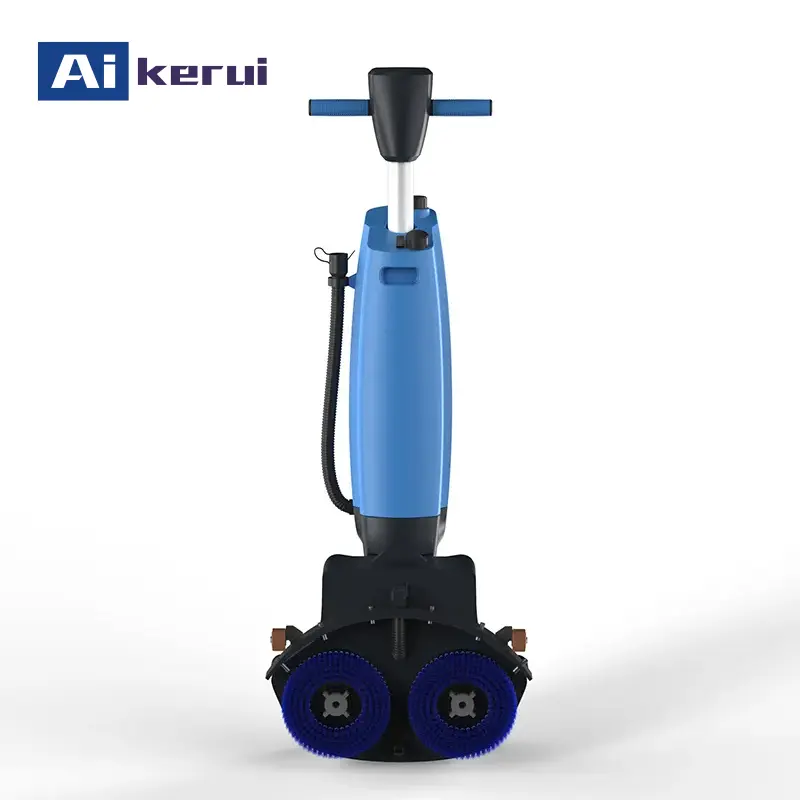
What Makes a Floor Scrubber Compact
Compact is not a marketing label with a fixed definition. In catalogue terms it describes machines at the small end of the walk-behind range, and the boundary is usually drawn at a brush width of about 500 mm and a body weight one person can move without help.
The Aikerui compact models sit between 380 mm and 520 mm of brush width, and between 10 kg and 76 kg of net weight. That span matters, because two machines both sold as compact can differ by a factor of seven in weight and by a factor of five in tank volume, and those two numbers decide where the machine can go and how long it can run.
What makes a compact machine useful is not that it cleans less. It is that it fits: through a service door, into a lift, around racking, and into the back of a vehicle.
- Brush width under about 520 mm, so the machine passes a standard service door without being lifted.
- Net weight the operator can move unaided, which in practice means under about 30 kg for machines carried between levels.
- Tank volume small enough to fill from a sink rather than a hose point.
The Four Constraints That Decide a Compact Machine
Buyers usually compare brush width and price. On a compact machine four other numbers decide whether it is usable at all, and all four are published in the specification.
| Constraint | What it governs | Aikerui figures to check | Where it bites |
|---|---|---|---|
| Body width | Whether the machine enters the area at all | 410 to 600 mm | Service corridors, back-of-house, between racking |
| Clean tank | Minutes of cleaning between refills | 5 to 25 L | Large floors with no tap nearby |
| Net weight | Whether one person can move it between levels | 10 to 76 kg | Stairs, lifts, vehicle loading |
| Noise | Whether it can run while the space is occupied | 63 to 68 dB | Offices, clinics, retail during trading hours |
Published Specifications for Four Compact Models
The table uses the published Aikerui specification for each model. Cleaning path is the brush width, which sets productivity. Working width is measured across the widest part of the machine with the deck down.
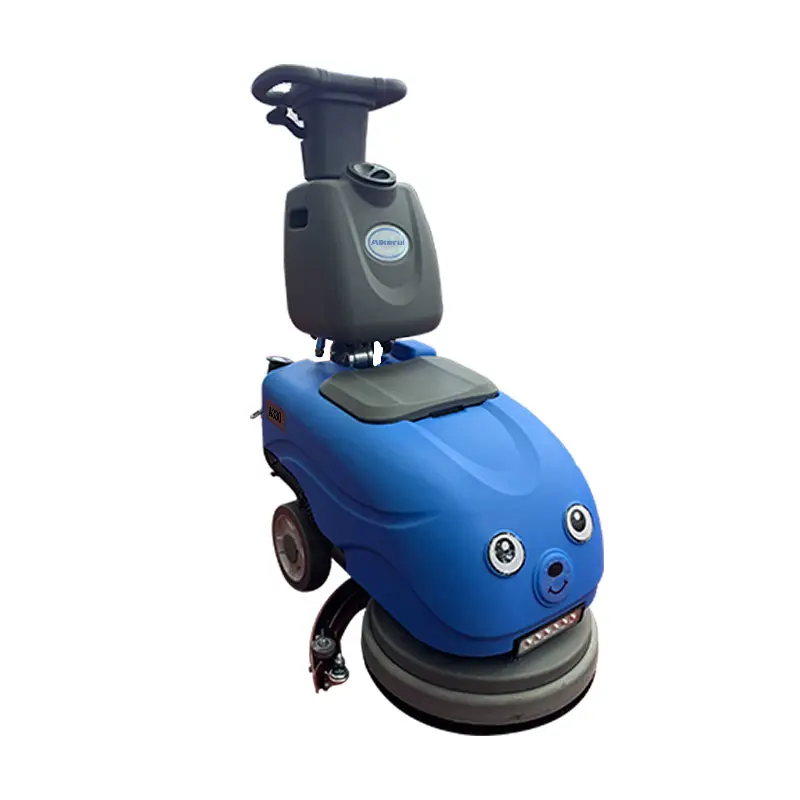
| Model | Cleaning path | Working width | Body L x W x H | Net weight | Rated sqm/h | Clean tank | Recovery tank | Runtime | Noise |
|---|---|---|---|---|---|---|---|---|---|
| A380 | 380 mm | 380 mm | 413 x 428 x 1080 mm | 10 kg | 1,200 | 5 L | 6 L | not published | not published |
| A518 | 520 mm | not published | 518 x 410 x 1235 mm | 24 kg | 1,200 | 6 L | 9 L | 2 h | 63 dB |
| A330 | 330 mm | 500 mm | 800 x 600 x 650 mm | 60 kg | 1,300 | 15 L | 18 L | 2 to 2.5 h | 65 dB |
| A400 | 400 mm | 580 mm | 800 x 580 x 680 mm | 76 kg | 1,600 | 25 L | 30 L | 4 h | 68 dB |
Working Width, Cleaning Path and Doorway Clearance
On two of the four models the working width exceeds the cleaning path, and the gap is not an error in the catalogue. Working width is measured across the widest part of the machine with the deck down, which is normally the squeegee, and the squeegee has to be wider than the brush to catch the water the brush pushes to the edge of each pass. The A330 shows a 170 mm difference between a 330 mm brush and a 500 mm working width. The A400 shows 180 mm.
The practical consequence is that the squeegee, not the brush, sets the narrowest gap the machine can pass through while cleaning. Measure the doorway, not the brush, before ordering.
Tank Volume Sets the Refill Interval, Not the Runtime
A compact machine usually runs out of water before it runs out of battery. At a solution flow of 0.5 litres per minute the refill interval follows directly from the clean tank, and doubling the flow halves the interval.
| Model | Clean tank | Refill interval at 0.5 L/min | Refill interval at 1.0 L/min | Floor covered per tank at 780 sqm/h |
|---|---|---|---|---|
| A380 | 5 L | 10 min | 5 min | about 130 sqm |
| A518 | 6 L | 12 min | 6 min | about 156 sqm |
| A330 | 15 L | 30 min | 15 min | about 390 sqm |
| A400 | 25 L | 50 min | 25 min | about 650 sqm |
Runtime and Charging in a Real Shift
Published runtime for these models runs from 2 hours on the A518 to 4 hours on the A400, and the A380 publishes no runtime figure at all. That gap is not something to skip over: without a published runtime the only honest way to size that machine is a trial on your own floor.
Two operational points follow. A 2 to 2.5 hour runtime on the A330 covers one morning or one evening block, not a full shift. And charge time is not published for three of the four models, so ask for it before planning a two-shift pattern. A machine whose charge time exceeds the gap between shifts cannot cover both shifts without a second battery pack.
Noise: The Specification Compact Buyers Forget
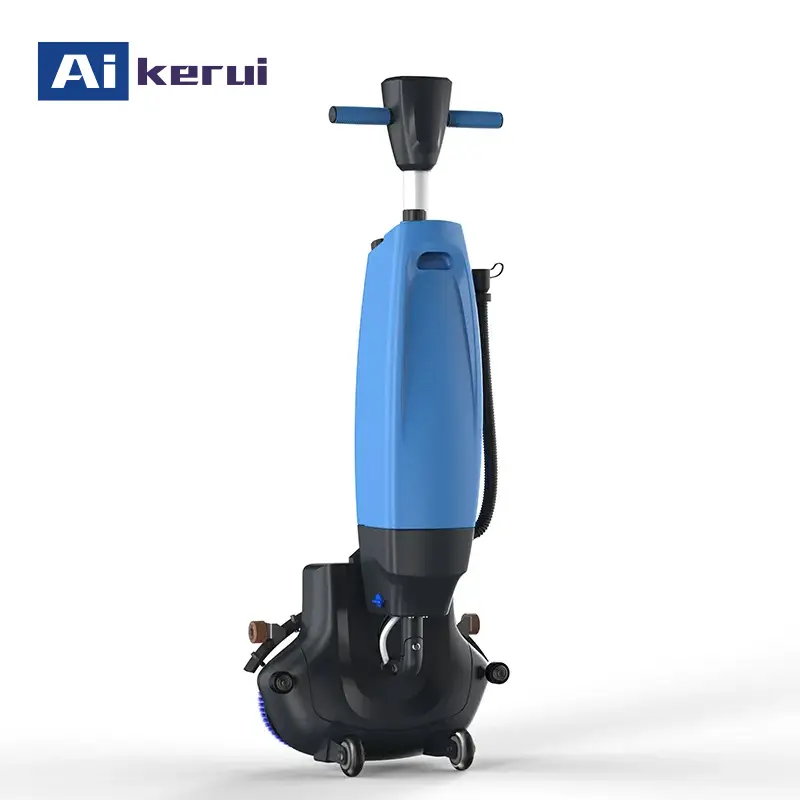
Compact machines work in occupied spaces, which is why noise belongs in the comparison rather than in the appendix. The published figures are 63 dB on the A518, 65 dB on the A330 and 68 dB on the A400.
Those numbers are close enough to look interchangeable and far enough apart to matter, because a 5 dB step is clearly audible. For a clinic, an office or a retail floor cleaned during trading hours, the quieter machine can be worth a smaller tank. For a warehouse cleaned at night, it is not worth anything.
Transport and Storage Between Sites
For a cleaning contractor the machine has to travel, and body dimensions decide whether that is a one-person job.
- A380: 413 x 428 x 1080 mm at 10 kg, light enough for one person to lift into a vehicle without a ramp.
- A518: 518 x 410 x 1235 mm at 24 kg, still a one-person lift, with height the constraint in a low van.
- A330: 800 x 600 x 650 mm at 60 kg, needs a ramp or two people.
- A400: 800 x 580 x 680 mm at 76 kg, needs a ramp, and the tailgate load rating of the vehicle should be checked first.
Where a Compact Machine Stops Being the Right Answer
The A400 publishes 1,600 square meters per hour. Derated to 65 percent for turning, overlaps and refills, that is about 1,040 square meters per hour, so a two hour cleaning window covers roughly 2,080 square meters and a four hour window roughly 4,160.
Past that point the constraint stops being the brush and becomes the tank. A 25 litre clean tank at 0.5 litres per minute is 50 minutes of cleaning before a refill, so a floor that takes four hours is four refills and four trips to a tap. A larger tank removes more labour at that stage than a wider brush does, which is when the answer moves to a mid-size walk-behind or a ride-on.
Where These Numbers Come From
Every specification in this guide is taken from published Aikerui product data for the four models named.
- Cleaning path, working width, body dimensions, net weight, tank volumes, motor ratings, runtime and noise: Aikerui specifications for A380, A518, A330 and A400.
- Productivity ratings are manufacturer figures, defined as cleaning path multiplied by maximum travel speed.
- Refill intervals are calculated as clean tank volume divided by flow rate, at the flow stated in the table.
- The 65 percent real-world factor and the 0.5 litre per minute flow rate are stated assumptions for arithmetic, not measured values. Measure both on your own floor before relying on them.
What Is the Smallest Model, and What Can It Clean?
The A380 is the smallest in the range at 380 mm of brush width, 10 kg net weight and a 5 litre clean tank. It carries a 5.5 kg brush pressure at 170 rpm from a 100 W brush motor, which is enough for light soil on sealed floors and not enough for a workshop with metal swarf. At the 0.5 litre per minute flow used above, one tank covers about 130 square meters, so it suits toilets, back-of-house corridors and small retail units rather than open floors.
Can a Compact Scrubber Clean a 1,000 Square Meter Floor?
It can, but the refill count decides whether it should. At the A400 derated productivity of about 1,040 square meters per hour, 1,000 square meters is roughly an hour of cleaning, which fits comfortably. The same floor with an A380 at about 780 square meters per hour takes closer to 80 minutes, and its 5 litre tank covers about 130 square meters per fill, which is seven refills. The area is not the problem. The number of trips to the tap is.
What Is the Difference Between the A518 and the A330?
They solve different problems. The A518 has the wider brush at 520 mm against 330 mm, but only 6 litres of solution against 15, a 2 hour runtime against 2 to 2.5, and 63 dB against 65. The A330 weighs 60 kg against 24 kg, so it needs a ramp or two people to move. Choose the A518 where the machine is carried between sites and noise matters, and the A330 where the floor is larger and the machine stays in one building.
Do Compact Scrubbers Need a Dedicated Charging Point?
Not usually. The A380 runs a 24 V pack and the A518 a 24 V 16 Ah pack, both small enough to charge from a standard socket. The larger compact models carry 24 V 100 Ah packs, which take longer to charge and are better placed on a fixed charging point than on a socket in a corridor. Plan where the machine lives overnight before you choose the model.
Is a Compact Scrubber Quiet Enough to Use in an Office?
The published figures are 63 dB on the A518, 65 dB on the A330 and 68 dB on the A400. Ordinary conversation is usually quoted at around 60 dB, so all three are audible above it. For occupied offices the A518 is the closest fit on noise, while the A400 is better scheduled outside working hours even though it carries the largest tank of the four.
Related Products
Get a Quote for These ProductsRelated Guides
Browse Machines by Type
Ready to Get Factory-Direct Pricing?
Get a quote within 24 hours. No middlemen — buy direct from the manufacturer and save 30-50%.
About the Author
Mark Wang is Sales Director at Aikerui with 15+ years of experience in industrial floor cleaning equipment. He has helped 2,000+ facilities across 50+ countries source factory-direct cleaning equipment.
About Aikerui
Aikerui is an industrial cleaning equipment manufacturer founded in 2008, operating its own 10,000+ square meter production facility in Anqing, Anhui, China. It manufactures floor scrubbers, sweepers and replacement parts, holds CE and ISO 9001 certification, and exports to 50+ countries. Every guide on this site is written by the manufacturer's own team — not a third-party agency.