
Commercial Floor Scrubber: Retail, Healthcare, Food Service | Aikerui Guide
Five Aikerui commercial floor scrubbers compared by cleaning path, water capacity, noise level and body width for retail, healthcare and food-service floors.
In This Guide
- Commercial Floor Scrubber: The Constraints Retail and Healthcare Add
- Four Floor Types and the Water Rate They Demand
- Published Specifications: Five Aikerui Machines from Hand-Held to Ride-On
- Body Width and Aisle Turnaround in a Store Layout
- Water Capacity and the Continuous-Cleaning Threshold
- Noise Level and Whether You Can Clean During Opening Hours
- Matching the Machine to Four Commercial Settings
- Cost per Square Metre and the Case for a Smaller Machine
- Data Sources and Stated Assumptions
- How Do I Choose Between a Walk-Behind and a Ride-On for a Retail Store?
- What Floor Type Needs the Most Water Changes per Shift?
- Why Does a Smaller Tank Sometimes Finish Faster Than a Larger One?
- What Happens When a Commercial Floor Scrubber Meets Carpet or Rubber?
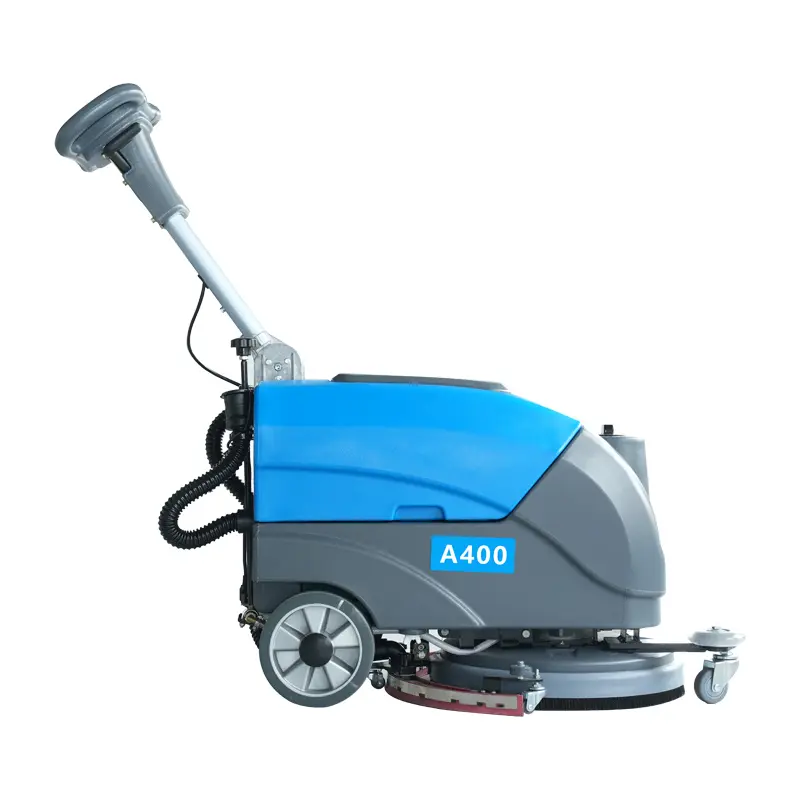
Commercial Floor Scrubber: The Constraints Retail and Healthcare Add
An industrial floor scrubber is bought for throughput: the widest path, the biggest tank and the highest hourly rating win. A commercial floor scrubber is bought for constraints: the aisle is only 1.2 metres wide, the kitchen closes for two hours, the hospital ward cannot exceed 70 decibels and the store manager wants the floor dry before the first customer arrives.
The same published specification sheet therefore produces two different answers depending on whether you read it for speed or for fit. This guide takes five Aikerui machines from a 10 kg handheld unit to a 4,900 square-metre-per-hour ride-on and reads each number against the real limits of retail, healthcare, food service and education floors.
Four Floor Types and the Water Rate They Demand
A commercial floor scrubber deposits water through the brush, scrubs the surface and recovers the slurry with a squeegee. The amount of water left on the floor after the squeegee pass is the critical variable for slip safety, and it depends on the floor texture more than on the machine.
Published studies on hard-floor cleaning give typical application rates of 0.08 litres per square metre on glazed ceramic tile, 0.10 on vinyl composition tile and sealed epoxy, 0.12 on quarry tile and unsealed concrete, and 0.15 on textured non-slip flooring. Aikerui does not publish an application rate, so the calculations below use the mid-range 0.10 litres per square metre as a working assumption for mixed commercial floors; high-traffic kitchens with quarry tile should be read at the upper bound.
Published Specifications: Five Aikerui Machines from Hand-Held to Ride-On
The five machines below are all listed under the Floor Scrubbers category in the Aikerui catalogue. They span a twelve-fold range in weight and a four-fold range in cleaning path, which is exactly the spread a facilities manager needs when matching a machine to a specific room size.
| Model | Format | Cleaning path | Productivity | Fresh tank | Dirty tank | Battery | Noise | Weight |
|---|---|---|---|---|---|---|---|---|
| A380 | Walk-behind | 380 mm | 1,200 ㎡/h | 5 L | 6 L | 24V/6Ah | — | 10 kg |
| A518 | Walk-behind | 520 mm | 1,200 ㎡/h | 6 L | 9 L | 24V/16Ah | — | 24 kg |
| A400 | Walk-behind | 400 mm | 1,600 ㎡/h | 25 L | 30 L | 24V/100Ah | — | 76 kg |
| A500 | Walk-behind | 500 mm | 2,200 ㎡/h | 50 L | 55 L | 24V/100Ah | 65 dB | — |
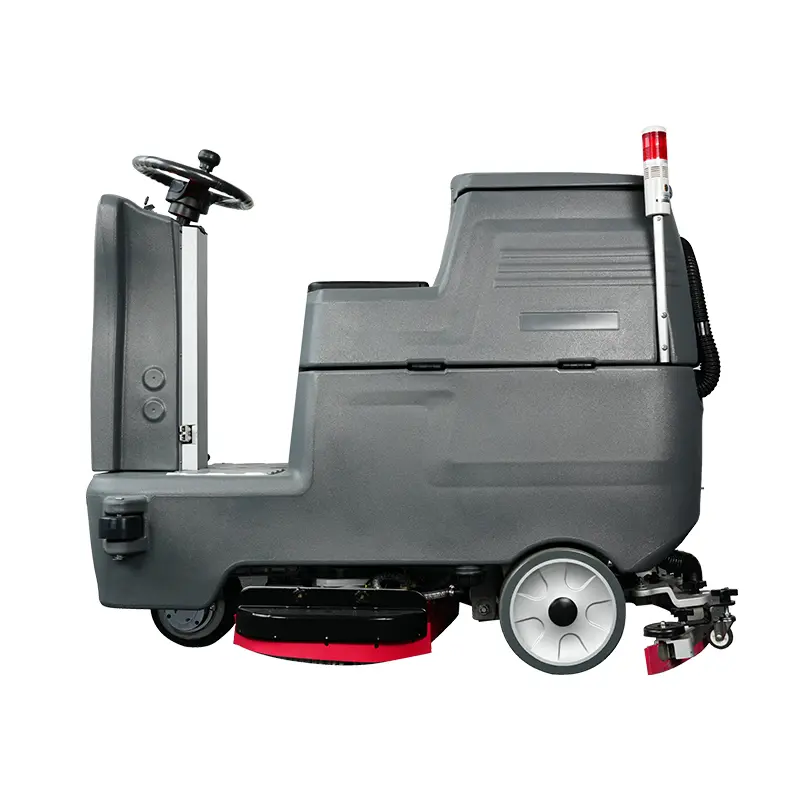
| K660 | Ride-on | 660 mm | 4,900 ㎡/h | 90 L | 110 L | 24V/150Ah | — | — |
Body Width and Aisle Turnaround in a Store Layout
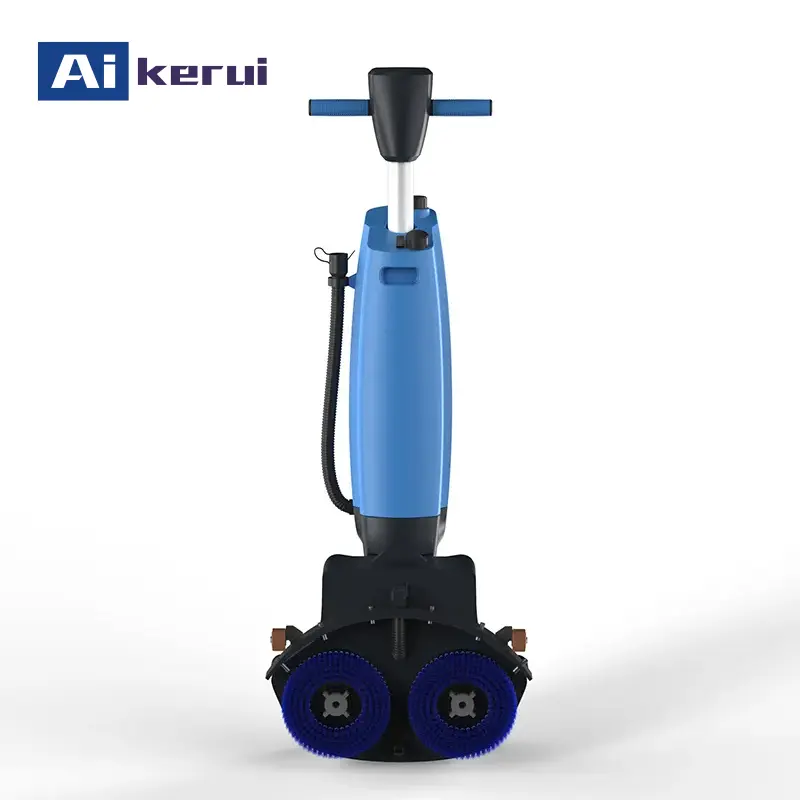
The cleaning path in the table above is the width the brushes actually touch. The body width is what has to fit between shelving, display units and kitchen equipment. Aikerui does not publish body width for most of these models, but the dimensional footprints give the governing width: the A380 at 10 kg is narrow enough to turn in a residential hallway, the A400 at 76 kg is closer to a standard supermarket aisle and the K660 ride-on needs the width of a small forklift aisle.
For a retail store with 1.2 metre aisle spacing, the A500 with its 500 mm cleaning path leaves 700 mm of side clearance, which is enough for an operator to walk alongside and steer around end-of-aisle displays. The K660 leaves only 540 mm, which is tight for a seated operator and requires a three-point turn at every aisle end. That turnaround time is not in the productivity rating, but it is real on the floor.
Water Capacity and the Continuous-Cleaning Threshold
Dividing the fresh tank by the 0.10 litre-per-square-metre application rate gives the area each machine can cover on one tank. Dividing that area by the published productivity gives the continuous-cleaning time before a refill stop.
| Model | Fresh tank | Area per fill at 0.10 L/㎡ | Minutes per fill at rated speed |
|---|---|---|---|
| A380 | 5 L | 50 ㎡ | 2.5 |
| A518 | 6 L | 60 ㎡ | 3.0 |
| A400 | 25 L | 250 ㎡ | 9.4 |
| A500 | 50 L | 500 ㎡ | 13.6 |
| K660 | 90 L | 900 ㎡ | 11.0 |
Noise Level and Whether You Can Clean During Opening Hours
Only the A500 publishes a noise rating: 65 decibels. That places it just below the 70 dB daytime exposure guideline used by occupational safety agencies in the European Union and the United States. In practice, 65 dB is comparable to a normal conversation at one metre; a customer in a retail aisle will notice it but will not need to raise their voice.
The other four models do not publish noise data. For hospitals and clinics that need cleaning during visiting hours, the absence of a published number is a risk: the machine may be quiet, or it may not, and the only way to know before purchase is to request a factory demonstration or a third-party acoustic report.
Matching the Machine to Four Commercial Settings
The table below maps each setting to the model that best fits its combination of area, constraint and budget. The verdict is based on the published specifications above plus two assumptions: a working day of four hours at 60 percent of rated speed, and an application rate of 0.10 litres per square metre.
| Setting | Typical area | Key constraint | Recommended model | Basis |
|---|---|---|---|---|
| Retail store (supermarket) | 500–2,000 ㎡ | 1.2 m aisle, daytime noise | A400 or A500 | 400–500 mm path fits aisle; A500 at 65 dB |
| Healthcare (hospital ward) | 200–800 ㎡ | Noise, sanitise between wards | A400 | 76 kg, manageable lift, 25 L tank |
| Food service (kitchen) | 100–400 ㎡ | Corners, grease, quick dry | A518 or A400 | Compact body; squeegee leaves floor dry |
| Education (school corridor) | 300–1,000 ㎡ | Budget, shift length | A500 | 50 L tank, 3–4 h runtime, manual push |
Cost per Square Metre and the Case for a Smaller Machine
A commercial floor scrubber that is too large for its space costs more than the purchase price: it wastes water on every partial tank, it needs a bigger charging station and it is harder to store. The A380 and A518 are so light that one operator can lift them into a utility closet without a ramp; the A400 and A500 need a dedicated corner with a power outlet.
Battery replacement is the largest operating cost over a five-year life. The A400 and A500 both use a 24-volt 100-amp-hour pack. At typical replacement pricing for sealed lead-acid or lithium-iron-phosphate industrial batteries, that pack represents roughly 25 to 35 percent of the machine's original purchase price every three to four years. The K660 uses a 24-volt 150-amp-hour pack, which is proportionally more expensive. For a school or small restaurant with limited capital, the lower battery cost of the smaller machines is often the deciding factor.
Data Sources and Stated Assumptions
All numbers in this guide come from the published specification sheets in the Aikerui product catalogue as of November 2026.
Assumptions that affect the calculations are stated explicitly: a working shift of four hours at 60 percent of the published productivity rating; a water application rate of 0.10 litres per square metre for mixed commercial hard floors; and a 70 decibel daytime noise threshold for occupied spaces. The 60 percent efficiency factor accounts for turning, filling, elevator waits and operator breaks; it is conservative for a trained operator on an open floor and optimistic for a cluttered retail aisle.
- Aikerui published specifications: cleaning path, productivity, tank capacity, battery, noise and weight.
- Water application rate: 0.10 L/㎡, mid-range of published values for VCT, epoxy and glazed tile.
- Shift assumption: four hours at 60 percent of rated productivity.
- Noise threshold: 70 dB daytime guideline for occupied commercial spaces (EU OSHA / US OSHA references).
How Do I Choose Between a Walk-Behind and a Ride-On for a Retail Store?
For a retail store under 2,000 square metres, a walk-behind commercial floor scrubber is usually the better fit. The ride-on K660 covers ground faster, but its turning circle and seated profile make it awkward in narrow aisles and around end-of-aisle displays. The walk-behind A500 matches the K660's dirty-tank capacity while keeping the operator on foot for tight manoeuvres. Only when the store exceeds 3,000 square metres with wide centre aisles does the ride-on's speed advantage outweigh its size penalty.
What Floor Type Needs the Most Water Changes per Shift?
Quarry tile and unsealed concrete absorb the most water per square metre, typically 0.12 to 0.15 litres, because the surface texture traps solution in the pores. On a 2,200 square-metre-per-hour machine like the A500, that water rate consumes 264 to 330 litres per hour; with a 50-litre fresh tank, the refill interval drops to 9 to 11 minutes. Glazed ceramic tile and sealed epoxy need only 0.08 to 0.10 litres per square metre, extending the same interval to 14 to 17 minutes.
Why Does a Smaller Tank Sometimes Finish Faster Than a Larger One?
Tank capacity is only half the equation; productivity is the other. The A400 carries 25 litres and the A518 carries only 6, yet the A400's higher productivity of 1,600 square metres per hour drains its 25 litres in 9.4 minutes, while the A518's lower productivity of 1,200 square metres per hour drains its 6 litres in 3.0 minutes. The ratio of tank size to productivity therefore determines the actual refill interval, not the absolute tank volume. A large tank paired with a very high productivity can still need frequent refills.
What Happens When a Commercial Floor Scrubber Meets Carpet or Rubber?
A floor scrubber is designed for hard, non-porous surfaces. On carpet or rubber flooring, the brush system will not lift soil effectively and the squeegee will not seal against the textured surface, leaving water trapped in the fibres or seams. The result is extended drying time, potential mould growth and slip hazards. For carpeted areas, a commercial extractor or dry-vacuum system is the correct tool; for rubber gym flooring, a damp mop with a neutral cleaner is safer than a scrubber.
Related Products
Related Guides
Browse Machines by Type
Ready to Get Factory-Direct Pricing?
Get a quote within 24 hours. No middlemen — buy direct from the manufacturer and save 30-50%.
About the Author
Mark Wang is Sales Director at Aikerui with 15+ years of experience in industrial floor cleaning equipment. He has helped 2,000+ facilities across 50+ countries source factory-direct cleaning equipment.
About Aikerui
Aikerui is an industrial cleaning equipment manufacturer founded in 2008, operating its own 10,000+ square meter production facility in Anqing, Anhui, China. It manufactures floor scrubbers, sweepers and replacement parts, holds CE and ISO 9001 certification, and exports to 50+ countries. Every guide on this site is written by the manufacturer's own team — not a third-party agency.