
Floor Scrubbers for Sale: Reading a Listing Properly | Aikerui Guide
What a floor scrubber for sale listing does and does not tell you: three seller types, the signals that expose each, and six questions to ask before paying.
In This Guide
Three Kinds of Seller Behind the Same Wording
Search for a floor scrubber for sale and every result looks alike: a photo, a model number, a price or a "contact us". The differences that actually matter are behind the page.
There are three kinds of seller, and they price, deliver and support very differently. Knowing which one you are talking to is more useful than any specification comparison, because it determines what happens after the machine arrives.
- None of the three is automatically better. A dealer with a service van two hours away can be worth a price premium; a broker with no technical staff rarely is.
- The problem is that all three write the same listing language. The next section is how to tell them apart before you pay.
| Seller type | What they do | Where the price goes |
|---|---|---|
| Manufacturer | builds the machine; sells direct or through channels | lowest — no intermediary margin, and spare parts come from the same line |
| Distributor / dealer | buys from a manufacturer, holds stock, provides local service | higher — carries stock, service capability and territory rights |
| Trading company / broker | does not build or stock; forwards your order to a factory | variable — sometimes lower than a dealer, but no engineering support and no parts accountability |
Signals That Expose the Seller Type
These are checkable in a few minutes and they rarely lie. A seller can describe themselves however they like, but these five things are hard to fake.
- The first check is the most reliable. A real manufacturer sells consumables because consumables wear out and customers come back for them. A broker has no reason to stock a squeegee blade.
- Ask one technical question the listing cannot answer: what is the brush contact pressure at the deck, or what is the recovery tank capacity against the solution tank. Brokers cannot answer this and will either guess or go quiet.
| Check | What a manufacturer shows | What a broker usually shows |
|---|---|---|
| Spare parts for the same model | lists brushes, squeegees, pad drivers as separate purchasable items | none, or "parts available on request" |
| Factory documentation | address, floor area, production photos, sometimes an audit report or a live video walkthrough | stock photos, no address, or a residential city address |
| Customisation | answers questions about deck width, voltage, branding and MOQ with specifics | forwards the question and comes back with a price only |
| Consistency across models | the whole range shares a design language and parts family | photos look like they come from several different factories |
| Certification paperwork | can send the CE / ISO certificate with the model listed | says "CE certified" with no document |
Where the Price Difference Actually Comes From
Buyers often assume the cheapest listing is a bargain and the expensive one is a markup. In machine tools and floor equipment the gap is usually structural, not commercial — it comes from four places.
- Channel structure. A dealer carries stock, provides local service and holds territory rights. Those cost money and are priced in. Buying direct removes that layer but also removes the local service.
- Configuration. The same model number ships with different batteries, different chargers and different brush compounds. A 24V/100Ah lead-acid pack and a lithium pack of the same nominal capacity are not the same price, and neither is a machine with a spare brush set included.
- What is excluded. Some listings price the machine only. Charger, batteries, squeegee assembly and delivery can be separate line items. Compare the total landed cost, not the headline number.
- Volume and terms. A single unit and a ten-unit order are not priced the same, and payment terms change the number too. A quoted price without terms is incomplete.
- Practical rule: ask every seller for a landed cost — machine, batteries, charger, delivery to your address, and payment terms. Only then compare.
What a Credible Listing Should Contain
This is the minimum. If a listing is missing more than two of these, treat the price as provisional and the specification as unverified.
| Item | Why it matters |
|---|---|
| Cleaning path and working width in mm or inches | decides which aisles and doorways the machine physically fits through |
| Solution and recovery tank capacity | decides refill frequency, which often limits a shift before the battery does |
| Rated productivity | a starting figure only — real output is 50-70% of it in a racked building |
| Battery chemistry, voltage and capacity | lead-acid and lithium at the same nominal capacity behave differently and cost differently |
| Brush motor and vacuum motor power | tells you the class of machine; a 550 W brush motor is not a heavy-duty deck |
| Machine dimensions and weight | needed for lift access, floor loading and transport |
| Noise level in dB | decides whether the machine can run during operating hours in a retail or healthcare setting |
| What is in the box | batteries, charger, brush set — the most common source of a surprise invoice |
The Range We Actually Build
For reference, this is what a published specification looks like. The figures below are from our own product documentation, not estimates.
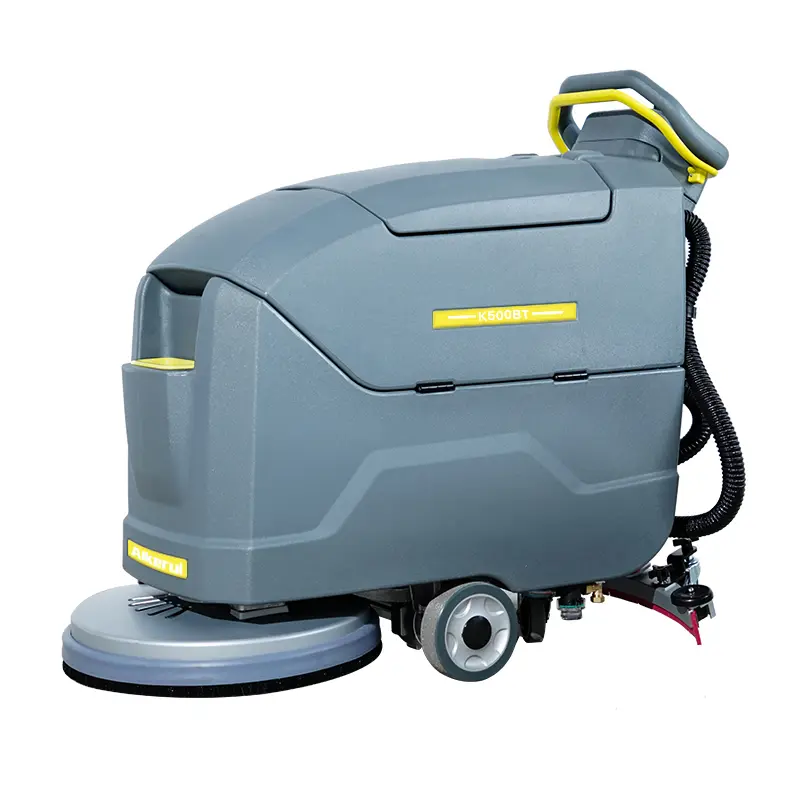
The range spans 15 walk-behind and ride-on scrubbers plus sweepers and dust carts. Two examples in the middle of the range:
- Both figures are the published specification. Neither is a guarantee of what you will achieve on your floor — that depends on the substrate, the soil and how often the operator has to refill or turn.
- Machines at the top of the range reach 860 mm cleaning path and 160 L tanks; the smallest is a 330 mm compact unit. The right one is decided by aisle width and cleanable area, not by the model number.
| Parameter | K500BT (walk-behind) | K660 (ride-on) |
|---|---|---|
| Cleaning path | 500 mm | 660 mm |
| Working width | 800 mm | 900 mm |
| Rated productivity | 2,500 m²/h | 4,900 m²/h |
| Solution tank | 55 L | 90 L |
| Recovery tank | 55 L | 90 L |
| Battery | 24V / 100Ah | 24V / 150Ah |
| Working time | 4-5 h | 4-5 h |
Six Questions to Ask Before Paying
These questions separate a seller who knows the machine from one who is reading the same listing you are. Ask all six in writing.
- What is the landed cost — machine, batteries, charger, delivery to this address, and what payment terms apply?
- What is the recovery tank capacity against the solution tank, and at what flow rate does the solution run out?
- Which brush compound ships with the machine, and what does a replacement cost from you?
- Can you send the CE certificate with this model number on it?
- Is the battery lead-acid or lithium, and what is the expected service life on each?
- If a part fails in month four, where does the replacement ship from and how long does it take?
- The sixth question is the one most buyers skip and later regret. A machine is a ten-year asset maintained by consumables; if the consumable supply chain is a forwarding address, the asset is worth less than the price suggests.
Inspecting Before You Accept Delivery
Whether the machine arrives from a factory or a dealer, the acceptance check is the same. Do it before signing the delivery note, not after.
- Lower the squeegee and check the blade touches the floor evenly along its whole width — a bent mount is the most common transit damage and it stops the machine picking up water.
- Run the machine on a small area and confirm it picks up water in one pass. If it leaves a film, stop and inspect the squeegee before accepting.
- Check the solution flow adjusts and that the recovery tank drains fully.
- Confirm the battery matches what was ordered — chemistry, voltage and capacity are printed on the battery label.
- Photograph the machine and the delivery note before signing. Damage found after the courier leaves is much harder to claim.
Common Questions
The questions that come up most often when a buyer is comparing listings.
- Why is the same model priced so differently across sellers? — Usually channel structure and configuration, not margin. A dealer price includes stock, local service and territory rights; a direct price does not. Batteries and chargers are also frequently priced separately.
- How do I tell a factory from a trading company? — Ask whether they sell spare parts for the model as separate items. A manufacturer does, because consumables wear out. A broker usually does not stock any.
- Is a used machine a better buy? — Only if you can inspect it running and confirm the battery has remaining capacity. A battery that reads correct voltage at rest but collapses under load is finished, and a replacement pack can approach a third of the machine cost.
- What should I compare first when prices differ? — Landed cost, not headline price. Machine plus batteries plus charger plus delivery plus payment terms, for the same configuration.
- Do I need a ride-on instead of a walk-behind? — Depends on cleanable area and aisle width. Below roughly 2,000-3,000 m² of cleanable floor, or wherever racking prevents a ride-on turning, a walk-behind is the better value.
- Can I buy direct from a factory outside the country? — Yes, and it is common. Ask for the certificate, a video walkthrough of the production line, and clarify warranty handling and the shipping terms before paying.
Related Guides
Browse Machines by Type
Ready to Get Factory-Direct Pricing?
Get a quote within 24 hours. No middlemen — buy direct from the manufacturer and save 30-50%.
About the Author
Mark Wang is Sales Director at Aikerui with 15+ years of experience in industrial floor cleaning equipment. He has helped 2,000+ facilities across 50+ countries source factory-direct cleaning equipment.
About Aikerui
Aikerui is an industrial cleaning equipment manufacturer founded in 2008, operating its own 10,000+ square meter production facility in Anqing, Anhui, China. It manufactures floor scrubbers, sweepers and replacement parts, holds CE and ISO 9001 certification, and exports to 50+ countries. Every guide on this site is written by the manufacturer's own team — not a third-party agency.