
Ride On Floor Sweeper: Sizing by Hopper, Battery and Output | Aikerui Guide
Ride on sweeper sizing from published specifications: implied travel speed behind each productivity rating, hopper emptying interval, and battery runtime floor.
In This Guide
- Ride On Floor Sweeper Productivity Numbers Are Not Comparable
- The Four Aikerui Ride On Sweepers on Published Specification
- Deriving the Implied Travel Speed From Each Rating
- Reading the Implied Speed Against Cleaning Width
- Operator Format: Stand-On Platform, Seat and Cab
- Hopper Volume Against Debris Generation Rate
- Emptying Frequency on a Real Shift
- Battery Energy in Watt-Hours as a Runtime Floor
- Body Width, Side Brush Overhang and Aisle Clearance
- Matching a Machine to Your Floor Area and Debris Load
- Ride On Sweeper Against Walk Behind on the Numbers
- Data Sources and Stated Assumptions
- How Do I Calculate the Real Coverage of a Ride On Sweeper?
- What Happens If the Hopper Fills Mid-Shift?
- Why Does a 48V Battery Give Different Run Times on Different Machines?
- Can a Ride On Sweeper Work Outdoors on Yards and Ramps?
- How Do I Compare Ride On Sweepers From Different Manufacturers?
Ride On Floor Sweeper Productivity Numbers Are Not Comparable
Every sweeper specification states output in square metres per hour, and buyers compare those figures directly. That comparison does not work, because the figure is cleaning path multiplied by maximum travel speed, so the speed is buried inside the result.
Reversing that calculation on the four ride-on machines produces implied travel speeds that differ by 46.5 percent across models of similar size. The highest-rated machine is not the widest one, and the widest one is not the fastest, so two machines can rank in opposite order.
The way out is to rebuild the comparison from published specifications: implied speed, absorbable debris rate and battery energy.
- Productivity ratings are calculated values, not measured output on a real floor.
- They assume continuous straight running with no turns, no overlapping passes and no hopper stops.
- The four ride-on sweepers imply speeds from 4.80 to 7.03 km/h.
The Four Aikerui Ride On Sweepers on Published Specification
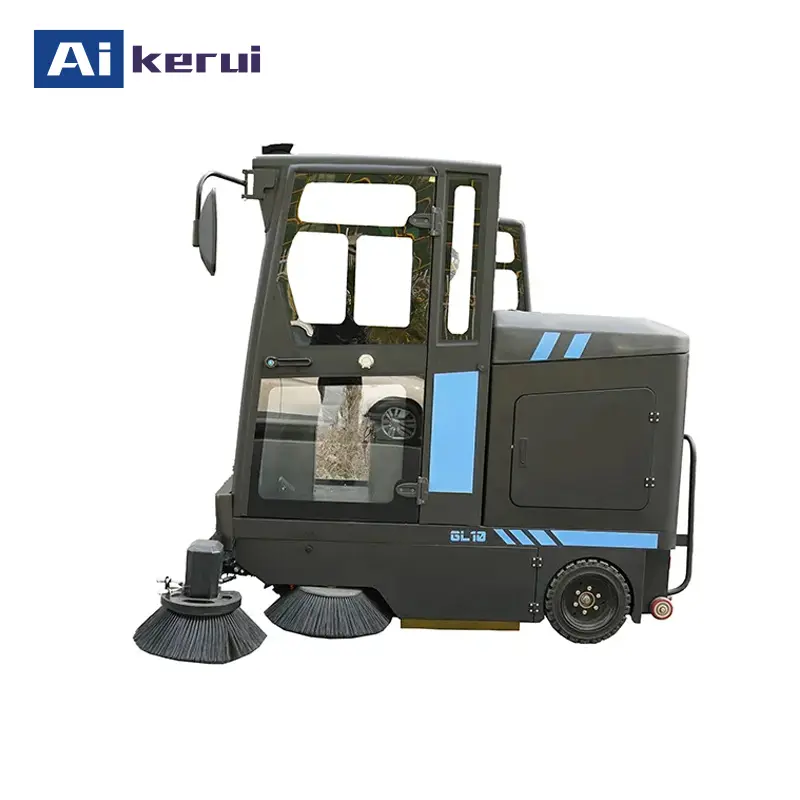
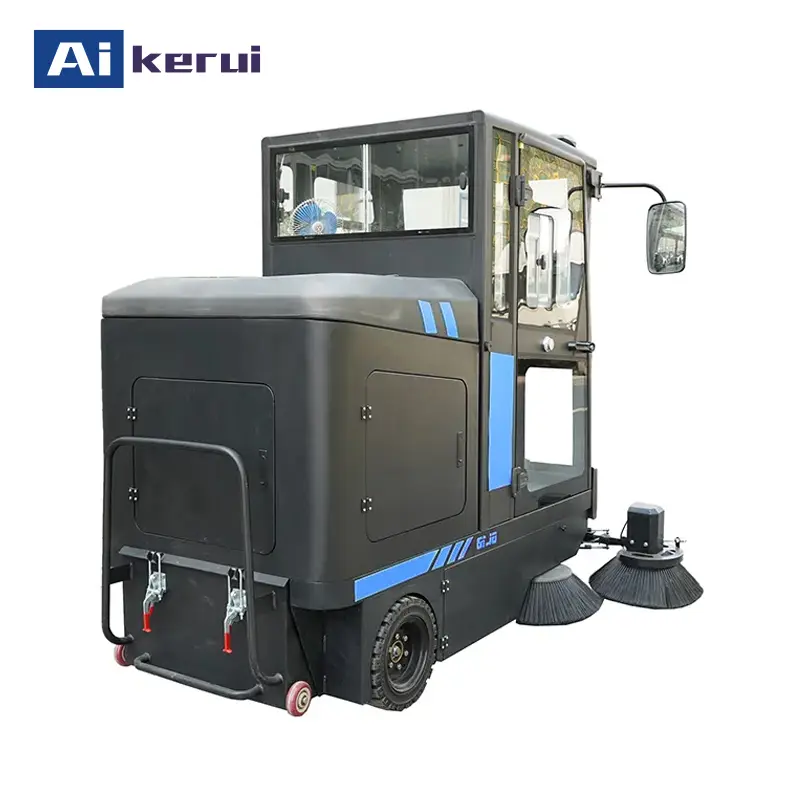
These four models make up the ride-on sweeper range, and every figure below comes from the published specification for that model. The two walk-behind sweepers are carried through the comparison further down.
One detail shapes the rest of this guide: only the A1280 publishes a working time, so the battery section works from energy rather than a quoted hour.
| Model | Cleaning path | Main brush | Side brushes | Rated sqm/h | Hopper | Net weight | Battery | Body L x W x H |
|---|---|---|---|---|---|---|---|---|
| S1250 | 1250 mm | 490 mm | 220 mm x 2 | 6,000 | 80 L | 396 kg | 48 V, 67 Ah | 1600 x 1250 x 1300 mm |
| A1280 | 1280 mm | 490 mm | 500 mm x 2 | 9,000 | 80 L | 285 kg | 48 V, 45 Ah | 1470 x 1200 x 1220 mm |
| A1350 | 1350 mm | 590 mm | 260 mm x 2 | 8,000 | 120 L | 495 kg | 48 V, 83 Ah | 1700 x 1350 x 1200 mm |
| S2000 | 1900 mm | 690 mm | 260 mm x 4 | 13,000 | 180 L | 780 kg | 48 V, 100 Ah | 2000 x 1950 x 1950 mm |
Deriving the Implied Travel Speed From Each Rating
Speed is productivity divided by cleaning path. Applying that to each published rating gives the speed the manufacturer must have assumed.
The spread runs from 3.50 km/h on the walk-behind models to 7.03 km/h on the A1280. The walk-behind figure is normal walking pace, and every ride-on figure is faster, so the ratings rest on different assumptions about how hard each machine is driven.
| Model | Cleaning path | Rated sqm/h | Implied speed | Implied speed in m/min |
|---|---|---|---|---|
| S1250 | 1250 mm | 6,000 | 4.80 km/h | 80 m/min |
| A1280 | 1280 mm | 9,000 | 7.03 km/h | 117 m/min |
| A1350 | 1350 mm | 8,000 | 5.93 km/h | 99 m/min |
| S2000 | 1900 mm | 13,000 | 6.84 km/h | 114 m/min |
| A1000 walk-behind | 1050 mm | 3,680 | 3.50 km/h | 58 m/min |
| A1050 walk-behind | 1050 mm | 3,680 | 3.50 km/h | 58 m/min |
Reading the Implied Speed Against Cleaning Width
The two ratings most often compared are the A1280 at 9,000 square metres per hour and the A1350 at 8,000. Read as ratings, the A1280 wins. Read as width, the A1350 wins by 70 mm.
The implied speed explains why. The A1280 rating assumes 7.03 km/h on the narrowest ride-on path in the range, while the A1350 rating assumes 5.93 km/h on a wider path. Driven at the same speed, the wider machine would sweep more ground per hour and the rating order would reverse.
A rating is a manufacturer's assumption; path width and hopper volume are physical facts.
- The A1280 carries the highest rating on the narrowest ride-on path.
- The A1350 is 70 mm wider but rated 1,000 sqm/h lower.
- Ranking by rating and by width give opposite results for these two models.
- The S2000 pairs the widest path with the second-highest implied speed.
Operator Format: Stand-On Platform, Seat and Cab
The four ride-on sweepers differ in how the operator is carried, and that changes the numbers above in ways a specification table does not show.
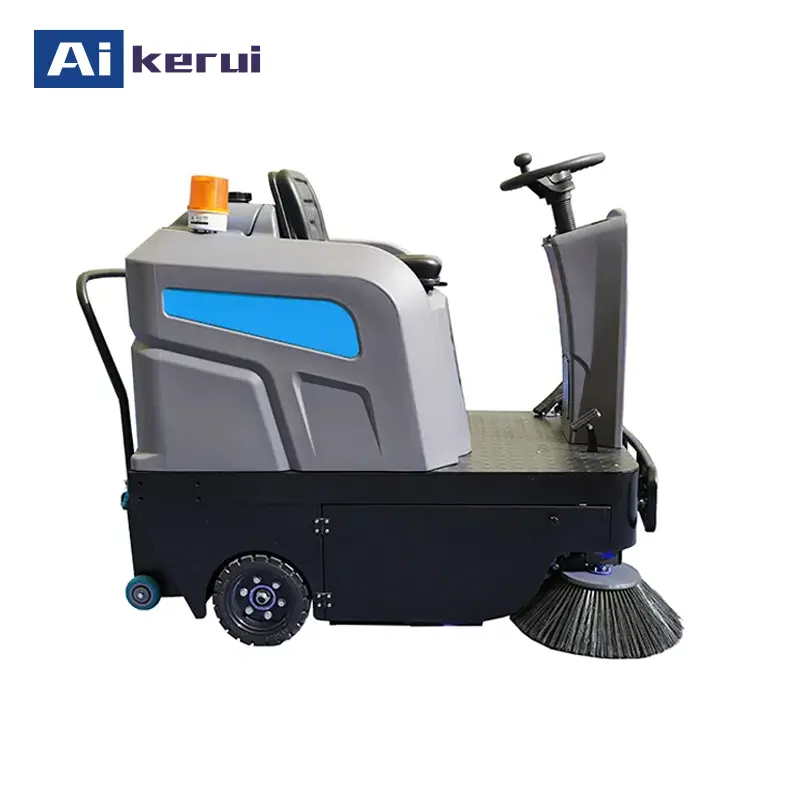
The S1250 and the A1280 use a stand-on platform with a steering wheel on a column, so the operator steps off sideways at the end of an aisle and turns quickly. The A1350 provides a seat, which suits longer shifts behind a larger hopper. The S2000 is an enclosed cab that shields the operator from dust and adds width and weight.
Format matters most for the A1280, which combines the highest published rating with the lowest hopper threshold.
Hopper Volume Against Debris Generation Rate
The hopper is what stops the shift. Any sweeper must stop when full, and the interval between stops is set by how much debris the floor generates rather than by machine size.
That debris rate belongs to the operation and is published in no catalogue. It can be derived from the machine side, because hopper volume divided by hourly output gives the maximum debris rate a machine absorbs in one hour of rated work.
The threshold is not proportional to hopper size: the A1280 has the same 80-litre hopper as the S1250 but moves 50 percent more area per hour.
| Model | Hopper | Rated sqm/h | Maximum absorbable debris rate | Basis |
|---|---|---|---|---|
| A1280 | 80 L | 9,000 | 0.0089 L per sqm | lowest threshold in the range |
| A1000 walk-behind | 40 L | 3,680 | 0.0109 L per sqm | small hopper, low output |
| S1250 | 80 L | 6,000 | 0.0133 L per sqm | same hopper as the A1280, lower output |
| S2000 | 180 L | 13,000 | 0.0138 L per sqm | largest hopper and highest output |
| A1050 walk-behind | 55 L | 3,680 | 0.0149 L per sqm | second-highest threshold |
| A1350 | 120 L | 8,000 | 0.0150 L per sqm | highest threshold in the range |
Emptying Frequency on a Real Shift
Convert the threshold into a time and it becomes an operational number. At a moderate debris rate of 0.12 litres per square metre, an hour of rated work fills an S1250 hopper in 11 minutes of real running and an A1280 hopper in 7 minutes.
That interval limits how much area one operator can sweep without a disposal point, and it is far tighter than the headline ratings suggest. A machine that empties every seven minutes is not running at 9,000 square metres per hour; it is walking to a bin.
| Model | Hopper | Area swept per fill at 0.12 L/sqm | Emptying interval at rated output | Emptying interval at 60 percent |
|---|---|---|---|---|
| A1280 | 80 L | 667 sqm | 4.4 min | 7.4 min |
| S1250 | 80 L | 667 sqm | 6.7 min | 11.1 min |
| A1350 | 120 L | 1,000 sqm | 7.5 min | 12.5 min |
| S2000 | 180 L | 1,500 sqm | 6.9 min | 11.5 min |
Battery Energy in Watt-Hours as a Runtime Floor
Published runtime is the softest number on a specification sheet, because it depends on load, floor condition and driving habits. Battery energy in watt-hours is not soft: multiply the voltage by the amp-hour rating for the energy stored, then divide by the machine's rated power for the shortest possible shift.
Only the A1280 publishes a working time, and comparing it against that floor is instructive. Its 48-volt 45-amp-hour pack stores 2,160 watt-hours against a 2,100 watt nameplate, so the floor is 1.03 hours, while its published working time is 2 plus or minus 0.5 hours. Both can be true, because nameplate power is the sum of motor ratings rather than the draw at any moment.
The same test applies to any machine on a quotation sheet. At the midpoint of the A1280 range, two hours of running from 2,160 watt-hours, the average draw is 1,080 watts, or 51 percent of its nameplate; at one and a half hours it is 1,440 watts or 69 percent, and at two and a half hours 864 watts or 41 percent. A quoted runtime longer than the calculated floor reveals the duty cycle the supplier is claiming.
A bigger battery does not buy a proportionally longer shift: energy per square metre of rated work runs from 0.24 watt-hours on the A1280 to 0.54 on the S1250.
- Multiply rated volts by rated amp-hours for stored energy in watt-hours.
- Divide by nameplate power for the shortest shift the battery can support.
- The A1280 passes this test; the other three publish no runtime.
| Model | Battery | Stored energy | Nameplate power | Runtime floor | Published working time |
|---|---|---|---|---|---|
| A1280 | 48 V, 45 Ah | 2,160 Wh | 2,100 W | 1.03 h | 2 +/- 0.5 h |
| S1250 | 48 V, 67 Ah | 3,216 Wh | 2,200 W | 1.46 h | not published |
| S2000 | 48 V, 100 Ah | 4,800 Wh | 2,900 W | 1.66 h | not published |
| A1350 | 48 V, 83 Ah | 3,984 Wh | 2,300 W | 1.73 h | not published |
Body Width, Side Brush Overhang and Aisle Clearance
The second physical constraint after the hopper is whether the machine fits. Body width and cleaning path are both published, but the two are not always the same number.
Where the side brushes sit outside the chassis, the swept path is wider than the body; where they are mounted inboard, the body is the wider figure. Aisle planning should use whichever is larger.
The A1280 sweeps 1,280 mm on a 1,200 mm body. The S2000 sweeps 1,900 mm on a 1,950 mm body, so its chassis is the wider of the two by 50 mm.
| Model | Body width | Cleaning path | Governing width | Net weight | Note |
|---|---|---|---|---|---|
| A1000 walk-behind | 800 mm | 1050 mm | 1050 mm | 70 kg | side brushes protrude 125 mm each side |
| A1050 walk-behind | 800 mm | 1050 mm | 1050 mm | 25 kg | lightest machine in the range |
| A1280 | 1200 mm | 1280 mm | 1280 mm | 285 kg | lightest ride-on, narrowest governing width |
| S1250 | 1250 mm | 1250 mm | 1250 mm | 396 kg | brushes inboard, body equals path |
| A1350 | 1350 mm | 1350 mm | 1350 mm | 495 kg | brushes inboard, body equals path |
| S2000 | 1950 mm | 1900 mm | 1950 mm | 780 kg | body wider than the swept path |
Matching a Machine to Your Floor Area and Debris Load
Bring the constraints together and the decision becomes arithmetic. A warehouse floor of 18,000 square metres swept per shift at 0.12 litres per square metre generates 2,160 litres of debris in total.
At 60 percent real efficiency the four ride-on models need between 2.3 and 5.0 hours to cover that area, which makes this a machine-count question before a machine-choice question. The S2000 finishes in 2.3 hours, the A1280 in 3.3, and the S1250 needs 5.0, more than one shift allows once battery changes are added.
Every model exceeds its own hopper threshold by a factor of eight to thirteen, so the disposal point sets the pace.
| Model | Hours for 18,000 sqm at 60 percent | Absorbable debris rate | Multiple of threshold at 0.12 L/sqm | Verdict |
|---|---|---|---|---|
| S2000 | 2.31 h | 0.0138 L/sqm | 8.7 | fastest coverage, largest hopper |
| A1280 | 3.33 h | 0.0089 L/sqm | 13.5 | fastest per square metre, empties most often |
| A1350 | 3.75 h | 0.0150 L/sqm | 8.0 | most debris headroom in the range |
| S1250 | 5.00 h | 0.0133 L/sqm | 9.0 | fits one shift, tightest on time |
Ride On Sweeper Against Walk Behind on the Numbers
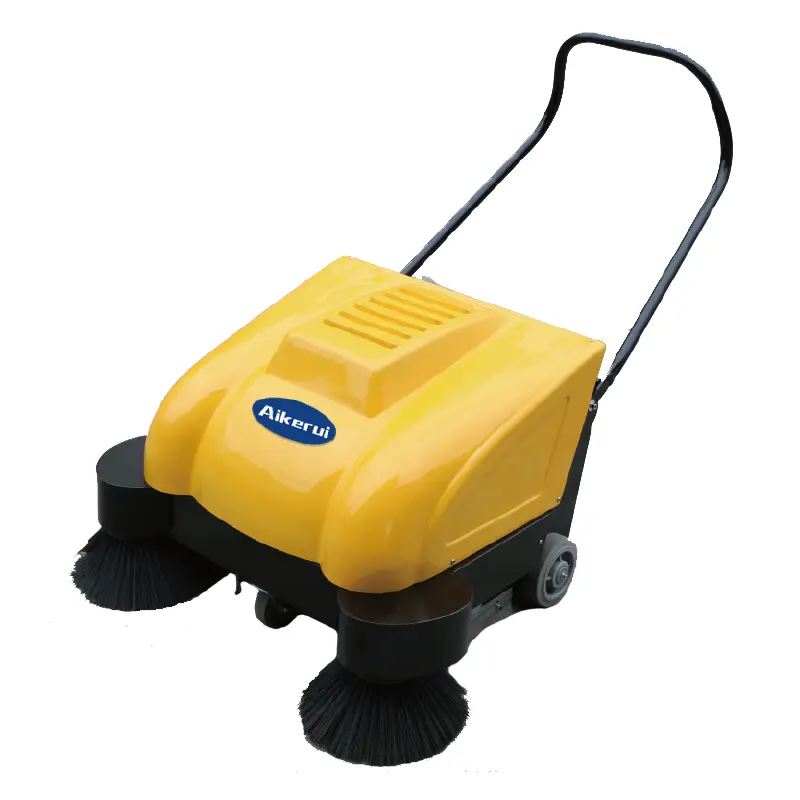
The walk-behind sweepers cover different situations rather than being a smaller ride-on machine. Both sweep 1,050 mm at a rated 3,680 square metres per hour, implying 3.50 km/h. The A1000 carries a 585 mm main brush and a 40-litre hopper at 70 kg. The A1050 carries a smaller 480 mm main brush but a 55-litre hopper at 25 kg, the lightest machine in the range.
For narrow aisles, tight turns and areas where the machine must be carried between floors or loaded into a vehicle, the walk-behind is the only option that works. Its 800 mm body clears passages no ride-on machine enters, and the A1050 at 25 kg can be handled by one person without a lift.
On a large open floor the ride-on wins on output; the trade is width and weight.
| Model | Type | Cleaning path | Rated sqm/h | Implied speed | Hopper | Net weight | Body width |
|---|---|---|---|---|---|---|---|
| A1050 | walk-behind | 1050 mm | 3,680 | 3.50 km/h | 55 L | 25 kg | 800 mm |
| A1000 | walk-behind | 1050 mm | 3,680 | 3.50 km/h | 40 L | 70 kg | 800 mm |
| A1280 | ride-on | 1280 mm | 9,000 | 7.03 km/h | 80 L | 285 kg | 1200 mm |
| S1250 | ride-on | 1250 mm | 6,000 | 4.80 km/h | 80 L | 396 kg | 1250 mm |
| A1350 | ride-on | 1350 mm | 8,000 | 5.93 km/h | 120 L | 495 kg | 1350 mm |
| S2000 | ride-on | 1900 mm | 13,000 | 6.84 km/h | 180 L | 780 kg | 1950 mm |
Data Sources and Stated Assumptions
All machine figures come from the published Aikerui specifications for the S1250, A1280, A1350, S2000, A1000 and A1050; the implied speeds, absorbable debris rates, runtime floors and area-per-fill figures are calculated from those values, with every calculation shown in the tables above.
Three figures are assumptions rather than published data, each labelled where it is used: the 60 percent real-efficiency factor that converts rated output into shift time, the 0.12 litres per square metre debris rate for a mixed industrial floor, and the 15 degree climb angle that covers the S1250, A1350 and S2000 but not the A1280. The efficiency factor should be replaced with a figure measured on your own floor.
Two fields need supplier confirmation. The A1280 lists a 30-litre water tank alongside an 80-litre dust bin, which a dry sweeper normally does not carry. The A1000 lists charging time and battery values as label text, so no runtime can be derived for it.
Aikerui has manufactured floor cleaning equipment since 2008 and holds CE and ISO 9001 certification.
How Do I Calculate the Real Coverage of a Ride On Sweeper?
Divide the published productivity rating by the published cleaning path in metres to get the implied speed in metres per hour, then apply the share of time the machine is actually sweeping rather than turning, refilling or emptying. The derating factor has to come from your own floor, because it is a property of the route rather than of the machine.
- S1250: 6,000 divided by 1.250 m gives 4,800 metres per hour.
- Multiply by your own derating factor to get real sqm per hour.
- Multiply by shift hours to get covered area per machine per shift.
What Happens If the Hopper Fills Mid-Shift?
The machine stops, and the time spent walking to a disposal point, emptying the hopper and returning is lost from every hour of the shift. On the A1280 the 80-litre hopper fills every 7 minutes of real running, so a shift contains a large number of interruptions, and each one is a fixed cost that no productivity rating accounts for.
- The A1280 hopper fills every 4.4 minutes at rated output and every 7.4 minutes at 60 percent.
- Add the round trip to a disposal point to every interruption.
- Disposal point location matters more than which model is chosen.
Why Does a 48V Battery Give Different Run Times on Different Machines?
Because the same voltage says nothing about the energy stored, and the runtime depends on how much the machine actually draws. The A1280 has the smallest pack in the range at 2,160 watt-hours and the highest published rating at 9,000 square metres per hour, while the S2000 stores 4,800 watt-hours and is rated at 13,000. Energy per unit of work is the figure to compare, not volts and not amp-hours alone.
- Energy per sqm of rated work: A1280 0.24 Wh, S2000 0.37, A1350 0.50, S1250 0.54.
- The A1280 floor is 1.03 hours and the S2000 floor is 1.66 hours.
- A published runtime is only credible once checked against energy and power.
Can a Ride On Sweeper Work Outdoors on Yards and Ramps?
Three of the four ride-on models publish a 15 degree climb angle, which covers ramps and sloped yard approaches. The A1280 does not publish one, so it should not be assumed for outdoor work. Outdoor use also raises a question the specifications do not answer, which is how much loose grit and standing water the machine handles, since the published figures cover dry debris collection on a floor.
- The S1250, A1350 and S2000 publish a 15 degree climb angle.
- The A1280 publishes no climb angle.
- A climb limit describes ramps, not surface condition.
How Do I Compare Ride On Sweepers From Different Manufacturers?
Ignore the productivity rating until last, because it embeds each manufacturer's assumption about speed. Compare the physical figures instead: cleaning path, hopper volume, body width and governing aisle width, stored battery energy against nameplate power, and the climb angle where outdoor work is planned. Then check the rating against the speed it implies, and if that speed sits far outside what the machine can hold in your aisles, treat the rating as unreliable.
- Compare cleaning path and governing aisle width before output.
- Convert each rating into an implied speed and compare those.
- Compare stored watt-hours against nameplate watts, not volts against volts.
- Ask every supplier for the same six figures.
Related Products
Related Guides
Browse Machines by Type
Ready to Get Factory-Direct Pricing?
Get a quote within 24 hours. No middlemen — buy direct from the manufacturer and save 30-50%.
About the Author
Mark Wang is Sales Director at Aikerui with 15+ years of experience in industrial floor cleaning equipment. He has helped 2,000+ facilities across 50+ countries source factory-direct cleaning equipment.
About Aikerui
Aikerui is an industrial cleaning equipment manufacturer founded in 2008, operating its own 10,000+ square meter production facility in Anqing, Anhui, China. It manufactures floor scrubbers, sweepers and replacement parts, holds CE and ISO 9001 certification, and exports to 50+ countries. Every guide on this site is written by the manufacturer's own team — not a third-party agency.