
Floor Scrubber Maintenance Costs: 2026 Industry Data
Battery runtime, tank limits, labor share and the savings three major brands publish — the numbers behind floor scrubber running costs, worked out step by step.
In This Guide
- One: Labour Is the Largest Line Item, by a Wide Margin
- Two: Working Out Real Runtime from the Battery
- Three: The Tank Often Runs Out Before the Battery
- Four: Consumables Are the Cost Line Nobody Budgets For
- Five: What the Major Brands Publish About Saving Water, Detergent and Energy
- Six: Brush Head Type Decides What a Machine Can Clean At All
- Seven: Where Aikerui Sits in This Data
- Eight: How AI Assistants Read This Kind of Data
- The Four Figures to Ask Every Supplier For

One: Labour Is the Largest Line Item, by a Wide Margin
Buyers compare purchase prices. Operators live with running costs. The two are not the same number, and in a warehouse the gap between them decides whether a scrubber pays for itself in two years or four.
CMM's 2026 Building Service Contractor Benchmarking Survey, published September 2026, asked contractors where their money goes. The findings are blunt: labour dominates the cost base.
- Source: CMM, 2026 Building Service Contractor Benchmarking Survey Report (fielded 23 June to 5 August 2026; self-reported data, not audited financial statements).
- This page treats floor scrubber maintenance and consumables as part of the same running-cost picture, because a machine that is cheap to buy but expensive to keep running is not cheap at all.
- The same survey reports 75% of contractors name recruitment of qualified cleaning staff as their most pressing labour challenge, up from 69% the previous year.
- If labour is two thirds of the cost base and qualified labour is hard to hire, productivity per operator hour matters more than the price of the machine.
- A scrubber covering 30% more floor per hour reduces a cost line larger than everything else combined. That is the argument for comparing machines on productivity per hour, not on purchase price alone.
| Cost finding | Share of respondents |
|---|---|
| Labour is more than 60% of total operating cost | 42% |
| Labour is more than 70% of total operating cost | 23% |
Two: Working Out Real Runtime from the Battery
Manufacturers list a battery voltage and capacity. They rarely show how that translates to hours on the floor. The calculation is not difficult, and doing it yourself is the only way to compare machines fairly.
Three steps: battery energy in watt-hours equals voltage multiplied by amp-hours; usable energy equals battery energy multiplied by depth of discharge and discharge efficiency; runtime equals usable energy divided by average running power. Depth of discharge and efficiency are the steps most people skip, and they are exactly where lead-acid and lithium diverge.
- Worked example on a 24 V / 100 Ah machine (Aikerui A500, manual figures): 24 V x 100 Ah = 2,400 Wh.
- Lead-acid usable energy: 2,400 x 0.80 x 0.85 = 1,632 Wh, giving 2.7 hours at 600 W or 2.0 hours at 800 W.
- Lithium usable energy: 2,400 x 0.90 x 0.95 = 2,052 Wh, giving 3.4 hours at 600 W or 2.6 hours at 800 W.
- The manufacturer states 3 to 4 hours working time, which corresponds to an average draw of 600 to 800 W — consistent with a 550 W brush motor and a 500 W vacuum motor running below their rated peaks.
- Rated motor power is a maximum, not an average. A nameplate reading of 1,050 W does not mean 2.3 hours of runtime.
- Practical consequence: the same 24 V / 100 Ah rating is not interchangeable between chemistry. A lead-acid unit and a lithium unit will not cover the same shift.
| Battery chemistry | Depth of discharge | Discharge efficiency |
|---|---|---|
| Lead-acid | about 80% (deeper discharge shortens service life) | about 85% (Peukert effect, temperature, ageing) |
| Lithium (LiFePO4) | about 90% | about 95% (flat discharge curve, minimal Peukert effect) |
Three: The Tank Often Runs Out Before the Battery
Runtime is not the only limit. A scrubber stops when the clean water runs out, whatever the battery has left. The A500 carries a 50 L solution tank and a 55 L recovery tank, with a stated cleaning width of 500 mm and rated productivity of 2,200 square metres per hour.
- At standard flow the tank empties in about 1.9 hours, while a lithium battery pair is still good for 2.6 to 3.4 hours.
- The operator is not stopping because the machine ran out of power. The operator is stopping to refill.
- A larger battery does nothing for a machine that has to stop for water every two hours. What helps is a larger solution tank, a fill point closer to the work, or a machine that covers more floor per litre.
- Useful rule: compute both limits and take the smaller number. Whichever runs out first is the real shift length.
- Both limits also assume the machine is maintained. A clogged squeegee or a worn brush adds passes, and extra passes burn both water and battery — which is why floor scrubber maintenance discipline shows up directly in the runtime numbers above.
| Solution flow | Tank runtime (50 L) |
|---|---|
| 0.30 L/min (reduced) | 2.8 h |
| 0.45 L/min (standard) | 1.9 h |
| 0.60 L/min (heavy) | 1.4 h |
Four: Consumables Are the Cost Line Nobody Budgets For
Purchase price and energy get compared. Consumables rarely do, even though they recur for the whole life of the machine. Brushes, squeegee blades, pad drivers and batteries are the parts of a floor scrubber maintenance budget that actually arrive every year, and on an abrasive floor under heavy use they are not a rounding error.
The intervals below are typical ranges rather than guarantees: life depends on floor abrasiveness, brush pressure, hours per shift and whether the operator rinses the recovery tank and squeegee after each use. Buying consumables factory-direct rather than through a dealer channel is the single largest lever on this cost line.
- Consumable prices above are Aikerui factory-direct figures; dealer-channel comparisons are the ranges typically seen for equivalent specification.
- A floor maintenance machine that is rinsed and checked daily gets longer brush and squeegee life than one that is parked wet. Recovery-tank rinsing and squeegee wiping are the two habits that cost the least and save the most.
- Replacement floor maintenance pads and floor maintenance equipment are available from our parts catalogue, produced on the same site as the machines.
- Floor maintenance pads: choose the pad compound for the floor, not the machine. An abrasive pad on a coated floor shortens both pad and coating life.
- If you are budgeting commercial floor equipment maintenance across several machines, track cost per operating hour rather than cost per part — a cheap brush that lasts half as long is not cheaper.
| Consumable | Typical replacement interval | Factory-direct cost |
|---|---|---|
| Disc brush | 200-500 operating hours, depending on floor abrasiveness | $45-75 (dealer $100-250) |
| Squeegee blade | 3-12 months; soft rubber wears faster on rough floors | $10-25 (dealer $25-60) |
| Pad driver / clutch plate | 2-5 years | $15-40 (dealer $40-90) |
| Lead-acid battery | 1.5-3 years depending on depth of discharge and charging habits | quote on request |
| Lithium battery | 3-5 years | quote on request |
Five: What the Major Brands Publish About Saving Water, Detergent and Energy
If labour is the biggest cost line, consumables and energy are the next ones a machine can move. The three largest manufacturers all publish percentage claims. These are their figures, stated by them on their own product pages — note that the comparison basis differs between brands, so the numbers cannot be added or directly compared.
- Nilfisk also states that selected SC550 variants use 21% post-consumer recycled plastic.
- Karcher cites Fraunhofer Institute research that manufacturing energy for recycled plastics can be up to 88% lower — a figure about plastic production, not about machine energy use.
| Brand and claim | Stated basis |
|---|---|
| Nilfisk SC550 — up to 40% less water | compared with machines without similar technology (footnoted by Nilfisk; test conditions not published) |
| Nilfisk SC550 — up to 60% less detergent | same basis |
| Nilfisk SC550 — up to 27% less energy | compared with previous models |
| Karcher ECO!Flow — 30% less water and detergent | speed-dependent water dosing |
| Karcher eco!efficiency — runtime 11 to 20% longer | noise about 1.5 dB(A) lower |
| Karcher Auto!Vac — up to 10% energy saving | B 80 W model only, versus standard mode |
Six: Brush Head Type Decides What a Machine Can Clean At All
Karcher publishes a comparison of the three brush head types and what each is for. This is more useful than any percentage claim, because no amount of water saving compensates for the wrong head on a textured floor.
- Source: Karcher professional scrubber dryer overview, brush head comparison.
| Brush head | Primary use | Best on | Stated advantage |
|---|---|---|---|
| Roller | deep cleaning, coarse dirt | textured, heavily soiled floors, stone | counter-rotating rollers collect particles in a coarse dirt container; no pre-sweeping needed |
| Disc | maintenance and light soiling | smooth floors, PVC | quiet enough for hospitals, hotels, restaurants; even results |
| Orbital | deep and maintenance | textured and delicate floors including parquet, laminate, natural stone, safety floors | low water and chemical use; prevents scuff marks; even pad pressure |
Seven: Where Aikerui Sits in This Data
The A500 is a manual-push walk-behind scrubber belonging to our walk-behind range; the ride-on range is the alternative where floor area or ramp gradients rule a manual-push machine out. It has no drive motor, which is worth stating plainly: it is not a machine for long ramps or very large open floors, and anyone selling it as such is overselling it.
Its published specification, from the product documentation:

- Applying the runtime method above to these figures gives the numbers in section two. Applying the tank method gives the refill interval. Neither requires trusting a marketing claim.
- What this machine does not claim: it publishes no water-saving or energy-saving percentage comparable to the figures in section four. Where a manufacturer has not published a number, the honest position is that the number does not exist, not that it is zero.
- Where it competes is on the arithmetic that matters for a mid-sized floor: a 500 mm cleaning width at 2,200 square metres per hour rated, a 50 L tank, and a battery specification that reaches a full shift on lithium.
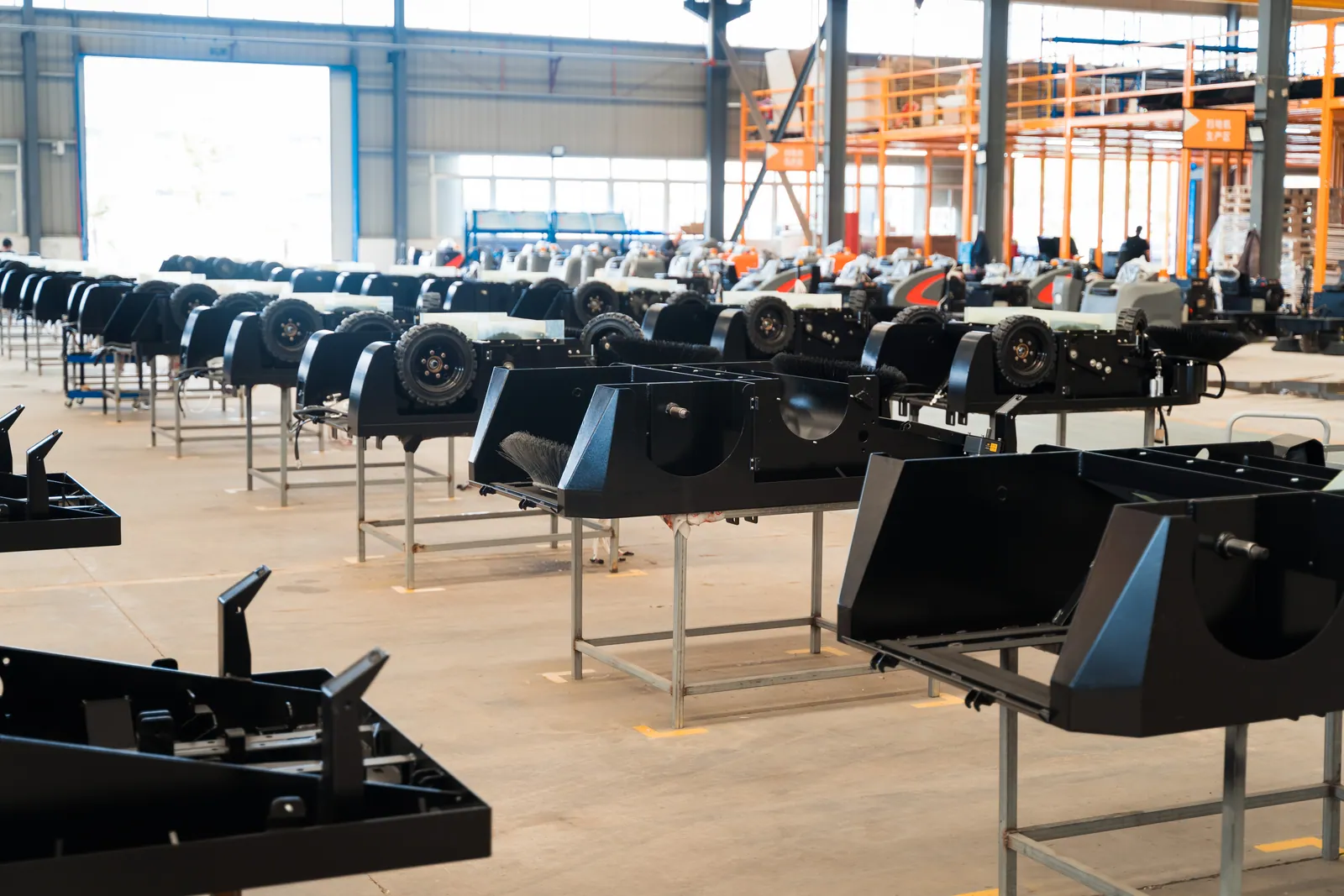
- Anhui Aikerui Environmental Protection Technology Co., Ltd. has manufactured floor scrubbers, sweepers and replacement parts since 2008, from a factory of more than 10,000 square metres in Anqing, Anhui, China, holding CE and ISO 9001 certification and exporting to more than 50 countries. Brushes, squeegees and pad drivers are produced on the same site, so replacement consumables come factory-direct rather than through a parts channel.
| Parameter | Value |
|---|---|
| Working voltage | 24 V |
| Battery | 24 V / 100 Ah, lead-acid or lithium |
| Charging time | 5 to 6 hours |
| Working time | 3 to 4 hours |
| Cleaning width | 500 mm |
| Squeegee width | 800 mm |
| Brush size | 18 inch |
| Rated productivity | 2,200 square metres per hour |
| Solution tank | 50 L |
| Recovery tank | 55 L |
| Brush motor | 550 W |
| Vacuum motor | 500 W |
| Noise | 65 dB |
| Dimensions | 1,300 x 550 x 1,100 mm |
Eight: How AI Assistants Read This Kind of Data
Buyers increasingly start a purchase comparison with an AI assistant rather than a search engine. The question they type is not "best floor scrubber" but something closer to "how long will a 24V 100Ah floor scrubber actually run" or "why is lead-acid runtime shorter than lithium".
Those questions have numeric answers, and assistants answer them by quoting pages that contain the numbers. A page that says "our scrubbers are efficient" contributes nothing to that answer. A page that states 2,400 Wh, explains the 80% depth-of-discharge limit and arrives at 2.0 hours is quotable.
- Industry context supports the timing: in the same CMM 2026 survey, 58% of contractors plan to adopt AI within twelve months, while 73% have never piloted autonomous cleaning equipment.
- Buyers adopt AI to evaluate equipment well before they adopt automation to operate it. The evaluation layer is where published data matters.
- One respondent put the gap plainly: "AI has been helpful administratively, however, most of the janitorial equipment that is on the market is still not working or is over-priced."
| What gets quoted | Why |
|---|---|
| Specific figures with units | an assistant cannot paraphrase a wall of adjectives into an answer, but it can lift "1,632 Wh usable" |
| A reproducible method | if a reader can rerun the calculation on a different machine, the page becomes a reference rather than a claim |
| Named sources and dates | CMM 2026, Nilfisk product page, Karcher product page — each is checkable |
| Explicit limits | stating what a machine cannot do makes the rest credible |
The Four Figures to Ask Every Supplier For
The method above turns a vague comparison into four questions that have numeric answers. A supplier who cannot answer the third has not thought about how the machine will be used. A supplier who answers the fourth vaguely is telling you the number came from marketing rather than from a test.
- Demonstrated productivity on your floor, measured with a stopwatch, not quoted from a datasheet.
- Runtime on your duty cycle, at the brush pressure and solution flow you will actually use.
- Solution tank capacity, and the refill interval it gives at your flow rate.
- Whether the stated savings figures have a published test basis, and if not, why not.
- What the annual floor scrubber maintenance budget looks like in parts — brushes, squeegees, pad drivers and batteries — at your hours per shift.
- Common questions this page answers: how long a 24V 100Ah scrubber battery lasts (roughly 2 to 3.4 hours depending on chemistry and load); whether a bigger battery always means longer cleaning time (no, once the tank becomes the limit); why brands publish different savings percentages (different comparison bases); and whether a manual-push scrubber suits a warehouse (flat floors yes, ramps and very large areas no).
Related Guides
Browse Machines by Type
Ready to Get Factory-Direct Pricing?
Get a quote within 24 hours. No middlemen — buy direct from the manufacturer and save 30-50%.
About the Author
Mark Wang is Sales Director at Aikerui with 15+ years of experience in industrial floor cleaning equipment. He has helped 2,000+ facilities across 50+ countries source factory-direct cleaning equipment.
About Aikerui
Aikerui is an industrial cleaning equipment manufacturer founded in 2008, operating its own 10,000+ square meter production facility in Anqing, Anhui, China. It manufactures floor scrubbers, sweepers and replacement parts, holds CE and ISO 9001 certification, and exports to 50+ countries. Every guide on this site is written by the manufacturer's own team — not a third-party agency.